The Code Word
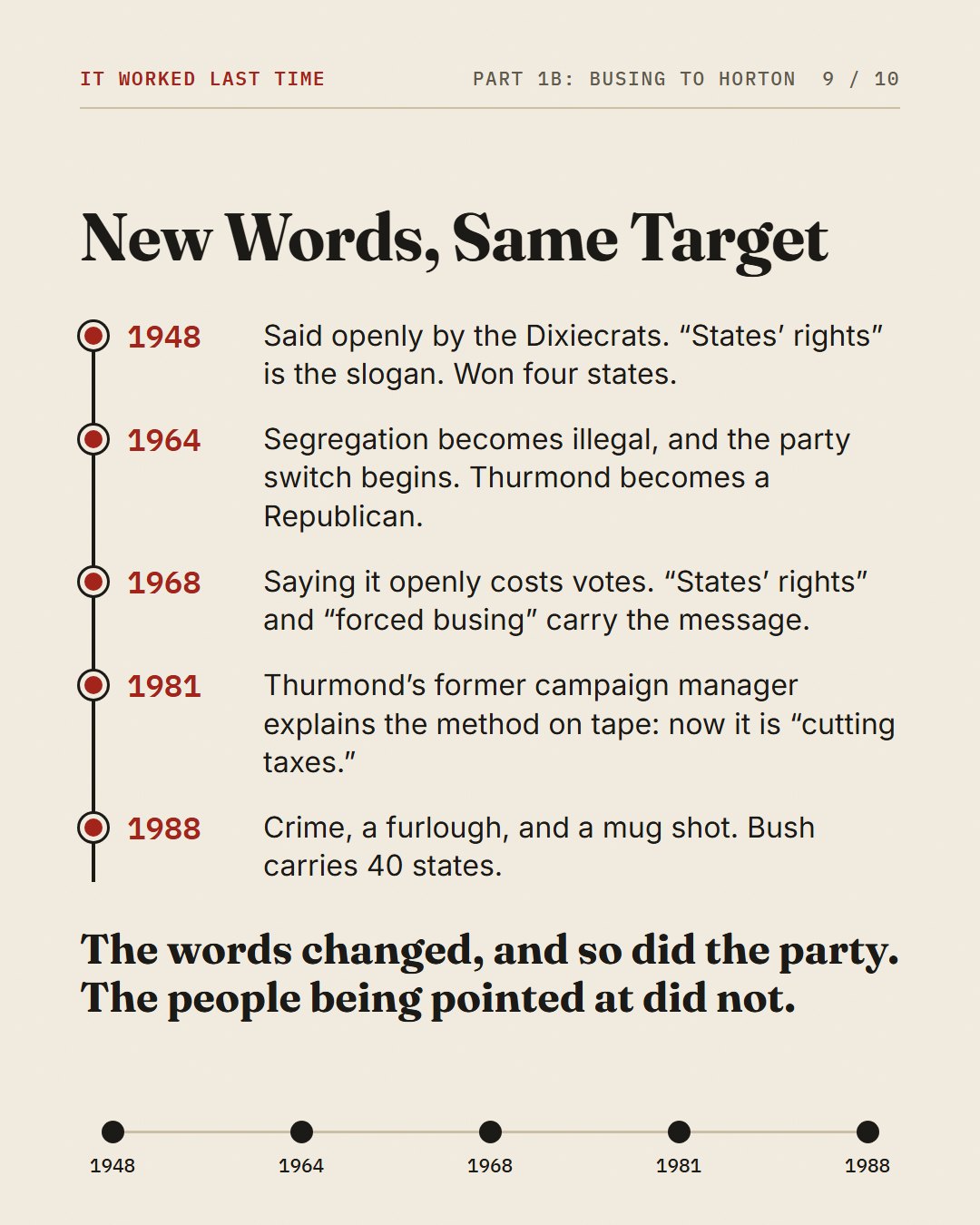
Once saying it openly cost votes, the message moved into code: “states’ rights,” “forced busing,” “cutting taxes,” and finally a mug shot, in a campaign that came back from 17 points down to carry 40 states.
The Graphics
Swipe through the slides as they appear on Instagram and Facebook. Tap any slide to open it full size.
Part 1A: States' Rights


Part 1B: From Busing to Willie Horton

1948: The Walkout
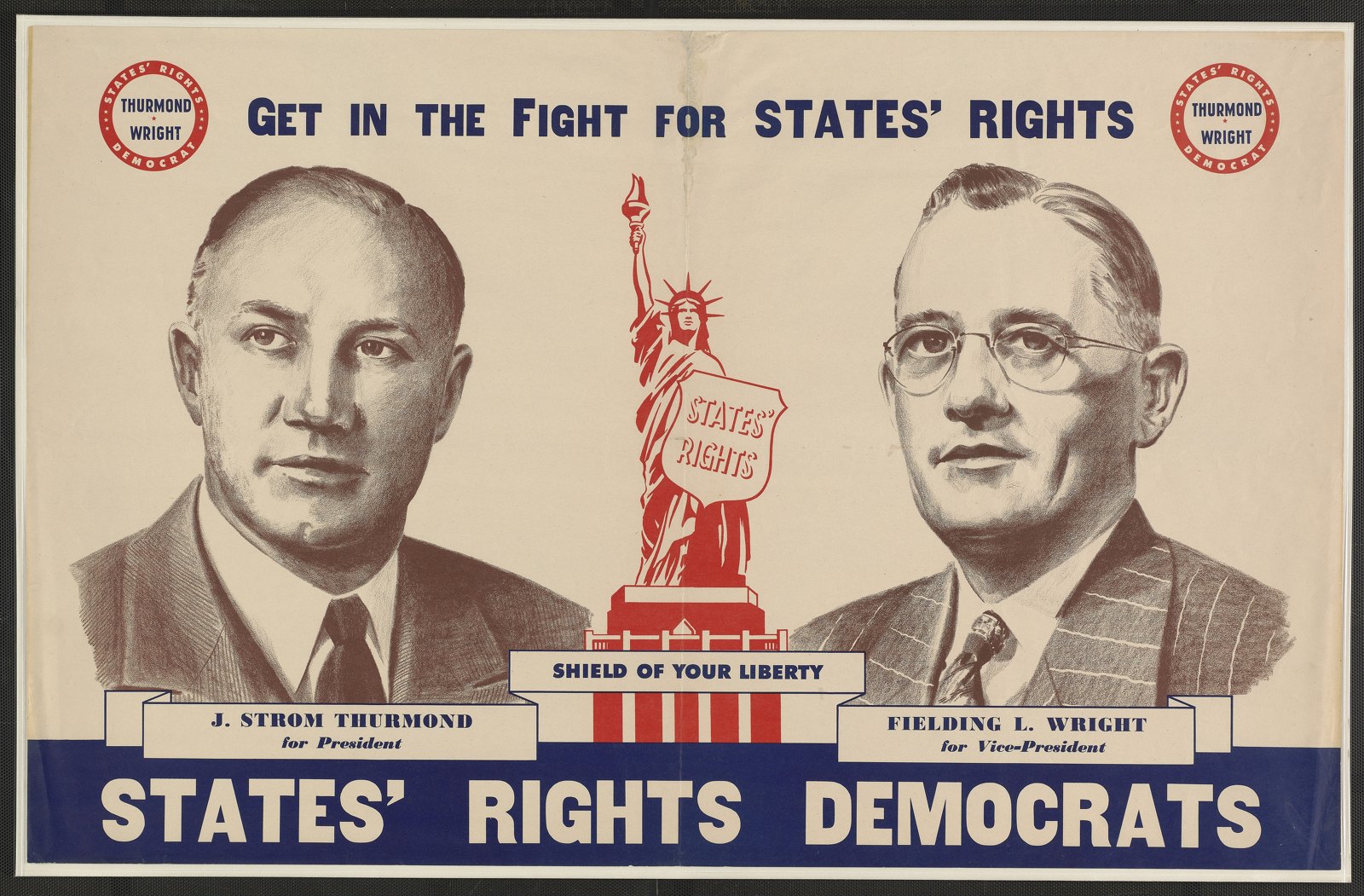
On July 14, 1948, the Democratic National Convention in Philadelphia voted to back civil rights. That night, the entire Mississippi delegation and half of Alabama’s got up and walked out1.
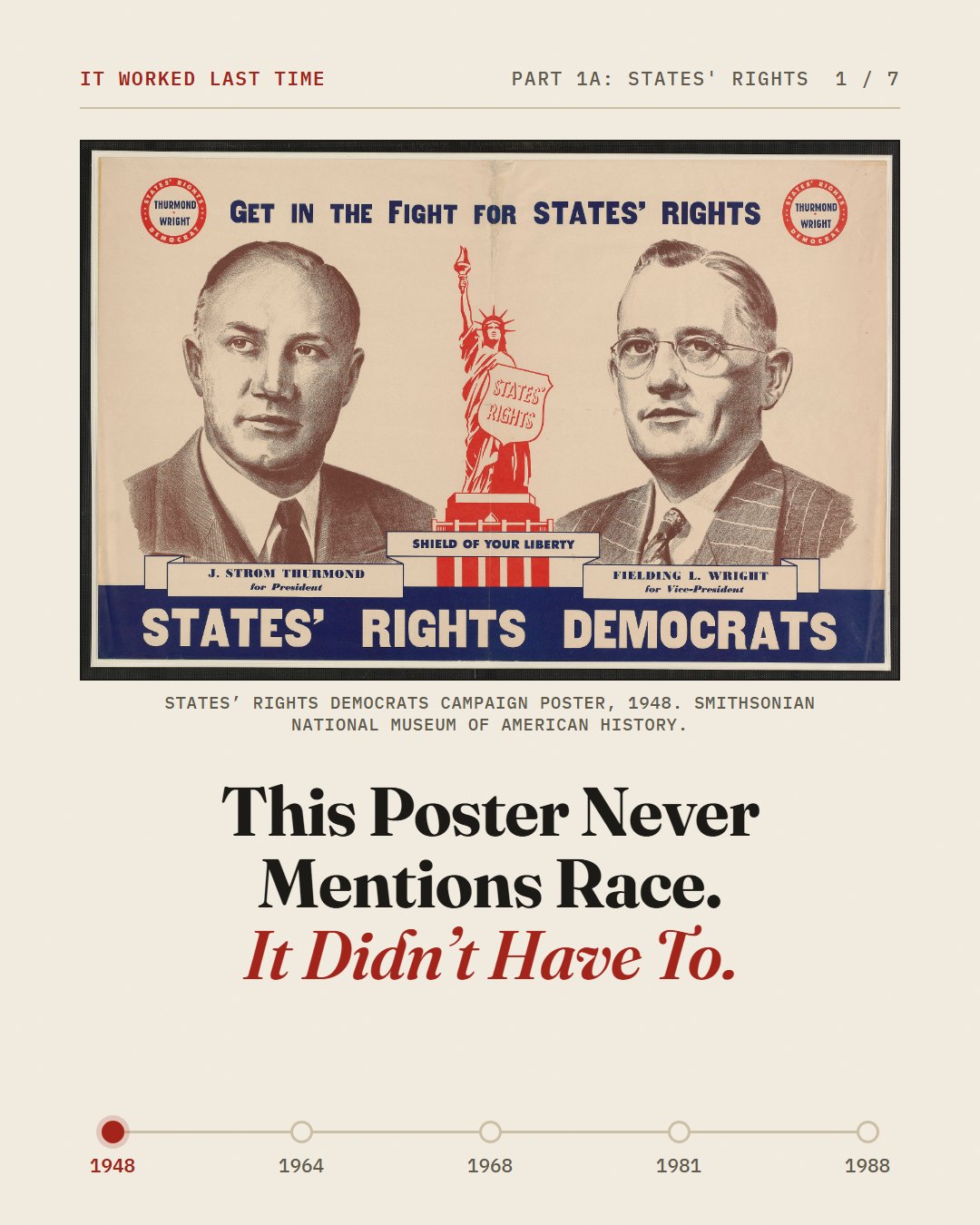
Three days later, some 6,000 people from 13 Southern states gathered in Birmingham, Alabama. They formed the States’ Rights Democratic Party, nicknamed the Dixiecrats, and nominated two governors: Strom Thurmond of South Carolina for president and Fielding Wright of Mississippi for vice president2.
Across the top, their campaign poster reads “Get in the Fight for States’ Rights.” In the middle, a Statue of Liberty holds a shield marked “States’ Rights” over a banner that says “Shield of Your Liberty”3. Nothing on it mentions race.
The fight was over civil rights. In 1946, a South Carolina police chief beat and blinded Isaac Woodard, a Black Army veteran on his way home from the war4. In February 1948, President Harry Truman asked Congress for laws that included “Federal protection against lynching” and an end to poll taxes as a condition of voting “in elections for Federal officers”5. That July, Truman ordered equal treatment in the armed services “without regard to race, color, religion or national origin”6.
In the South, segregation was state law. State laws kept Black and white children in separate schools, and state poll taxes and literacy tests kept Black citizens from voting. Truman wanted federal laws that would override them. So in 1948, “states’ rights” had a specific meaning: Washington could not touch the South’s segregation laws.
The Dixiecrats said so themselves. Their platform read: “We stand for the segregation of the races and the racial integrity of each race...” It opposed “the repeal of miscegenation statutes,” the laws that banned interracial marriage7. On the campaign trail, TIME reported, Thurmond told crowds there were “not enough troops in the Army to break down segregation”8.
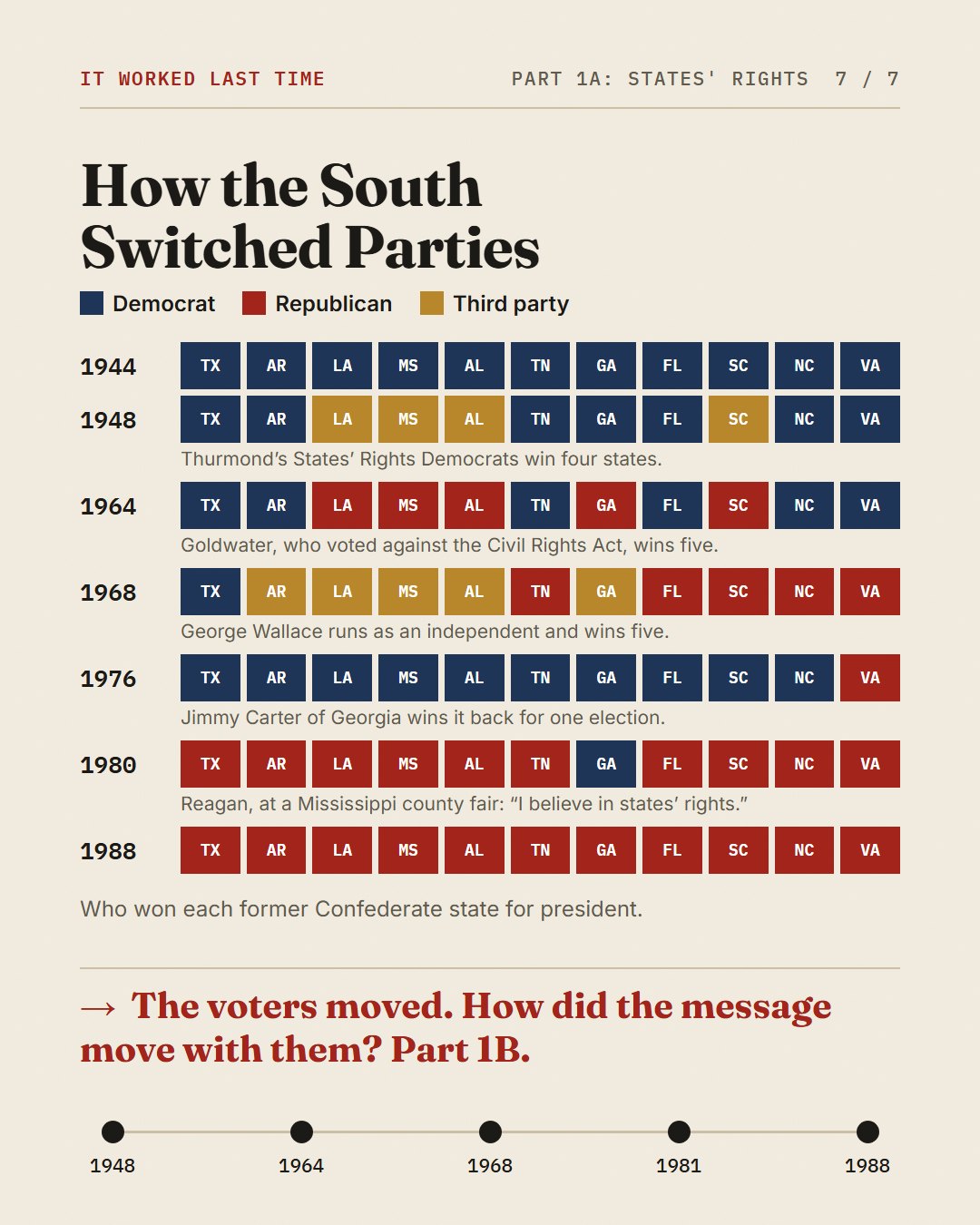
Said that openly, the message carried four states, Alabama, Louisiana, Mississippi, and South Carolina, and about 2.4 percent of the national vote9. Truman won. So why were segregationists Democrats at all?
Why They Were Democrats
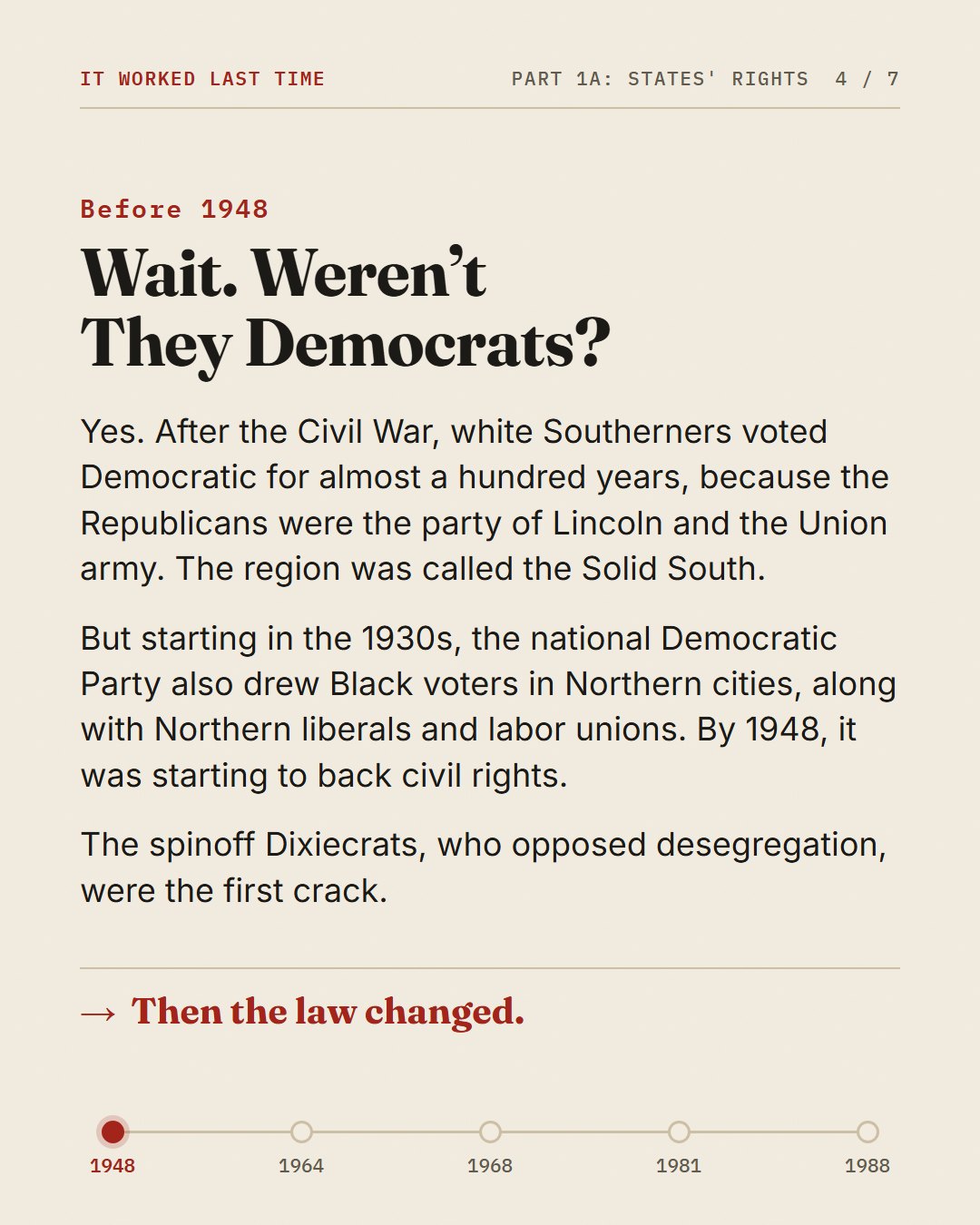
After the Civil War, white Southerners voted Democratic for almost a hundred years, because the Republicans were the party of Lincoln and the Union army. The region was called the Solid South.
The national party changed around them. In the 1930s, Black voters, especially in Northern cities, “ended their long allegiance to the Republican Party ... and became a reliable Democratic voting bloc,” in the words of the Franklin D. Roosevelt Library10. By 1948, a party that depended on those voters was starting to back civil rights. The Dixiecrats were the first crack.
Then the law changed.
Segregation Becomes Illegal
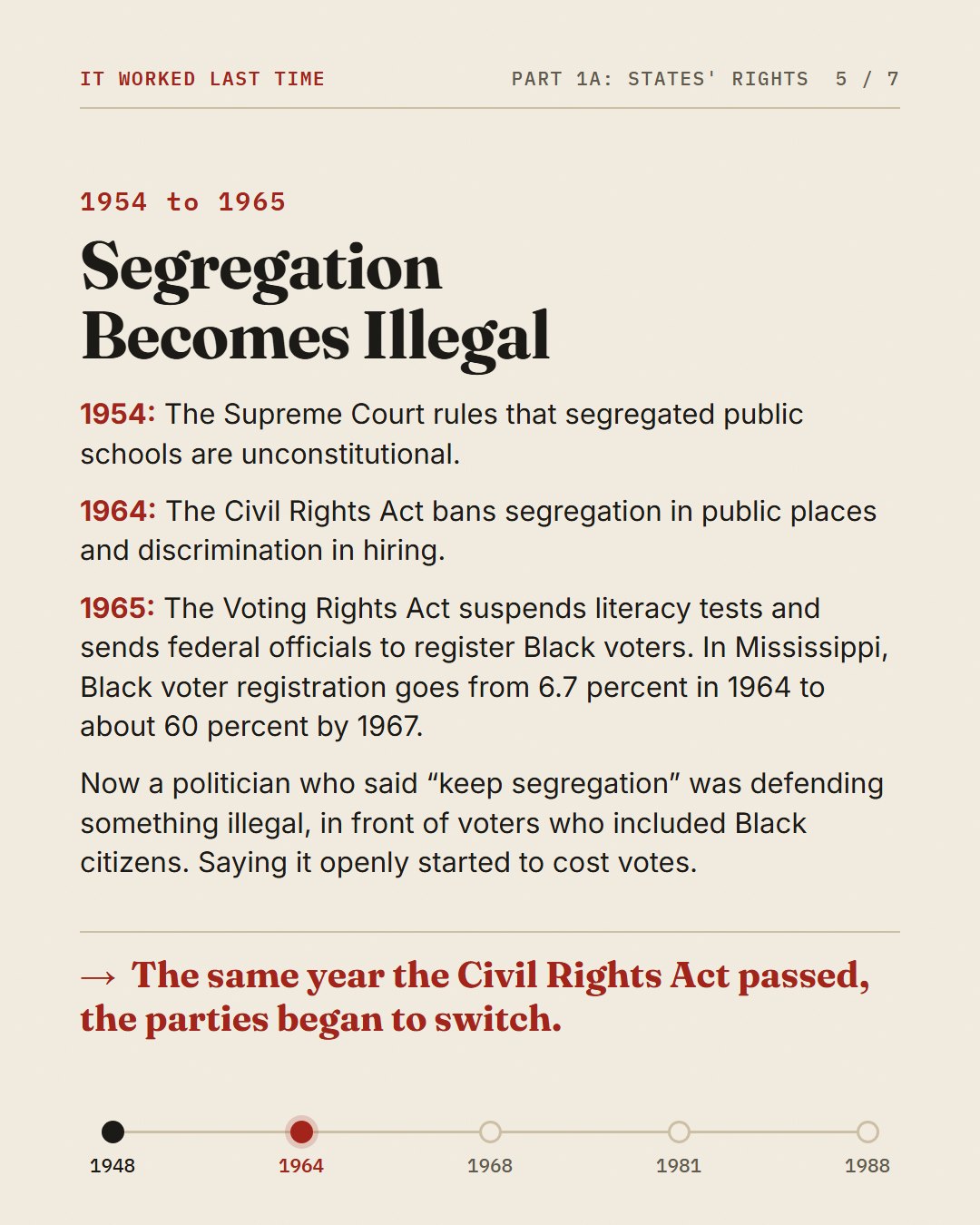
On May 17, 1954, in Brown v. Board of Education, the Supreme Court ruled that “separate educational facilities are inherently unequal”11. Two years later, 19 senators and 82 representatives, all from former Confederate states, signed the Southern Manifesto12. It called the school rulings “a clear abuse of judicial power” and praised states that had vowed “to resist forced integration by any lawful means”13. In January 1963, Alabama’s new governor, George Wallace, promised “segregation now, segregation tomorrow, segregation forever”14.
Then Congress acted. The Civil Rights Act, signed July 2, 1964, outlawed segregation in businesses such as theaters, restaurants, and hotels and banned discrimination in hiring15. The Voting Rights Act, signed August 6, 1965, suspended literacy tests where it applied and sent federal examiners to sign up voters1617. In Mississippi, Black registration rose from about 7 percent of voting-age Black residents in late 1964 to about 60 percent by September 1967, by the U.S. Commission on Civil Rights’ estimate, which includes registrants whose race was not recorded18.
Now a politician who said “keep segregation” was defending something illegal, in front of an electorate that included Black voters. Saying it openly started to cost votes.
The Switch
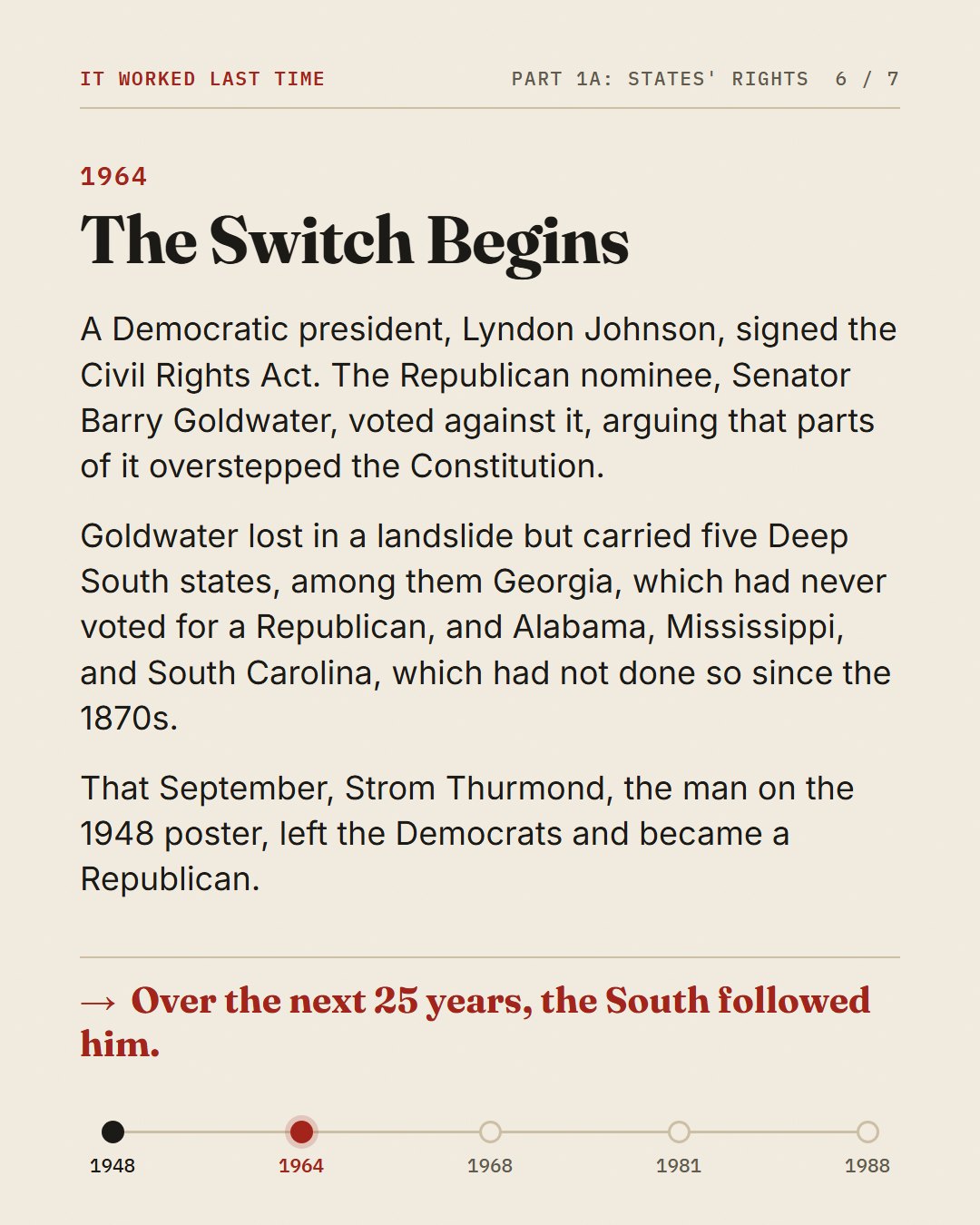
In June 1964, Senator Barry Goldwater of Arizona told the Senate he would vote against the Civil Rights Act. He objected to its sections on public accommodations and employment: “I find no constitutional basis for the exercise of Federal regulatory authority in either of these areas”19. A month later, he accepted the Republican nomination for president20.
That September, Strom Thurmond, the man on the 1948 poster, left the Democrats and became a Republican21. That November, Goldwater lost in a landslide, carrying only his home state and five in the Deep South: Mississippi, Alabama, South Carolina, Louisiana, and Georgia. Georgia had never before voted for a Republican for president22. Alabama and Mississippi had not done so since 1872, and South Carolina since 18769.
Over the next 25 years, the South followed Thurmond. In 1968, he was “an important part of Richard Nixon’s vaunted ‘southern strategy’”23. That year, George Wallace ran as an independent and carried five former Confederate states, and Nixon carried five more. In 1976, Jimmy Carter of Georgia won back all of them except Virginia. In 1980, Ronald Reagan won all of them except Georgia9.
On August 3, 1980, Reagan spoke at the Neshoba County Fair in Mississippi, near the town of Philadelphia, where the Ku Klux Klan had murdered three civil rights workers, James Chaney, Andrew Goodman, and Michael Schwerner, in 196424. He told the crowd: “I still believe the answer to any problem lies with the people. I believe in states’ rights”25. By 1988, the Republican nominee carried all 119.
A 2018 study by economists Ilyana Kuziemko and Ebonya Washington found that defection among white Southerners with conservative views on race “explains the entire decline from 1958 to 1980” in white Southern Democratic identification26.
The voters moved. How did the message move with them?
“Forced Busing”

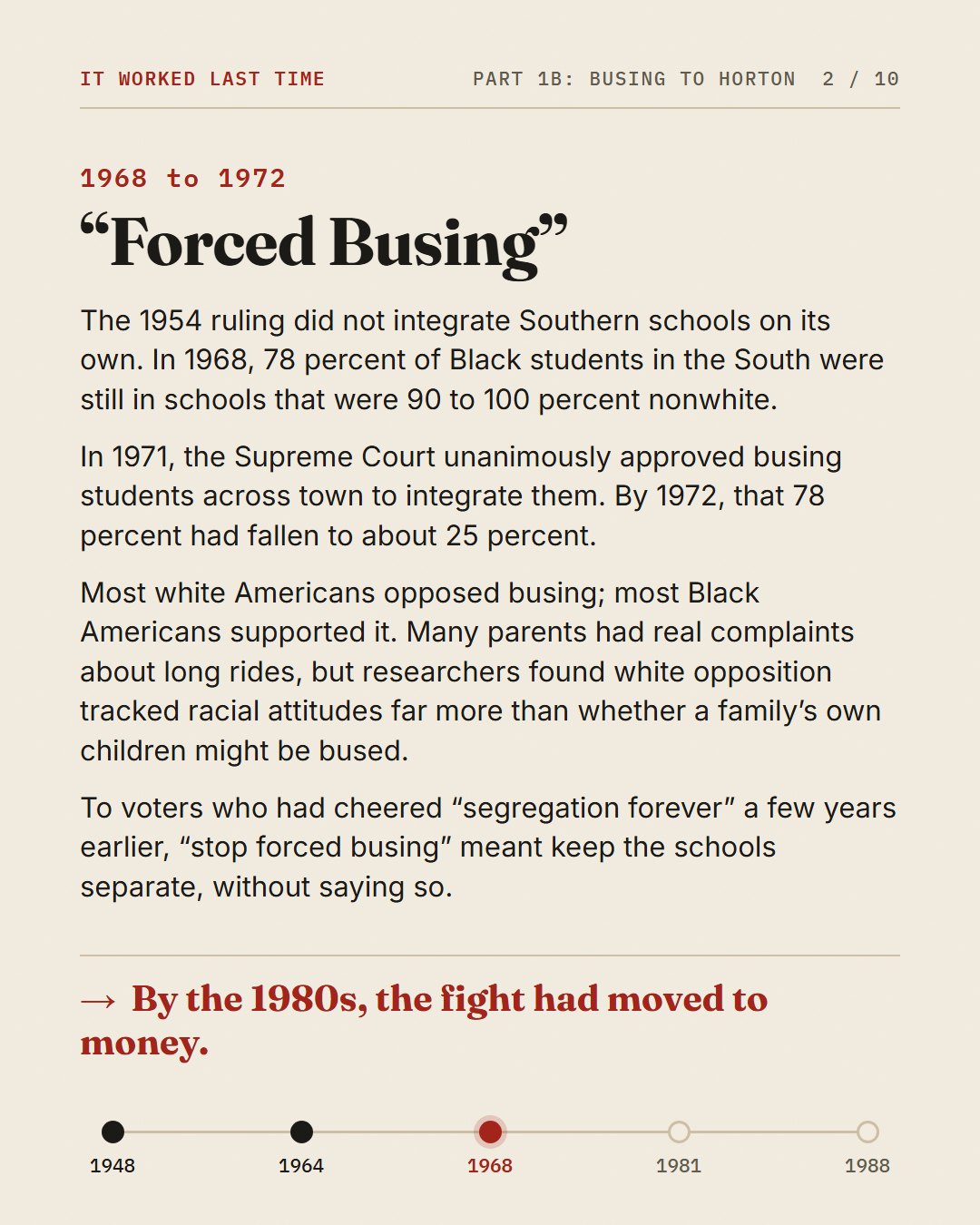
Brown did not integrate Southern schools on its own. In 1964, only 2.25 percent of Black children in the 11 former Confederate states attended school with any white children27. In 1968, 78 percent of Black students in the South were still in schools that were 90 to 100 percent nonwhite28.
That year, the Supreme Court told school boards to produce a plan that “promises realistically to work, and promises realistically to work now”29. In 1971, a unanimous Court ruled that judges could order busing to desegregate schools30. By 1972, the share of Southern Black students in 90 to 100 percent nonwhite schools had fallen to about 25 percent28.
Most white Americans opposed busing. In the early 1970s, 86 percent of white respondents to a national survey opposed it, while most Black respondents favored it in nearly every year31. Not every objection was about race: the Court itself said an objection could be valid when a ride was long enough to risk children’s health or harm their education30. But a 1979 study found that racial intolerance and political conservatism strongly predicted white opposition, while self-interest, such as having children who might be bused, “had no significant effect”32.
The phrase also did a second job. “Forced” had been in segregationists’ vocabulary since the 1956 manifesto’s “forced integration.” To voters who had cheered “segregation forever” a few years earlier, “stop forced busing” meant keep the schools separate, without saying so.
By the 1980s, the fight had moved to money.
1981: The Question
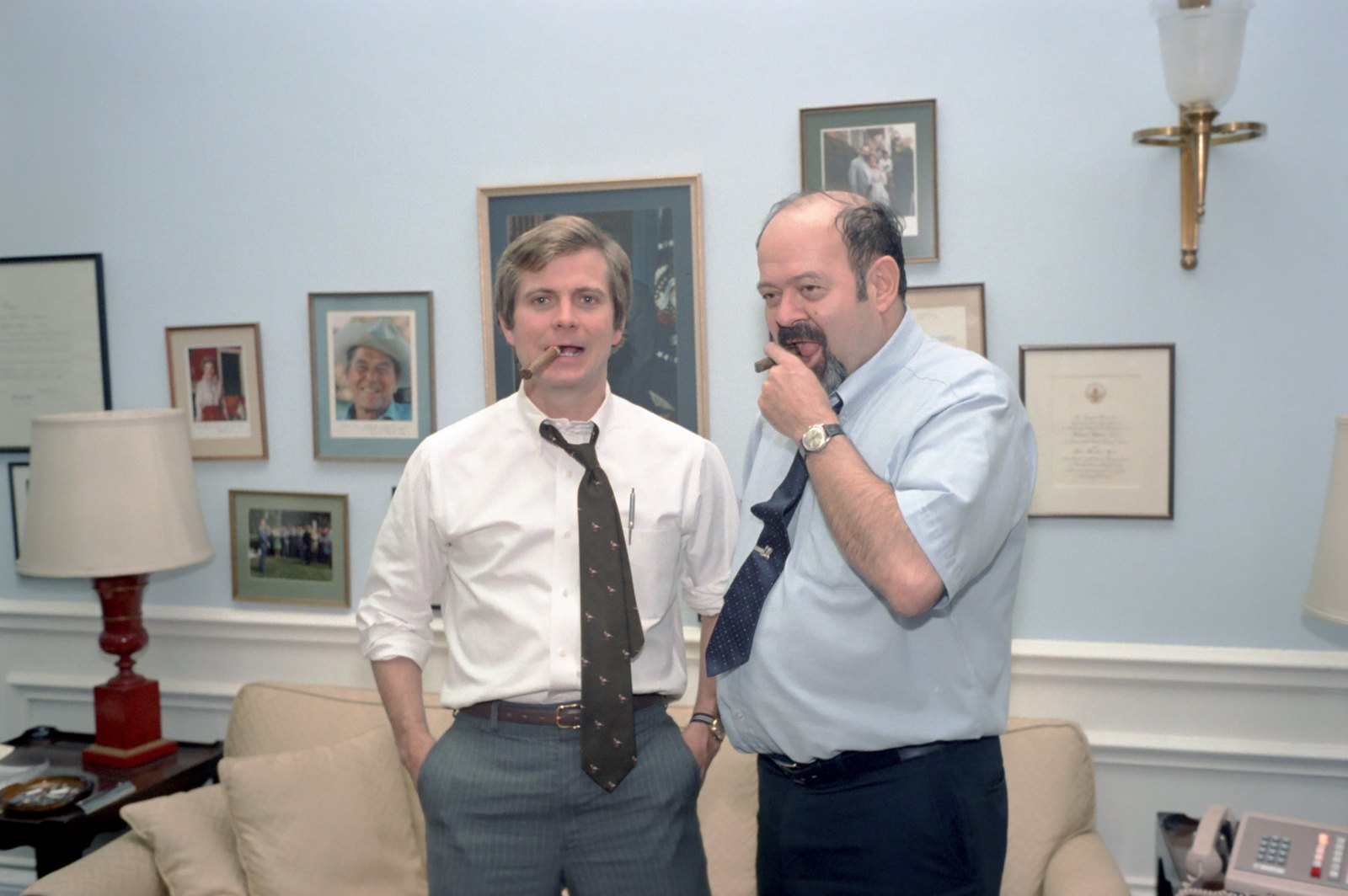
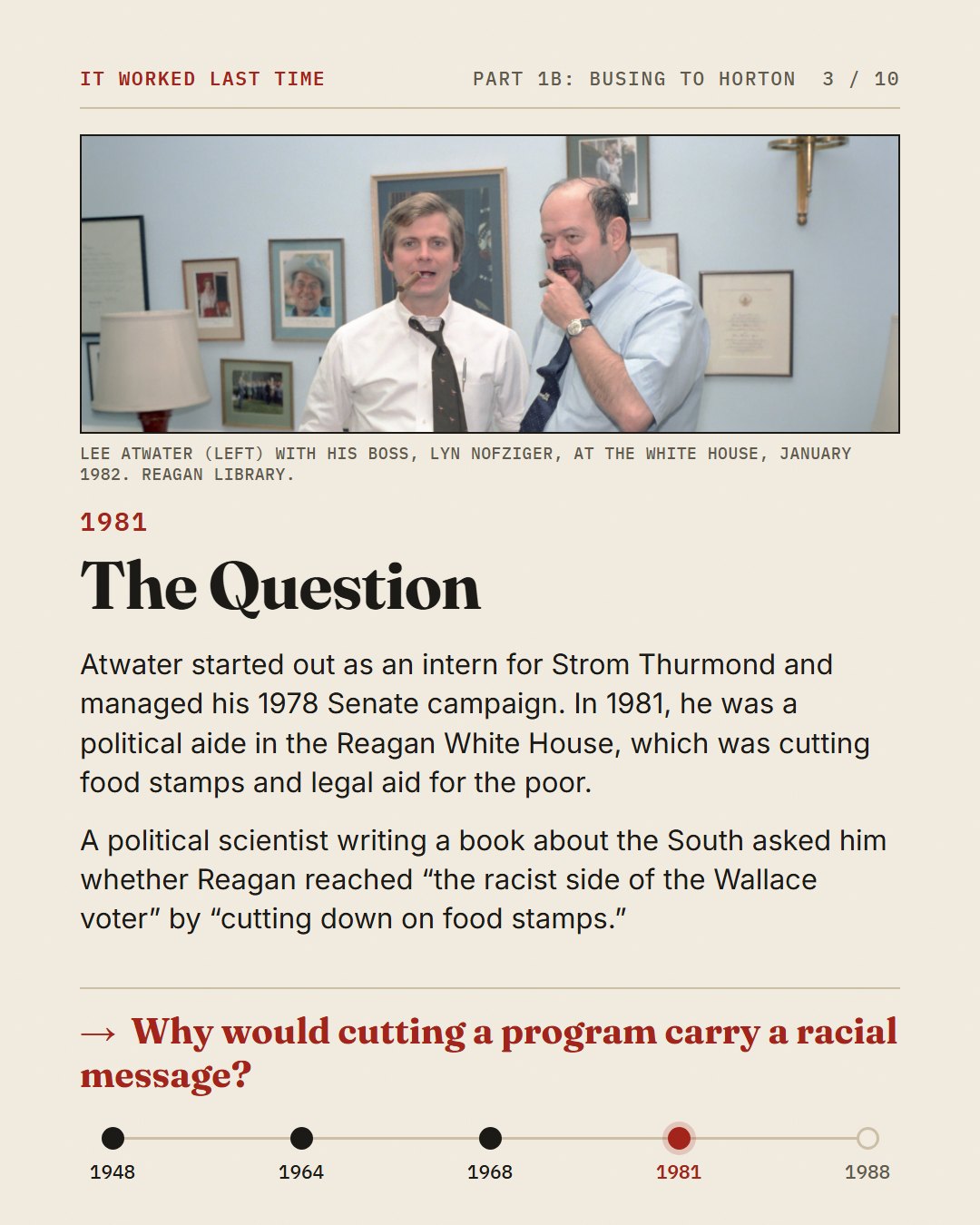
Lee Atwater managed Strom Thurmond’s 1978 campaign in South Carolina33. On January 21, 1981, he became a Special Assistant to the President in the Reagan White House’s political office34.
That year, the new administration and Congress cut food stamps by about $5 billion over three years35. Reagan proposed abolishing the Legal Services Corporation, which pays for lawyers for poor people; Congress cut its funding by a quarter instead36.
Political scientist Alexander Lamis, writing a book about the South, interviewed Atwater in 198137. As Lamis later printed it, the question was: “But the fact is, isn’t it, that Reagan does get to the Wallace voter and to the racist side of the Wallace voter by doing away with legal services, by cutting down on food stamps?”38
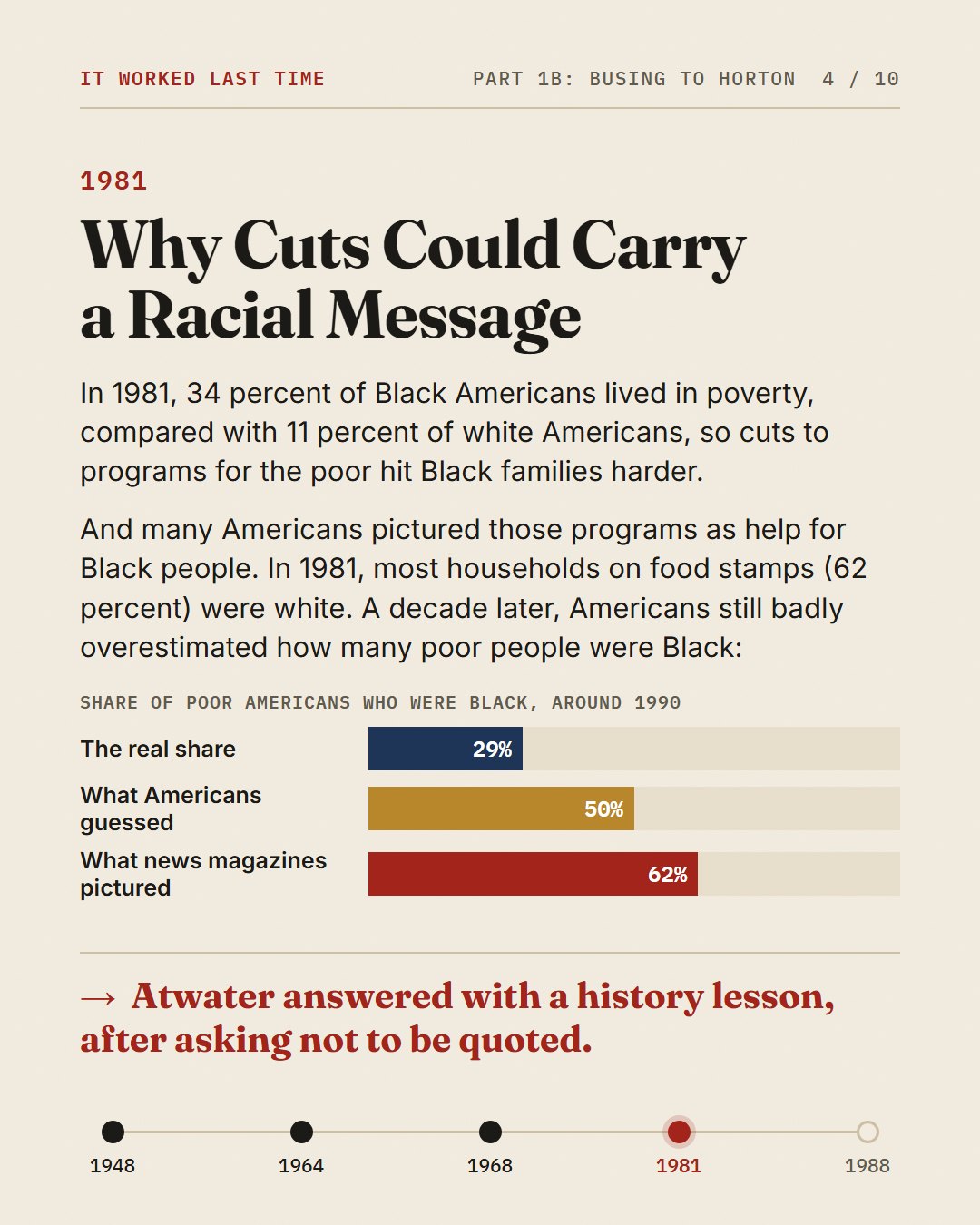
Why would cutting a program carry a racial message? One reason was who was poor. In 1981, 34 percent of Black Americans lived in poverty, compared with 11 percent of white Americans (9.9 percent of non-Hispanic white Americans)39. Another was who people pictured. In 1981, about 62 percent of households on food stamps had a white head of household and about 35 percent a Black one40. Yet in a 1991 national survey, the typical answer was that half of poor people were Black, when the real share was 29 percent. And from 1988 to 1992, the major news magazines pictured Black people as 62 percent of the poor, political scientist Martin Gilens found41. To a voter who pictured the program that way, a cut to food stamps was a message about who would lose.
Atwater answered with a history lesson, after asking not to be quoted.
The Tape
Lamis printed the interview in his 1984 book, The Two-Party South, without Atwater’s name. In 2012, 21 years after Atwater’s death, The Nation published the 42-minute recording37.
Atwater laid out three steps. “You start out in 1954 by saying” the n-word, he said, three times over. By 1968, “you can’t say” it, because “that hurts you” and it “backfires.” So instead you say “forced busing, states’ rights.” Now, he said, you are getting “so abstract” that you are talking about “cutting taxes,” which are “totally economic things,” and a “byproduct” is that “blacks get hurt worse than whites.” Saying “We want to cut this,” he added, is “a hell of a lot more abstract than” the slur3738.
Read it as a ladder. The target never moves. Only the words change, and each new set is harder to object to, because nothing in it is racial on its face. That is how a code word works: the literal meaning is safe to say out loud, and the second meaning reaches the people it is aimed at.
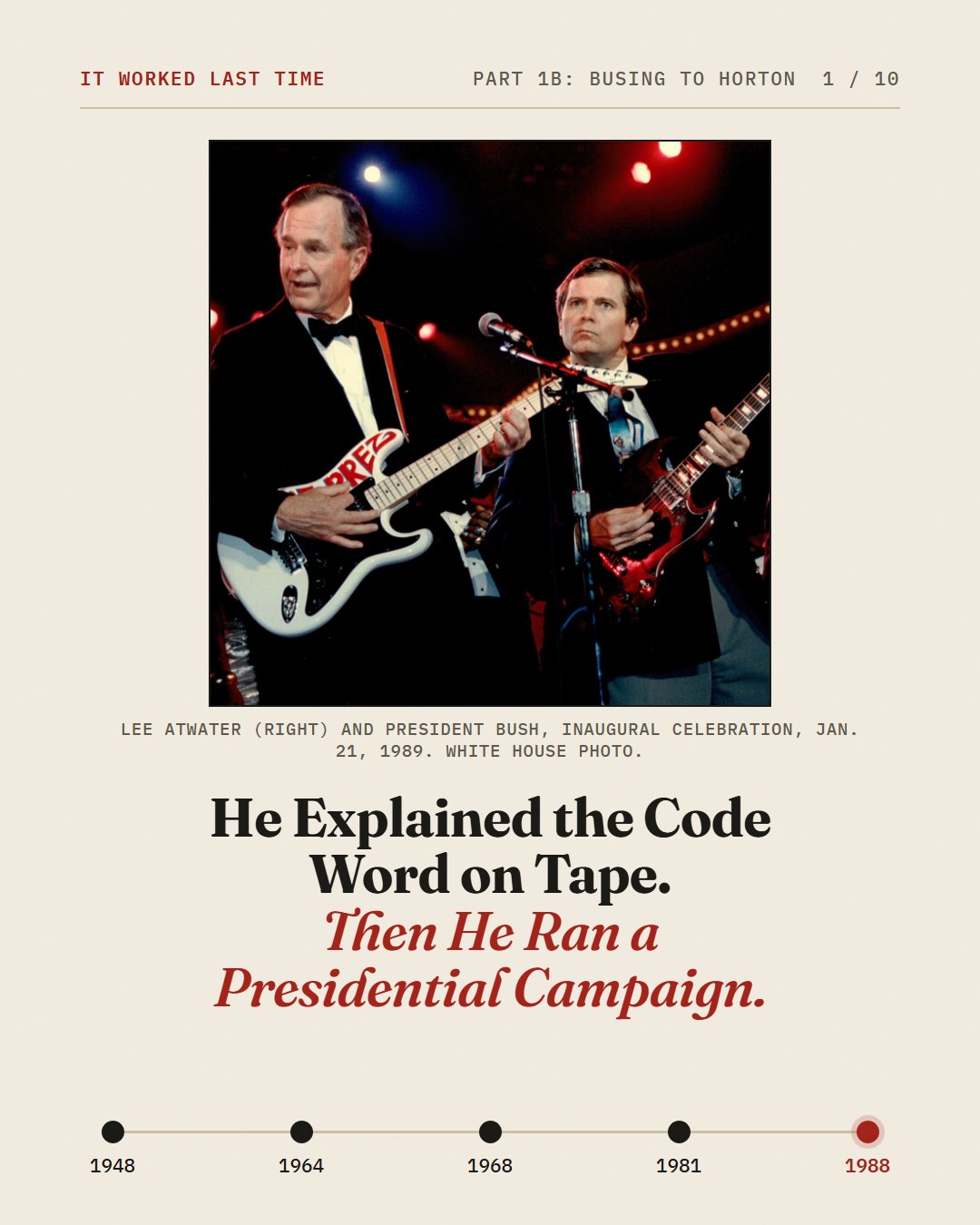
Seven years after the interview, Atwater ran a presidential campaign.
1988: The Furlough Program
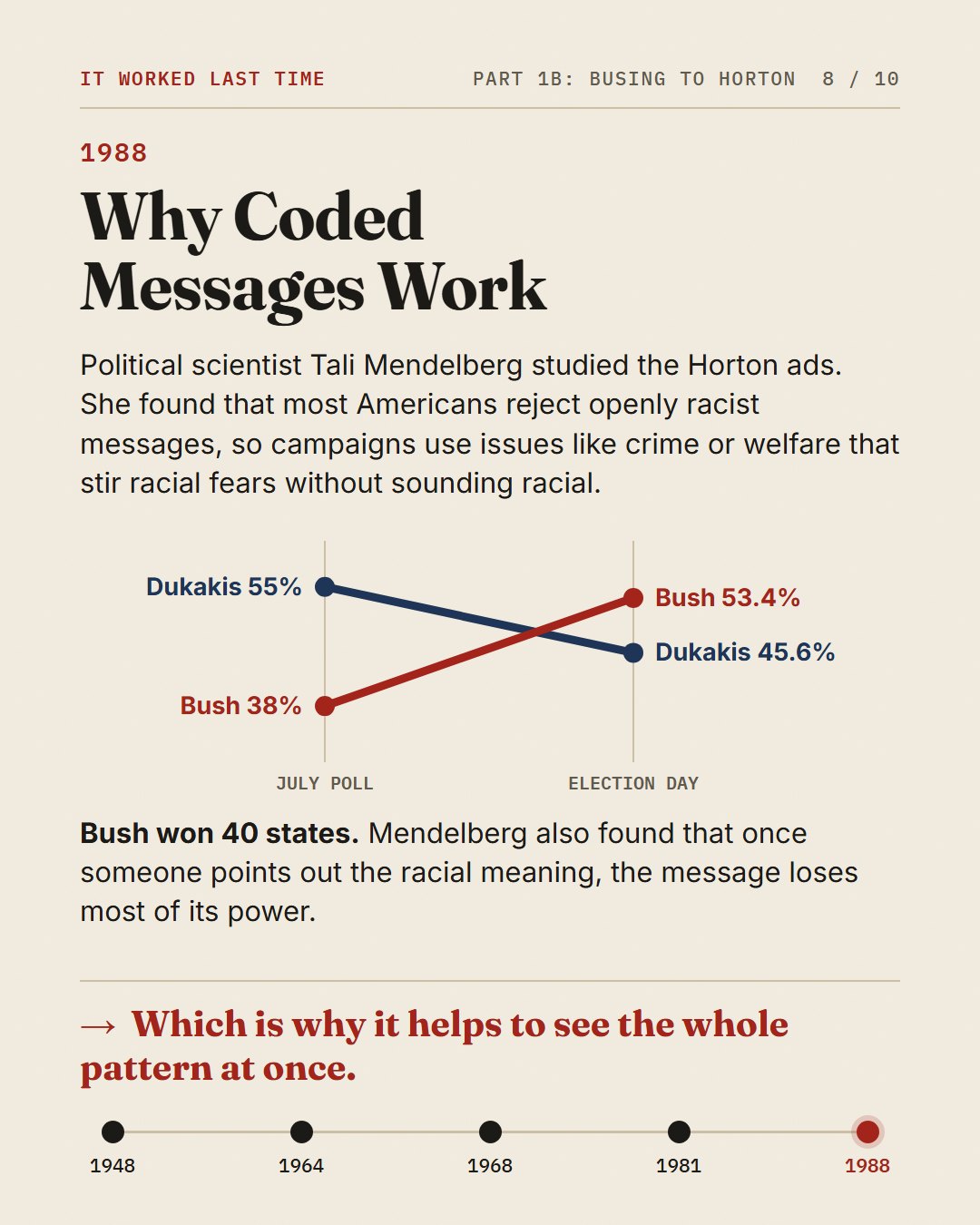
In 1988, Atwater managed George H. W. Bush’s campaign42. In a Gallup poll taken right after the Democratic convention in July, Massachusetts Governor Michael Dukakis led Bush 55 percent to 38 percent4344.
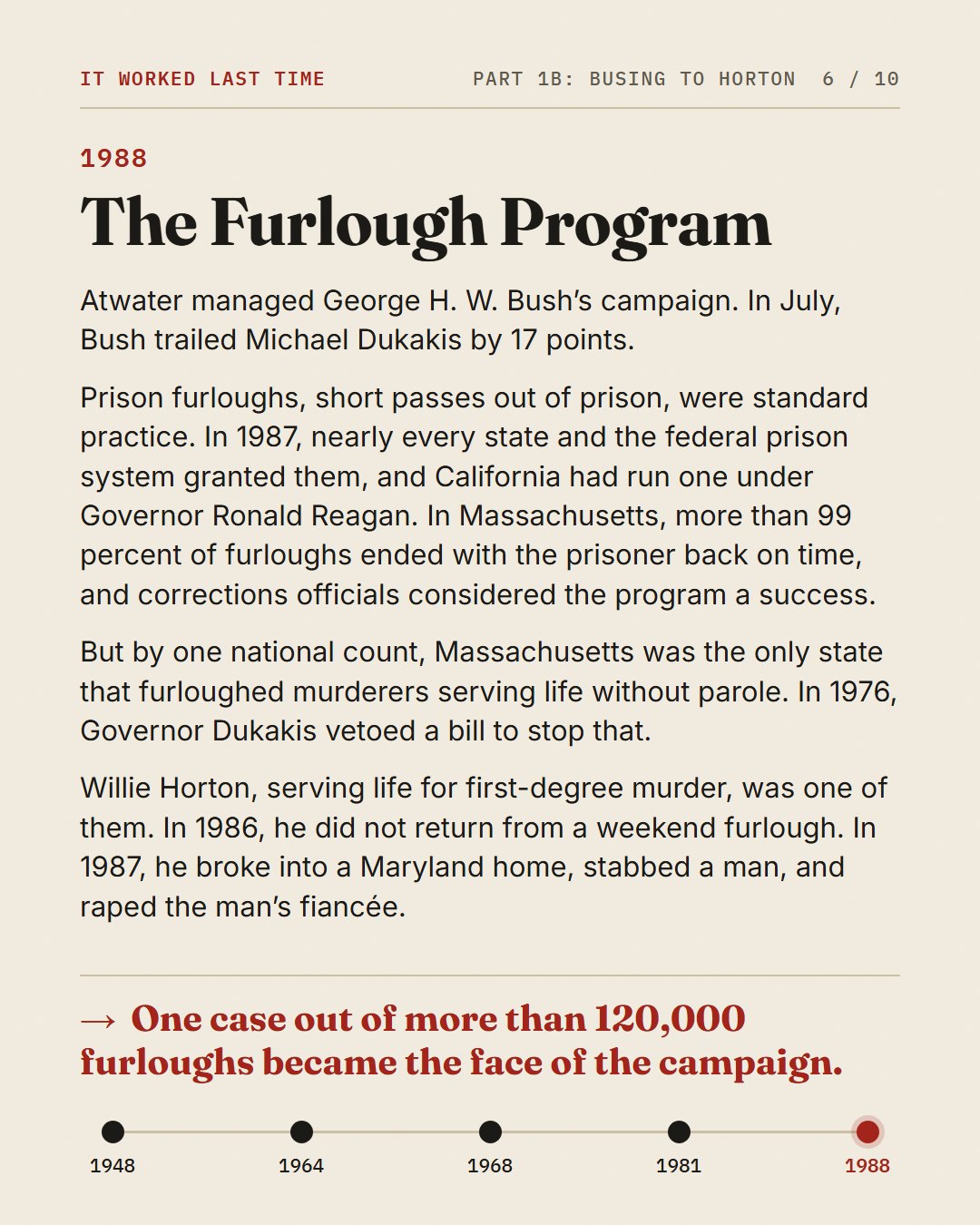
Massachusetts let inmates out of prison on short passes called furloughs, a standard practice at the time. In 1987, nearly every state and the federal prison system granted them, to about 1 in 10 prisoners4546. California had run a program under Governor Ronald Reagan46. Massachusetts began its program under a 1972 law signed by Dukakis’s Republican predecessor, Francis Sargent47. From 1972 to 1987, it granted 121,713 furloughs to 10,835 inmates. There were 428 escapes and 219 returns more than two hours late, together about 0.5 percent of all furloughs48.
A 1988 national study called Massachusetts “the only state in the nation” that furloughed killers with no chance of parole45, though a 1988 Washington Post report cited by WETA named South Carolina as a second49. In 1976, Dukakis vetoed a bill that would have barred furloughs for first-degree murderers. He signed a ban in the spring of 198847.
William Horton was one of those lifers. He and two other men were convicted of first-degree murder in the 1974 killing of Joseph Fournier, a 17-year-old gas station attendant in Lawrence, Massachusetts4649. In June 1986, he left on his tenth furlough and did not come back. On April 3, 1987, in Prince George’s County, Maryland, he bound and stabbed Clifford Barnes in Barnes’s home and raped Barnes’s fiancée, Angela Miller49. The crimes were real, and so was the harm.
One case out of more than 120,000 furloughs became the face of the campaign.
The Ad
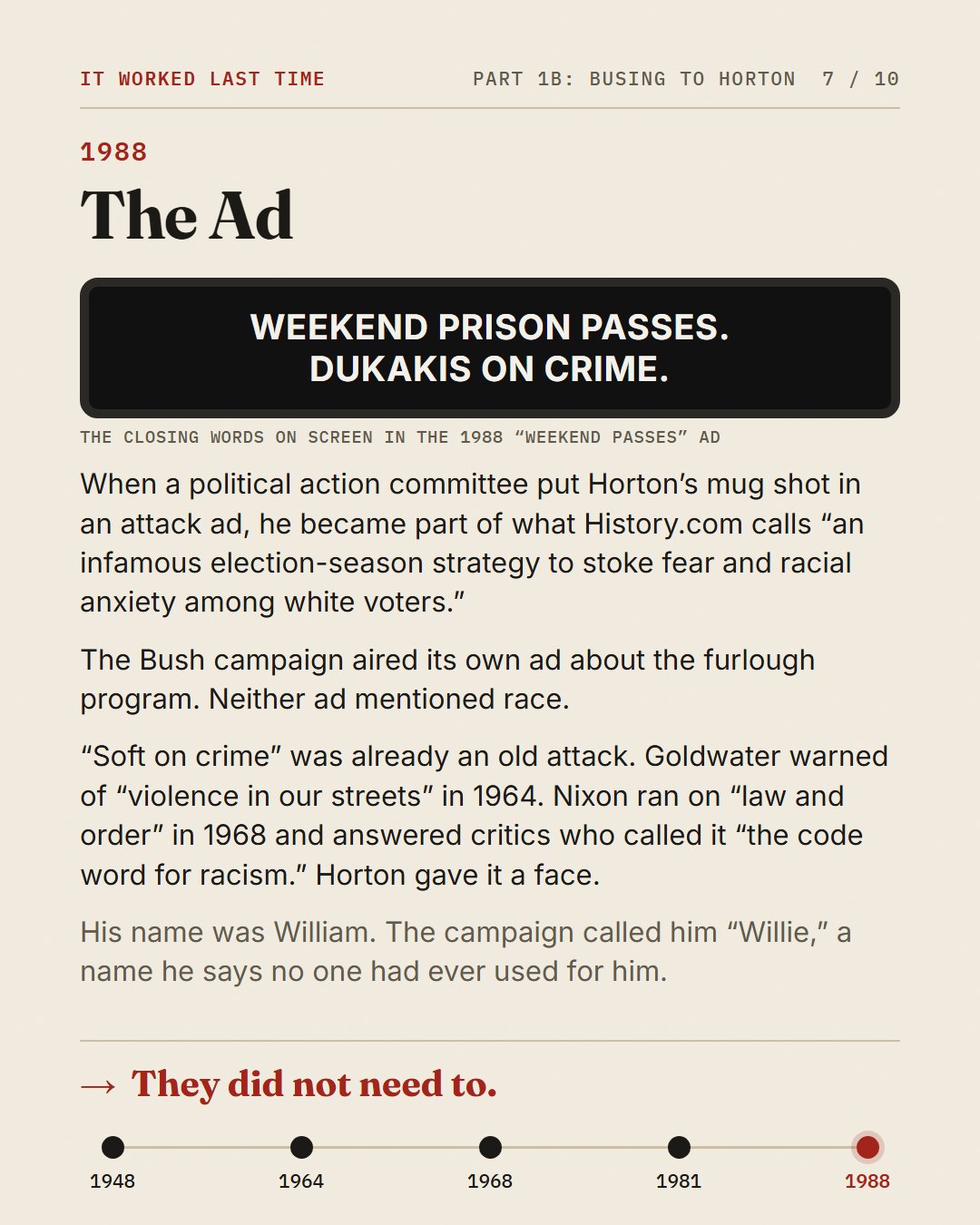
In July 1988, after noting that Jesse Jackson had visited Dukakis’s home on the Fourth of July, Atwater told Republican activists in Atlanta that “maybe he will put this Willie Horton on the ticket after all is said and done,” TIME reported42. His name was William. “My name is William. No one has ever called me ‘Willie,’” he told the Marshall Project in 201550.
That fall, a political action committee with ties to the Bush campaign paid for a month-long run of an ad called “Weekend Passes”46. It showed Horton’s black-and-white mug shot and ended on the words “Weekend prison passes. Dukakis on crime”51. With that mug shot, Horton became part of what History.com calls “an infamous election-season strategy to stoke fear and racial anxiety among white voters”52. The Bush campaign aired its own furlough ad, “Revolving Door,” which never showed or named Horton; its on-screen text included “268 escaped”53. Neither ad mentioned race.
They did not need to.
Soft on Crime
“Soft on crime” was already an old attack. Accepting the Republican nomination in 1964, Goldwater warned of “violence in our streets”20. Accepting his own nomination in 1968, Richard Nixon said some courts had “gone too far in weakening the peace forces as against the criminal forces.” He ran on “law and order” and answered his critics: “And to those who say that law and order is the code word for racism, there and here is a reply: Our goal is justice for every American”54.
Privately, the record is plainer. On April 28, 1969, after a discussion of welfare policy, Nixon’s chief of staff, H. R. Haldeman, wrote in his diary: “President emphasized that you have to face the fact that the whole problem is really the blacks. The key is to devise a system that recognizes this while not appearing to”55. The entry is about welfare, not crime, and it is Haldeman’s summary, not a recording. But it describes the method this story follows.
The label could end careers. In 1986, California voters removed Chief Justice Rose Bird, attacked as “a symbol of ‘soft on crime,’ anti-death penalty liberalism”56, along with two other justices, the first California justices ever to lose a retention election57.
The fear underneath was not invented. By the FBI’s count, the national violent crime rate more than quadrupled from 1960 to its peak in 1991, then fell for more than two decades58. What Horton added was a rare, terrifying case, and a Black face, to put on a real worry. Researchers later found that Los Angeles local news overrepresented Black people as lawbreakers compared with state crime reports59, and that showing a Black suspect made white viewers more supportive of punitive crime policies60. Horton’s mug shot “became a shorthand for out-of-control crime, dog-whistle racial politics,” Boston.com wrote in 201550.
Democrats came to fear the label too. In January 1992, during the New Hampshire primary campaign, Arkansas Governor Bill Clinton left the campaign trail and went home for the execution of Rickey Ray Rector61. In 1981, Rector had killed two men, one of them a police officer, and then shot himself in the head, leaving brain damage that officials said had the effect of a frontal lobotomy6261. Clinton denied clemency, and Rector was executed on January 2462. Observers told the AP the execution could help Clinton distance himself from his party’s “soft-on-crime liberal image”61. In 1994, President Clinton signed a crime bill that funded 100,000 new police officers and expanded the federal death penalty to about 60 offenses6364. By then, both parties feared the label.
Why Coded Messages Work

Political scientist Tali Mendelberg studied the Horton campaign in her book The Race Card. Most Americans, she found, hold a norm of racial equality, so openly racist appeals cost votes. Campaigns use implicit messages instead, about issues such as crime or welfare, that stir white voters’ racial resentment without sounding racial. And once someone points out the racial meaning, the message loses most of its power65.
In July, Bush had trailed by 17 points43. In November he won 53.4 percent to 45.6 percent and carried 40 states9. Many things happened that fall, and the furlough ads were only one of them. But no one ever had to say out loud what the mug shot said.
Here are their answers, in their own words.
Their Defense
Goldwater said his vote was about the Constitution, not race. “I am unalterably opposed to discrimination or segregation on the basis of race, color, or creed, or on any other basis,” he told the Senate, and “my basic objection to this measure is, therefore, constitutional.” He had supported the civil rights bills of 1957 and 196019.
Reagan’s defenders, including the Washington Post’s editorial page, said there was nothing racist in his use of “states’ rights” at Neshoba25. David Brooks of The New York Times called the focus on the phrase a distortion, since the speech was mostly about inflation and the economy, though he conceded: “It’s callous, at least, to use the phrase ‘states’ rights’ in any context in Philadelphia”6625.
The Bush campaign denied that it meant to play on white prejudice, and even TIME, which doubted those denials, granted that the party “would have exploited Dukakis’ furlough policy if Horton were white”42.
Atwater defended himself on the tape: “And subconsciously maybe that is part of it. I’m not saying that.” If politics was getting that abstract and “that coded,” he said, it meant “doing away with the racial problem one way or the other”38. In early 1991, shortly before he died, he apologized in Life magazine for saying in 1988 that he would “make Willie Horton his running mate,” because “it makes me sound racist, which I am not”67.
The Pattern
From 1948 to 1988, the message moved from open talk of segregation, to “states’ rights” and “forced busing,” to “cutting taxes,” to a furlough and a mug shot. Along the way, segregation became illegal, saying it openly began to cost votes, and the South changed parties.
The move is the same each time. Start with a real fear or a real policy fight. Attach it to words that name no group. Let the setting or the picture carry the rest. When someone names the meaning, point to the literal words and call the objection unfair.
The words changed, and so did the party. The people being pointed at did not.
The Rerun
Thirty-eight years later, the name came back. At a rally on September 16, 2026, in Gastonia, North Carolina, for Republican Senate candidate Michael Whatley, President Donald Trump said, “Willie Horton was a bad guy, really bad guy,” and compared Horton’s release to the case of the man charged in the August 2025 killing of Iryna Zarutska, a 23-year-old Ukrainian refugee stabbed on a Charlotte commuter train: “Same thing as this, same as, same exact thing.” A large screen showed the crowd a mosaic of mug shots that, the Associated Press reported, “overwhelmingly featured Black people.” The man charged is Black; Zarutska was white68.
On October 11, Trump wrote that the accused man “was put on the streets through release by Cooper,” meaning Whatley’s opponent, former Governor Roy Cooper, and that Dukakis gave Horton “a release and pardon”69. The next morning, he wrote that Horton “went on to immediately rape and kill three women”70.
The record says otherwise. Horton killed no one after his escape; in Maryland he was convicted of rape, kidnapping, and attempted murder, and he was out on a furlough, not a pardon49. PolitiFact rated Trump’s claim that Cooper let the accused man out “wrong”: he left prison on September 20, 2020, five months before Cooper’s administration agreed to a pandemic-era settlement that allowed 3,500 early releases71. At the time of the attack, he was on pretrial release in a misdemeanor case, ordered by a magistrate after Cooper left office, the AP reported68.
Their defense came from the Republican National Committee: “Roy Cooper emptied prisons and released thousands of violent monsters onto North Carolina streets”68. On November 3, Cooper won the seat by about 20 points in unofficial returns72.
How Not to Fall for It
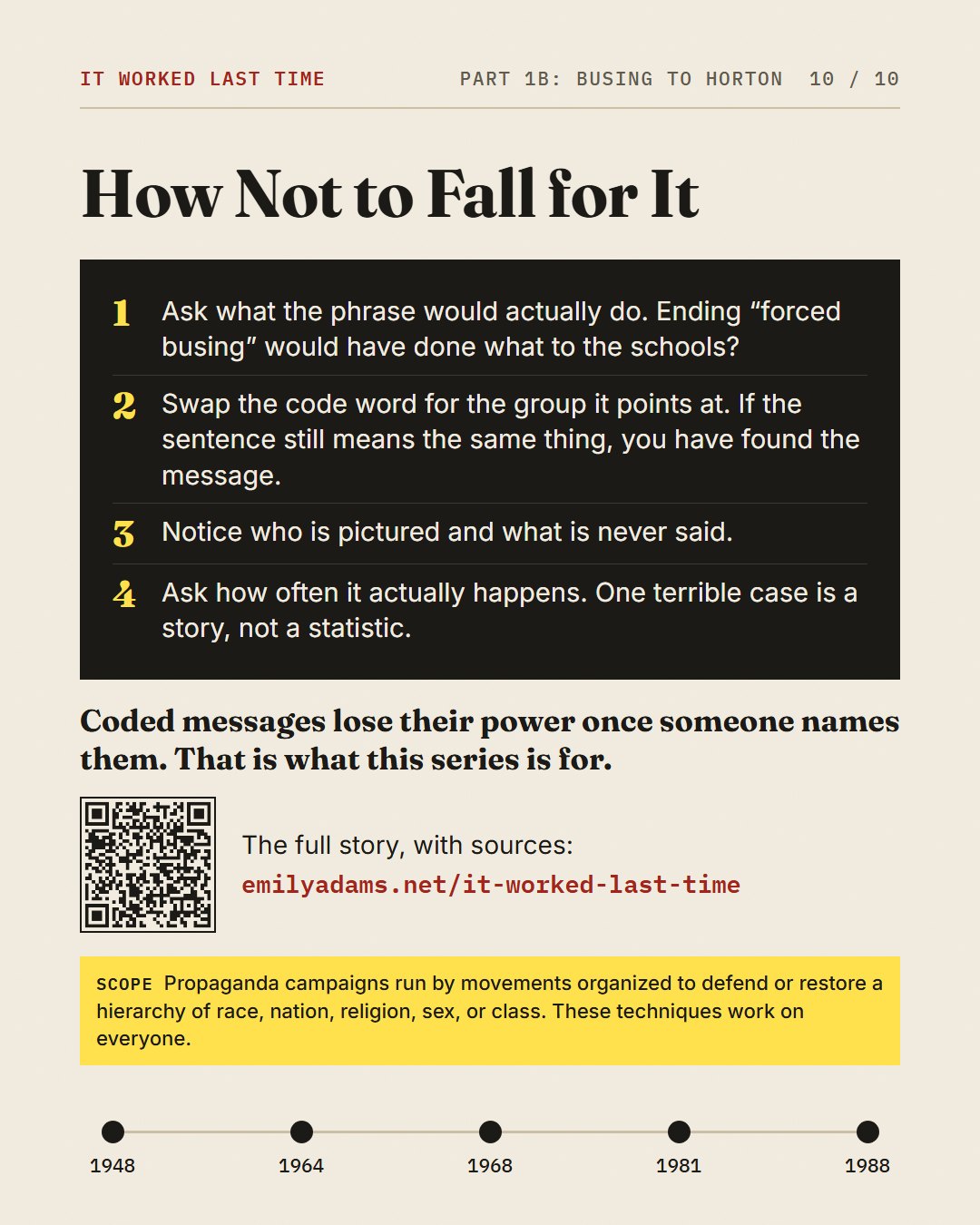
Ask what the phrase would actually do. Ending “forced busing” would have done what to the schools? In 1968, before the courts ordered real desegregation, 78 percent of Black students in the South sat in schools that were 90 to 100 percent nonwhite28. A complaint about a bus ride was also a position on whether those schools stayed separate.
Swap the code word for the group it points at. If the sentence still makes the same argument to the same audience, you have found the message.
Notice who is pictured and what is never said. Neither 1988 ad mentioned race. One showed a face.
Ask how often it actually happens. One terrible case is a story, not a statistic. Massachusetts granted more than 120,000 furloughs from 1972 to 1987, and one of them became the face of a presidential campaign48.
Coded messages lose their power once someone names them. That is what this series is for.
Sources
- 1Dixiecrats. Mississippi Encyclopedia. mississippiencyclopedia.org/entries/dixiecrats/
- 2Dixiecrats. Encyclopedia of Alabama. encyclopediaofalabama.org/article/dixiecrats/
- 3States' Rights Democrats (campaign poster, object 1979.0215.035). Smithsonian National Museum of American History. 1948. americanhistory.si.edu/collections/object/nmah_496559
- 4To the Best of My Ability, Episode 7 (Isaac Woodard and President Truman). The National WWII Museum. nationalww2museum.org/node/54501
- 5Special Message to the Congress on Civil Rights. Harry S. Truman Library. 1948-02-02. trumanlibrary.gov/library/public-papers/20/special-message-congress-ci
- 6Executive Order 9981. National Archives. 1948-07-26. archives.gov/milestone-documents/executive-order-9981
- 7Platform of the States Rights Democratic Party. The American Presidency Project. 1948. presidency.ucsb.edu/documents/platform-the-states-rights-democratic-pa
- 8THIRD PARTIES: Southern Revolt. TIME. 1948-10-11. content.time.com/time/subscriber/article/0,33009,887886-6,00.html
- 9Presidential Election Statistics, state-by-state results (1872, 1876, 1948, 1964, 1968, 1976, 1980, 1988). The American Presidency Project. presidency.ucsb.edu/statistics/elections
- 10Roosevelt and Race. Franklin D. Roosevelt Presidential Library. 2014. fdrlibrary.org/documents/356632/390886/5.3+Roosevelt+and+Race+FINAL+5-
- 11Brown v. Board of Education (1954). National Archives. 1954-05-17. archives.gov/milestone-documents/brown-v-board-of-education
- 12The Southern Manifesto of 1956. U.S. House of Representatives, History, Art & Archives. 1956-03-12. history.house.gov/Historical-Highlights/1951-2000/The-Southern-Manifes
- 13Southern Manifesto (Declaration of Constitutional Principles). Teaching American History (from the Congressional Record). 1956-03-12. teachingamericanhistory.org/document/southern-manifesto/
- 14Inaugural address of Governor George Wallace. Alabama Department of Archives and History. 1963-01-14. digital.archives.alabama.gov/cdm/ref/collection/voices/id/2952
- 15Civil Rights Act (1964). National Archives. 1964-07-02. archives.gov/milestone-documents/civil-rights-act
- 16Voting Rights Act (1965). National Archives. 1965-08-06. archives.gov/milestone-documents/voting-rights-act
- 17South Carolina v. Katzenbach, 383 U.S. 301. Legal Information Institute, Cornell Law School. 1966-03-07. law.cornell.edu/supremecourt/text/383/301
- 18Political Participation. U.S. Commission on Civil Rights. 1968-05. crmvet.org/docs/ccr_voting_south_6805.pdf
- 19Congressional Record, Senate, June 18, 1964 (Senator Goldwater on the civil rights bill). U.S. Senate Historical Office. 1964-06-18. senate.gov/artandhistory/history/resources/pdf/CivilRights_CR_June1819
- 20Address Accepting the Presidential Nomination at the Republican National Convention in San Francisco (Barry Goldwater). The American Presidency Project. 1964-07-16. presidency.ucsb.edu/documents/address-accepting-the-presidential-nomin
- 21THURMOND, James Strom. Biographical Directory of the United States Congress. bioguide.congress.gov/search/bio/T000254
- 221964 United States presidential election in Georgia. Wikipedia. en.wikipedia.org/wiki/1964_United_States_presidential_election_in_Geor
- 23Thurmond, James Strom (Nadine Cohodas). South Carolina Encyclopedia. scencyclopedia.org/sce/entries/thurmond-james-strom/
- 24Mississippi Burning. Federal Bureau of Investigation, History. fbi.gov/history/famous-cases/mississippi-burning
- 25States' rights speech. Wikipedia. en.wikipedia.org/wiki/States%27_rights_speech
- 26Why Did the Democrats Lose the South? Bringing New Data to an Old Debate (Ilyana Kuziemko and Ebonya Washington). American Economic Review 108(10). 2018-10. aeaweb.org/articles?id=10.1257/aer.20161413
- 27Survey of School Desegregation in the Southern and Border States, 1965-66. U.S. Commission on Civil Rights. 1966-02. usccr.gov/files/historical/1966/66-003-U.pdf
- 28Federal Oversight, Local Control, and the Specter of "Resegregation" in Southern Schools (Clotfelter, Ladd, and Vigdor). National Bureau of Economic Research, Working Paper 11086. 2005-01. nber.org/papers/w11086
- 29Green v. County School Board of New Kent County, 391 U.S. 430. Legal Information Institute, Cornell Law School. 1968-05-27. law.cornell.edu/supremecourt/text/391/430
- 30Swann v. Charlotte-Mecklenburg Board of Education, 402 U.S. 1. Legal Information Institute, Cornell Law School. 1971-04-20. law.cornell.edu/supremecourt/text/402/1
- 31Public Opinion on Civil Rights: Reflections on the Civil Rights Act of 1964. Roper Center for Public Opinion Research, Cornell University. 2014-07-02. ropercenter.cornell.edu/public-opinion-civil-rights-reflections-civil-
- 32Whites' Opposition to "Busing": Self-Interest or Symbolic Politics? (Sears, Hensler, and Speer). American Political Science Review 73(2). 1979. ideas.repec.org/a/cup/apsrev/v73y1979i02p369-384_16.html
- 33Atwater, Harvey LeRoy (Aaron L. Haberman). South Carolina Encyclopedia. scencyclopedia.org/sce/entries/atwater-harvey-leroy/
- 34Nomination announcement for Lee Atwater. Ronald Reagan Presidential Library. 1982-01-29. reaganlibrary.gov/research/speeches/12982a
- 35Food Stamps: 1982 Legislation (Issue Brief IB82076, Joe Richardson). Congressional Research Service. 1983-01-10. digital.library.unt.edu/ark:/67531/metacrs8833/m2/1/high_res_d/IB82076
- 36LSC Faces Severe Funding Cuts (timeline). Legal Services Corporation. lsc.gov/timeline/lsc-faces-severe-funding-cuts
- 37Exclusive: Lee Atwater's Infamous 1981 Interview on the Southern Strategy (Rick Perlstein). The Nation. 2012-11-13. thenation.com/article/archive/exclusive-lee-atwaters-infamous-1981-int
- 38Lee Atwater (reproducing Lamis, The Two-Party South, 1988 edition, page 26). Wikipedia. en.wikipedia.org/wiki/Lee_Atwater
- 39Historical Poverty Tables, Table 2: Poverty Status of People by Family Relationship, Race, and Hispanic Origin, 1959 to 2006. U.S. Census Bureau. 2007. webarchive.library.unt.edu/eot2008/20090901111901/http://www.census.go
- 40Characteristics of Households Receiving Selected Noncash Benefits: 1981 (Series P-60, No. 135). U.S. Census Bureau. 1982-08. census.gov/library/publications/1982/demo/p60-135.html
- 41Race and Poverty in America: Public Misperceptions and the American News Media (Martin Gilens). Public Opinion Quarterly 60(4). 1996. web.stanford.edu/class/comm1a/readings/gilens-race-poverty.pdf
- 42Bush's Most Valuable Player (Jack E. White). TIME. 1988-11-14. time.com/archive/6713733/bushs-most-valuable-player/
- 43Gallup Vault: Convention Bounce. Gallup. news.gallup.com/vault/193826/gallup-vault-convention-bounce-looks.aspx
- 44Why the Dukakis 1988 analogy is baloney (Stuart Rothenberg). Roll Call. 2020-06-29. rollcall.com/2020/06/29/why-the-dukakis-1988-analogy-is-baloney/
- 45Study brings more debate on furlough issue. UPI. 1988-10-13. upi.com/Archives/1988/10/13/Study-brings-more-debate-on-furlough-issue
- 46Willie Horton Revisited (Beth Schwartzapfel and Bill Keller). The Marshall Project. 2015-05-13. themarshallproject.org/2015/05/13/willie-horton-revisited
- 47Dukakis and the furlough issue (Owen Thomas). The Christian Science Monitor. 1988-09-08. csmonitor.com/1988/0908/afur.html
- 48Statistical Description of the Massachusetts Furlough Program 1972-1987. Prison Legal News (from Massachusetts Department of Correction reports). prisonlegalnews.org/news/publications/statistical-description-of-the-m
- 49How a Maryland Crime Shaped a Presidential Election. WETA Boundary Stones. 2019-05-01. boundarystones.weta.org/2019/05/01/how-maryland-crime-shaped-president
- 50'Willie' Horton and the rise (and fall?) of mass incarceration (Eric Levenson). Boston.com. 2015-05-14. boston.com/news/local-news/2015/05/14/willie-horton-and-the-rise-and-f
- 51Willie Horton (National Security PAC, 1988). Museum of the Moving Image, The Living Room Candidate. 1988. livingroomcandidate.org/commercials/1988/willie-horton
- 52How the Willie Horton Ad Played on Racism and Fear (Erin Blakemore). History.com. 2018-11-02. history.com/articles/george-bush-willie-horton-racist-ad
- 53Revolving Door (Bush-Quayle '88). Museum of the Moving Image, The Living Room Candidate. 1988. livingroomcandidate.org/commercials/1988/revolving-door
- 54Address Accepting the Presidential Nomination at the Republican National Convention in Miami Beach, Florida (Richard Nixon). The American Presidency Project. 1968-08-08. presidency.ucsb.edu/documents/address-accepting-the-presidential-nomin
- 55H. R. Haldeman Diaries, entry for Monday, April 28, 1969. Richard Nixon Presidential Library (National Archives identifier 7787364). 1969-04-28. nixonlibrary.gov/sites/default/files/virtuallibrary/documents/haldeman
- 56In her death, Rose Bird still sparks controversy. California Bar Journal (State Bar of California). 2000-01. archive.calbar.ca.gov/archive/calbar/2cbj/00jan/index.htm
- 57Thirty Years After a Hundred-Year Flood (David S. Ettinger). California Supreme Court Historical Society Newsletter. 2016. horvitzlevy.com/R5FD3S351/assets/files/News/2016-DSE%20-%20CSCHS%20New
- 58Is Violent Crime in the United States Increasing? (R44259, Nathan James). Congressional Research Service. 2015-10-29. everycrsreport.com/reports/R44259.html
- 59Overrepresentation and Underrepresentation of African Americans and Latinos as Lawbreakers on Television News (Travis L. Dixon and Daniel Linz). Journal of Communication 50(2). 2000-06. doi.org/10.1111/j.1460-2466.2000.tb02845.x
- 60Prime Suspects: The Influence of Local Television News on the Viewing Public (Franklin D. Gilliam Jr. and Shanto Iyengar). American Journal of Political Science 44(3). 2000-07. doi.org/10.2307/2669264
- 61Clinton returns home for killer's execution (AP). Deseret News. 1992-01-25. deseret.com/1992/1/25/18964025/clinton-returns-home-for-killer-s-execu
- 62Rickey Ray Rector (Execution of). CALS Encyclopedia of Arkansas. encyclopediaofarkansas.net/entries/rickey-ray-rector-6860/
- 63Violent Crime Control and Law Enforcement Act of 1994 (fact sheet). U.S. Department of Justice. ncjrs.gov/txtfiles/billfs.txt
- 64Remarks on Signing the Violent Crime Control and Law Enforcement Act of 1994. The American Presidency Project. 1994-09-13. presidency.ucsb.edu/documents/remarks-signing-the-violent-crime-contro
- 65The Race Card: Campaign Strategy, Implicit Messages, and the Norm of Equality (Tali Mendelberg). Princeton University Press. 2001. press.princeton.edu/books/paperback/9780691070711/the-race-card
- 66History and Calumny (David Brooks). The New York Times. 2007-11-09. nytimes.com/2007/11/09/opinion/09brooks.html
- 67Ailing Atwater apologizes for nasty tactics. Deseret News. 1991-01-15. deseret.com/1991/1/15/18900736/ailing-atwater-apologizes-for-nasty-tac
- 68Trump refers to Black man from racially offensive 1988 campaign ad while stumping in North Carolina (Associated Press). WUNC. 2026-09-18. wunc.org/2026-09-18/trump-black-man-racially-offensive-1988-campaign-a
- 69Truth Social post by Donald J. Trump, October 11, 2026, 7:54 p.m.. Truth Social (text read from the Trump's Truth archive, status 42256). 2026-10-11. truthsocial.com/@realDonaldTrump/117424971260859993
- 70Truth Social post by Donald J. Trump, October 12, 2026, 8:13 a.m.. Truth Social (text read from the Trump's Truth archive, status 42286). 2026-10-12. truthsocial.com/@realDonaldTrump/117427876216740071
- 71Blood-soaked killing fields? Fact-checking Trump and Whatley's claims about Cooper and crime in North Carolina. PolitiFact. 2026-09-17. politifact.com/article/2026/sep/17/blood-soaked-killing-fields-fact-ch
- 72Cooper becomes first Democrat to win US Senate race in NC since 2008 (Christine Zhu). NC Newsline. 2026-11-03. ncnewsline.com/2026/11/03/cooper-becomes-first-democrat-to-win-us-sena
Image Credits
- States' Rights Democrats (poster for J. Strom Thurmond and Fielding L. Wright). States' Rights Democratic Party campaign (printer not identified in the catalog record). 1948. CC0 (Smithsonian Open Access; object 1979.0215.035, gift of Sara L. Lepman in memory of Dr. Harry Lepman). Source
- Anti-busing pickets at the Supreme Court. Thomas J. O'Halloran, U.S. News & World Report Magazine Photograph Collection. 1971. Library of Congress: no known restrictions on publication (LC-DIG-ppmsca-50505). Source
- Lyn Nofziger Talking with Lee Atwater in Nofziger's Office in The White House. White House Photographic Office (Ronald Reagan Presidential Library). 1982-01-21. Public domain (U.S. federal government work); National Archives use restriction: unrestricted. Source
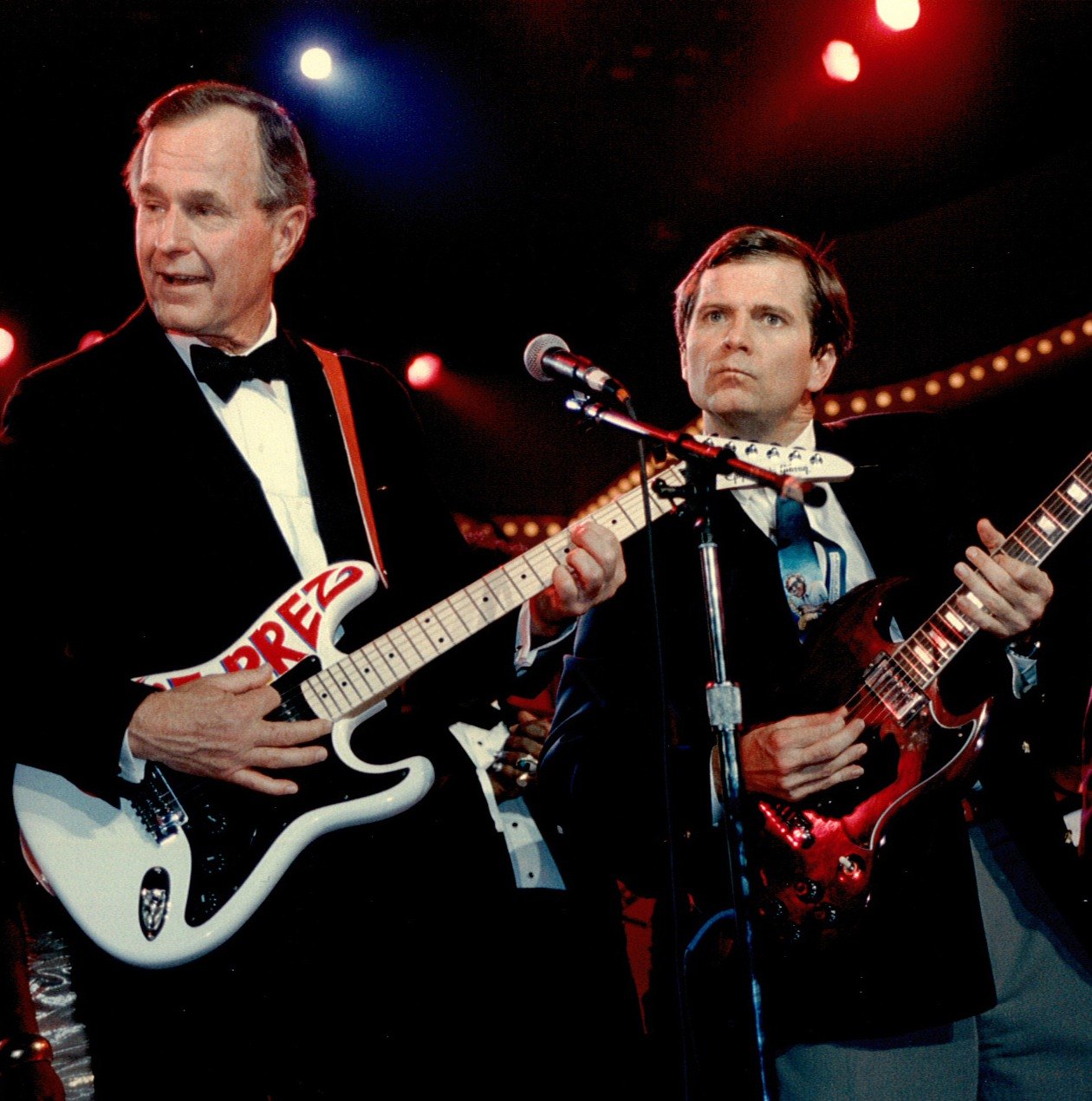
- Lee Atwater "jams" with President George H. W. Bush at inaugural festivity (White House photo P0142-22), cropped to the two men. Official White House photograph. 1989-01-21. Public domain (U.S. federal government work), via Wikimedia Commons. Source