Enemy of the People
For years before they took power, the Nazis called Germany’s newspapers the “lying press.” Then they suspended press freedom, jailed editors, and boasted that Germans were “completely immune” to foreign warnings of war. The label “enemy of the people” has done the same job for more than one kind of regime, and in 2026 it became a White House ban.


The Graphics
Swipe through the slides as they appear on Instagram and Facebook. Tap any slide to open it full size.
The Carousel

Forbidden


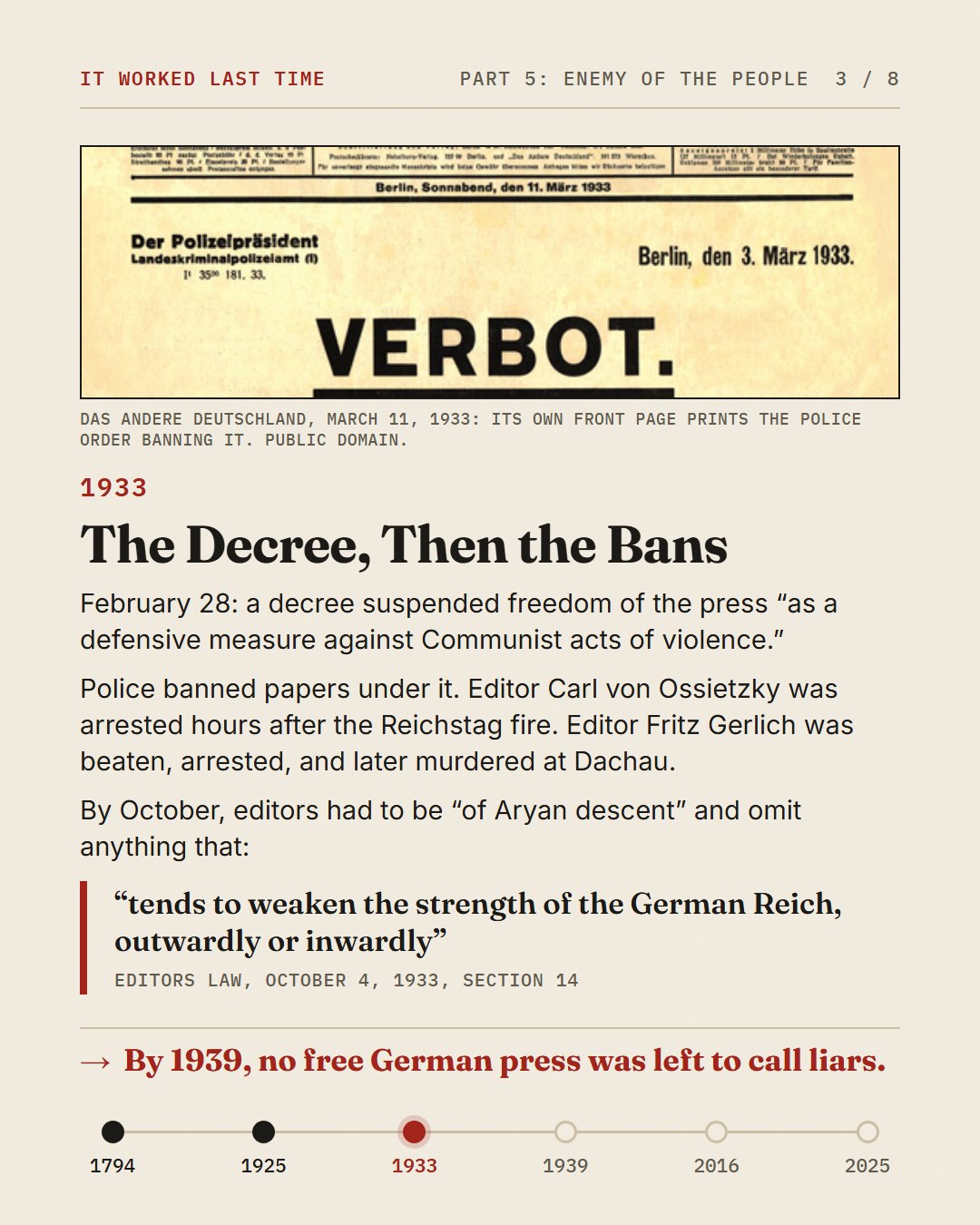
On Saturday, March 11, 1933, the Berlin weekly Das Andere Deutschland, “The Other Germany,” printed a single item on its front page: a police order dated March 3, two days before a national election, headed “VERBOT.” Forbidden. Under a decree the president had signed on February 28, the police barred the paper for three months “in the interest of public safety and order”7. The order was signed for the police chief by Rudolf Diels, who weeks later became the first head of the Gestapo7.
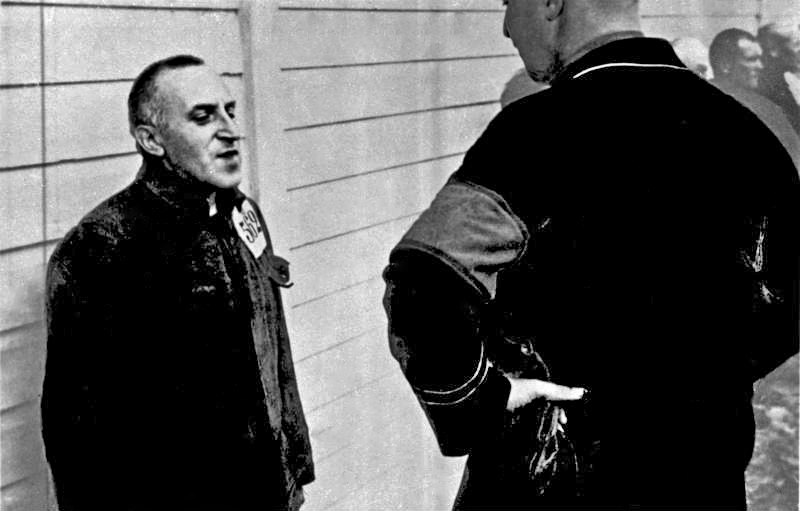
It was not the only target. Hours after the Reichstag fire of February 27, police arrested Carl von Ossietzky, editor of the magazine Die Weltbühne9. Ten days later, storm troopers beat and arrested Fritz Gerlich, whose paper called itself the “German Newspaper for Truth and Justice”10.
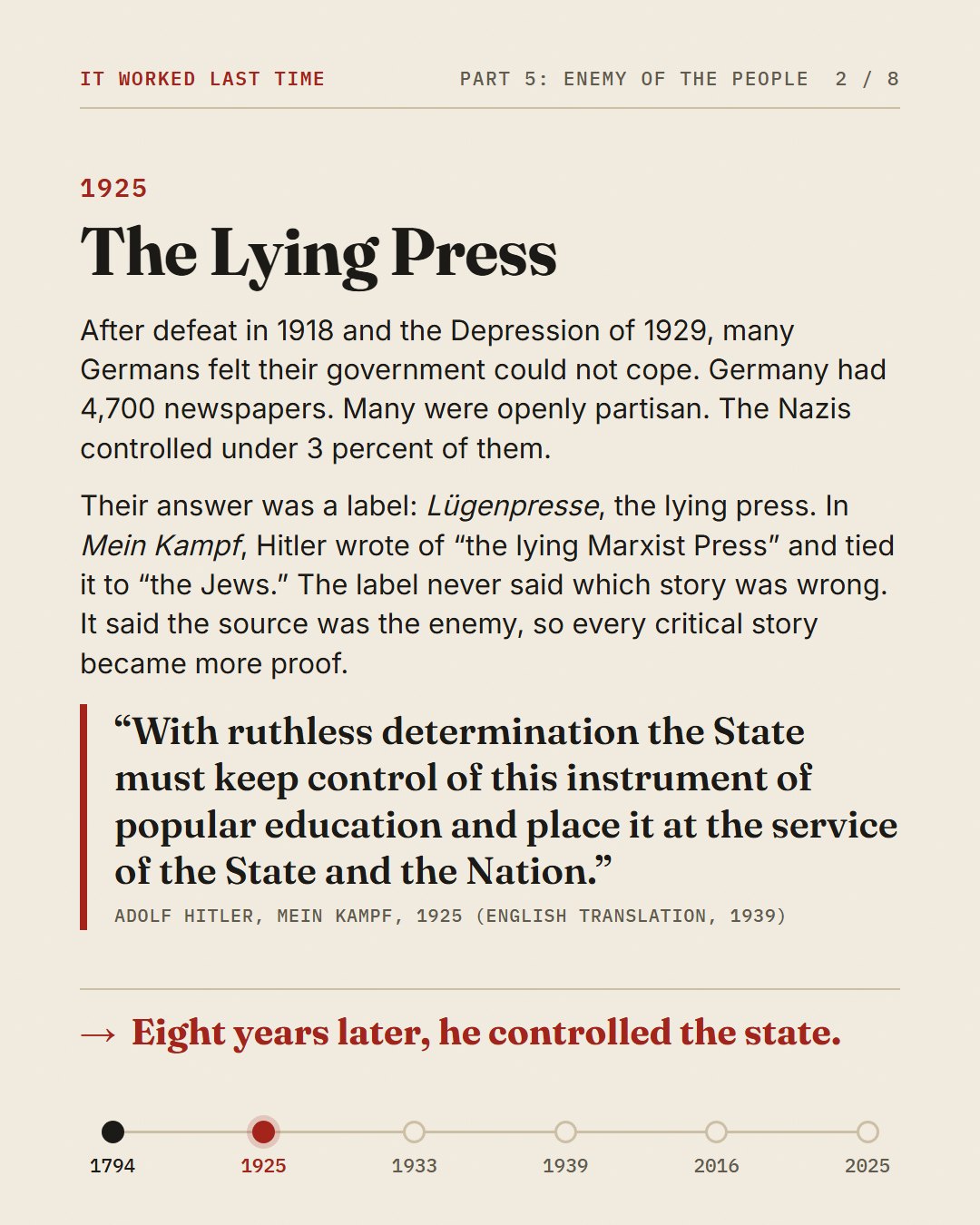
None of this came out of nowhere. For years, the men now giving the orders had told their followers that Germany’s papers were lying on purpose, for Germany’s enemies. The Nazis had a name for it: Lügenpresse, the lying press48.
The Lying Press, 1918 to 1932
Germany lost World War I in 1918. When the Great Depression hit in late 1929, unemployment rose quickly, and many Germans felt the government could not manage the crisis2. The country had about 4,700 newspapers, many openly partisan; hundreds were run by political parties1. Some of the best-known liberal dailies came from two Jewish-owned publishers, Mosse and Ullstein. The Nazis controlled less than 3 percent of all papers1.
The word Lügenpresse was older than the Nazi Party; it had turned up in German political fights since the 1800s8. The Nazis aimed it at the papers they wanted gone: Jewish-owned, Social Democratic, Communist and liberal8. In Mein Kampf, published in 1925, Hitler wrote (in English translation): “The function of the so-called liberal Press was to dig the grave for the German people and Reich. No mention need be made of the lying Marxist Press.” Its “sole task,” he wrote, was preparing Germans “to become the slaves of international finance and its masters, the Jews”4.
Notice what the label does. It never says which story is false, or why. It says the source is the enemy. Once a reader accepts that, a report of Nazi street violence becomes proof of a Jewish and Marxist plot against the movement, and a denial from the paper becomes more proof. Readers learn to dismiss the next story before it is printed.
Hitler also wrote down what he planned to do. The state, he said, must not be misled by “so-called ‘freedom of the Press’.” Then: “With ruthless determination the State must keep control of this instrument of popular education and place it at the service of the State and the Nation”4. He wrote that eight years before taking power. By 1945, the book had sold more than 12 million copies3.
The audience was not only fanatics. Millions of ordinary Germans were frightened and bitter, and many of their papers really were partisan, so a word that explained why the news felt hostile was easy to accept. The Nazis spread it “at mass rallies, on posters, and in newspapers and leaflets”2. In July 1932, they won 37 percent of the vote and became the largest party in parliament2. On January 30, 1933, Hitler became chancellor6.
One Page, Then the Bans
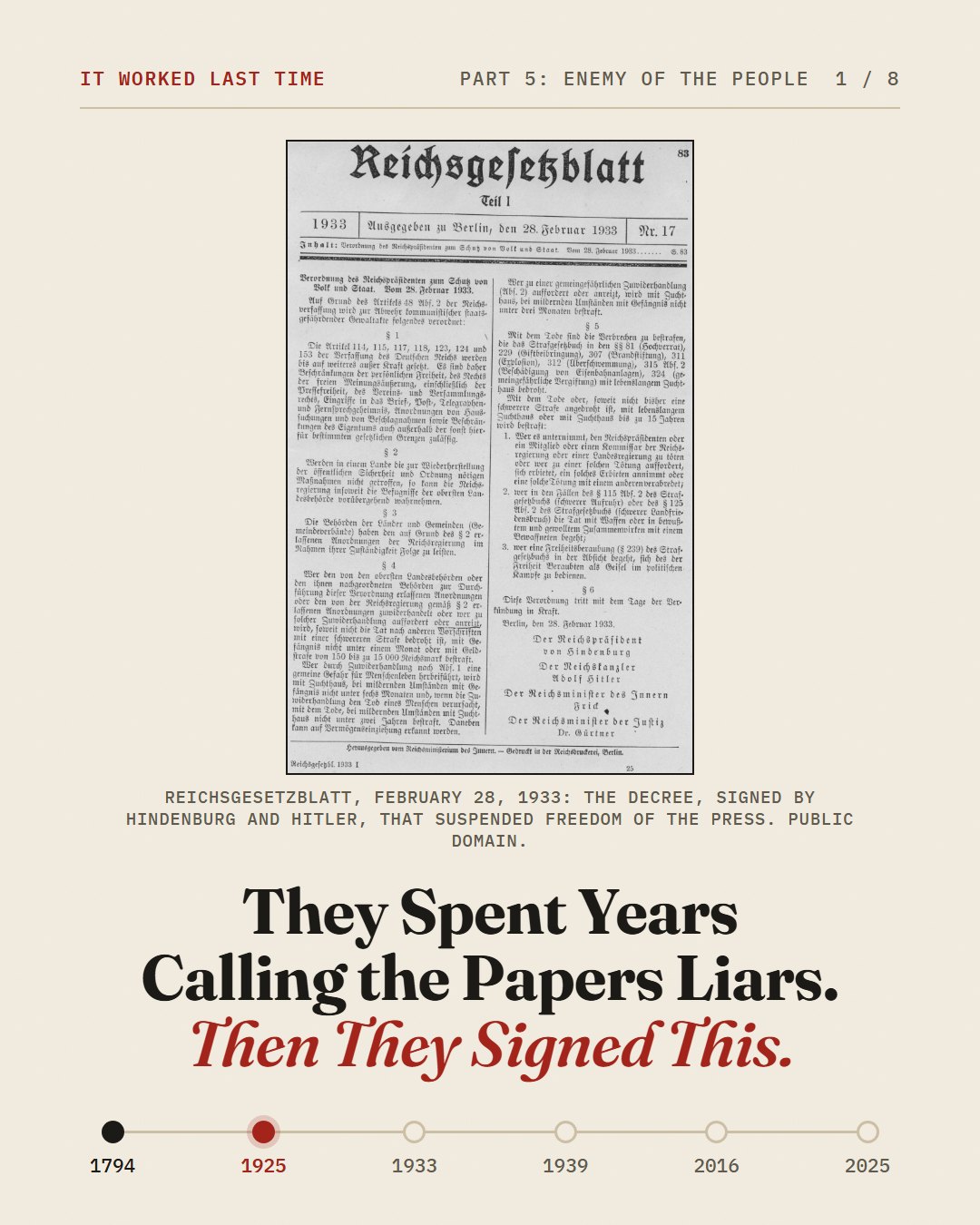
It took less than a month. On February 4, Hitler’s cabinet restricted the press6. On February 27, the Reichstag burned, and the government falsely blamed a Communist plot6. The next day, President Paul von Hindenburg signed a one-page decree, issued “as a defensive measure against Communist acts of violence that endanger the state.” It suspended seven articles of the constitution and permitted “restrictions on personal liberty, on the right to free expression of opinion including freedom of the press”5.
The decree let the regime “arrest and incarcerate political opponents without specific charge, dissolve political organizations, and suppress publications”6. The state seized Communist and Social Democratic printing plants and often handed them to the Nazi Party1. Even so, on March 5 the Nazis won only 43.9 percent of the vote5.
The editors paid first. Ossietzky was sent in April 1933 to the Sonnenburg concentration camp, where he was severely maltreated, and later to Esterwegen9. Gerlich, whose paper had reported on quarrels inside the Nazi leadership, was held for 16 months and murdered at Dachau on the night of June 30, 193410. The Ullstein family was forced off its company’s board in 1933 and made to sell a year later; the Mosse family fled the day after Hitler took power1.
On October 4, 1933, the Editors Law finished the job. Editors now had to be “of Aryan descent” and not married to anyone who was not11. Section 13 ordered them “to treat their subjects truthfully.” Section 14 set the limits of that truth: keep out anything that “tends to weaken the strength of the German Reich, outwardly or inwardly”11. Editors who disobeyed could be fired or, if officials suspected intent to harm Germany, sent to a concentration camp. The Propaganda Ministry issued daily directives on what could be reported1.
Completely Immune

With no free German press left, Joseph Goebbels, the propaganda minister, aimed the word abroad. In February 1939, he claimed that anyone reading the foreign “Hetz- und Lügenpresse,” the agitating and lying press, might think Europe stood at the edge of a new world war12. On May 1, 1939, he told the Reich Chamber of Culture: “The German people itself is completely immune to the international incitement and war hysteria that is systematically driven and stoked by the lying press in London, Paris and New York”12.
Four months later, Germany invaded Poland. The foreign papers had been right, and the Germans taught to dismiss them were, as Goebbels said, immune.
The cost can be counted. Of 4,700 German newspapers in 1933, no more than 1,100 remained by 1944, all publishing only what the Propaganda Ministry’s directives allowed. The Nazi Party’s 325 papers had a combined circulation of 21 million, against about 4.4 million for the rest1.
In November 1936, severely ill after more than three and a half years in custody, Ossietzky was awarded the Nobel Peace Prize. He was not allowed to accept it. He died on May 4, 1938, as a result of his imprisonment9.
A Label With a Long Record
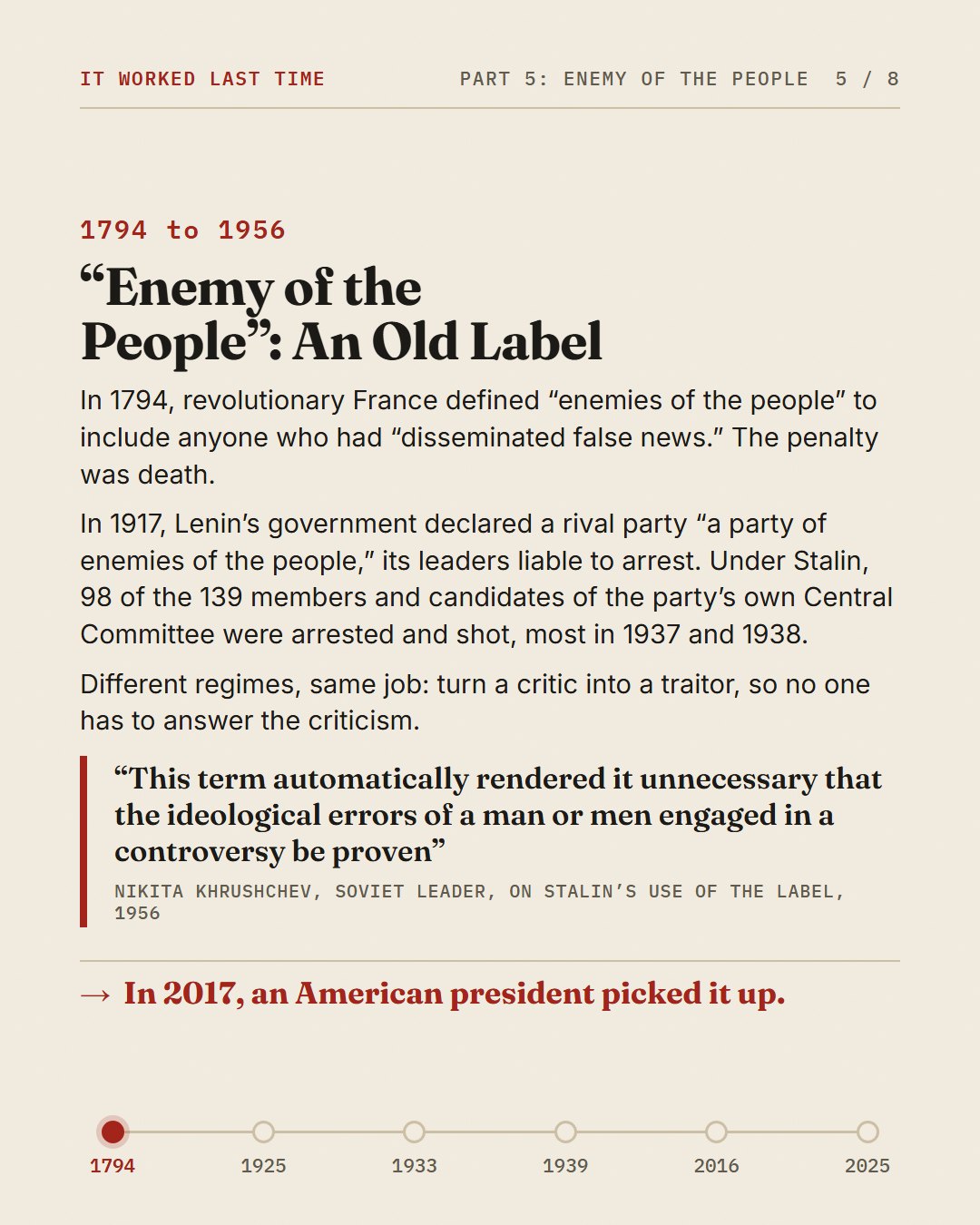
The other label in this story is older, and it has served more than one kind of regime. In June 1794, revolutionary France passed a law that read: “The enemies of the people are those who seek to destroy public liberty, either by force or by cunning.” They included anyone who had “disseminated false news in order to divide or disturb the people.” The penalty was death13.
In 1882, the playwright Henrik Ibsen turned the phrase into a warning. In An Enemy of the People, a doctor finds that his town’s medicinal baths are poisoned, and when he insists on saying so, a town meeting declares him “an enemy of the people”14.
Weeks after taking power, Lenin’s government made the leaders of a rival party liable to arrest “as a party of enemies of the people”15. Under Stalin, it became the charge of the purges. In 1956, his successor, Nikita Khrushchev, explained how it worked: “This term automatically rendered it unnecessary that the ideological errors of a man or men engaged in a controversy be proven.” Proof was often a confession “acquired through physical pressures against the accused.” Of the 139 members and candidates of the party’s Central Committee elected in 1934, 98 “were arrested and shot”16.
Khrushchev blamed Stalin for inventing the label; it was more than a century older. But he was right about what it did. In each case, the label turned a critic into a traitor, so no one had to answer what the critic said.
The Enemy of the American People

Americans’ trust in the news had been sliding for a decade. In September 2016, Gallup found it at a record low of 32 percent; among Republicans, it fell from 32 to 14 percent in one year. Gallup pointed to a long slide and a bitter campaign, then added: “It is also possible that Republicans think less of the media as a result of Trump’s sharp criticisms of the press”20.
The old German word turned up, too. Pegida, an anti-Islam movement, had revived it in Germany in 2014839. In October 2016, a video from a Trump event in Cleveland caught two supporters shouting “Lügenpresse” at reporters17. In November, at a white nationalist conference in Washington, Richard Spencer railed against the “Lügenpresse” and called out “Hail Trump”18. These were fringe moments, and the president-elect said of that group, “I disavow and condemn them”19.
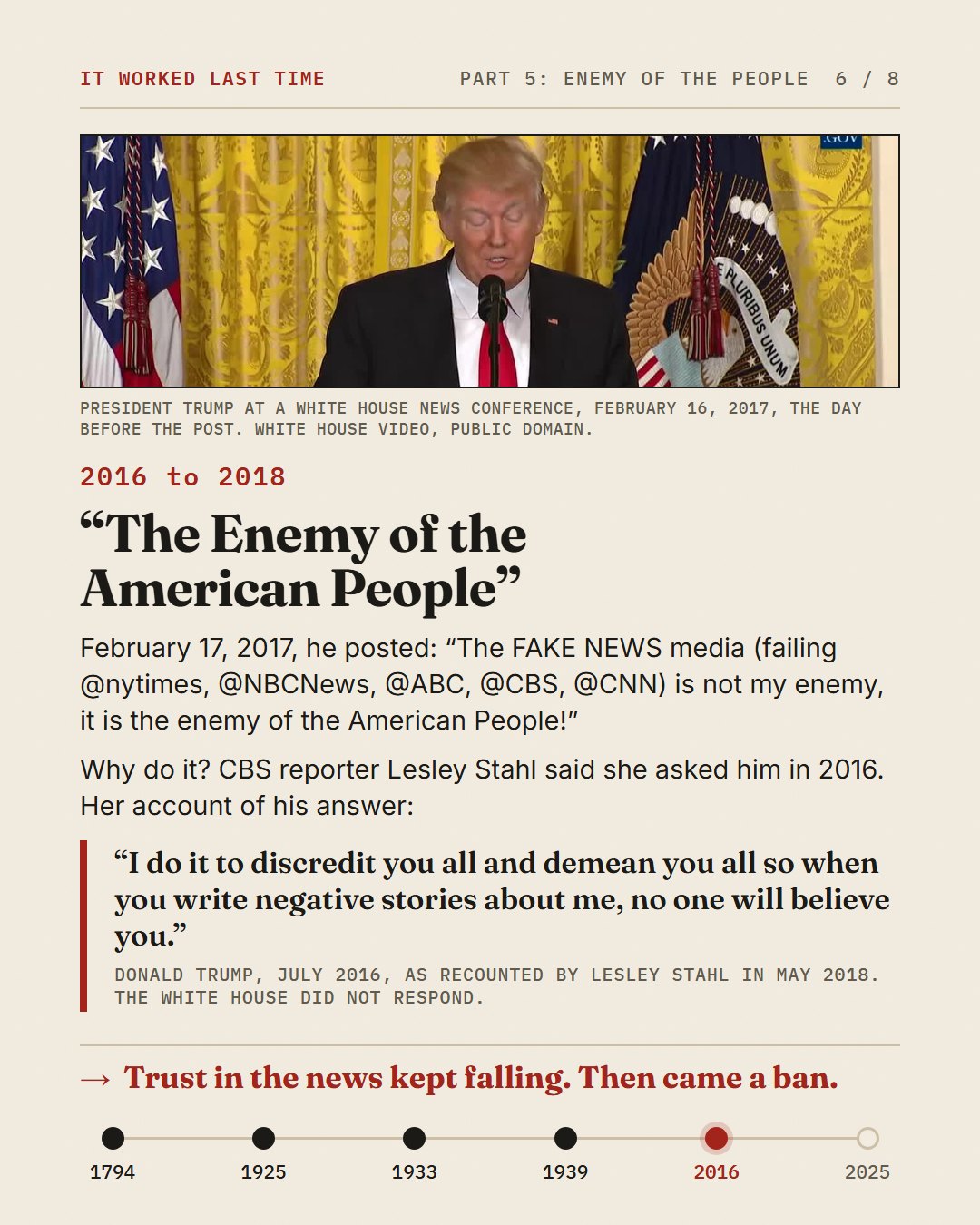
He chose the other label. On February 16, 2017, President Trump held a news conference at the White House40. The next day he posted: “The FAKE NEWS media (failing @nytimes, @NBCNews, @ABC, @CBS, @CNN) is not my enemy, it is the enemy of the American People!”21
A week later, at the Conservative Political Action Conference, he said: “A few days ago, I called the fake news ‘the enemy of the people,’ and they are. They are the enemy of the people. Because they have no sources, they just make them up when there are none.” His example: “I saw one story recently where they said nine people have confirmed. There are no nine people”22. FactCheck.org found that the likely story, a Washington Post report on his national security adviser’s talks with Russia’s ambassador, had “turned out to be accurate, not ‘fake’ at all.” The White House confirmed it, and the adviser, Michael Flynn, resigned at Trump’s request21.
That is the move at work. The post did not name a false story. It named five of the largest news organizations in the country21. Once a reader accepts that they are the enemy, every critical story about the leader arrives already discredited.
Why do it? In May 2018, the CBS correspondent Lesley Stahl told a journalism awards dinner about an off-camera talk with Trump in July 2016, when she asked why he kept attacking the press2324. His answer, by her account: “You know why I do it? I do it to discredit you all and demean you all so when you write negative stories about me, no one will believe you.” The White House did not answer a request for comment24. It is one reporter’s account of a private conversation, and it should be weighed as that. CBS’s first story got the month wrong, and CBS published a correction23. That is what a free press does with its mistakes.
In July 2018, the publisher of The New York Times, A.G. Sulzberger, met Trump. By Sulzberger’s account, he warned the president “that this inflammatory language is contributing to a rise in threats against journalists and will lead to violence”25.
That August, after The Boston Globe asked papers nationwide to publish editorials defending a free press, a California man named Robert Chain began calling its newsroom. “You’re the enemy of the people, and we’re going to kill every [expletive] one of you,” he said on August 16. His reason, on August 22: “As long as you keep attacking the President, the duly elected President of the United States, in the continuation of your treasonous and seditious acts, I will continue to [make] threats, harass, and annoy the Boston Globe.” He pleaded guilty and was sentenced to four months in prison26.
His case shows the phrase coming back as a threat. It does not show that such threats were common. One terrible case is a story, not a statistic: in all of 2017, the U.S. Press Freedom Tracker counted 44 physical attacks on journalists or their equipment, 70 percent of them at protests and rallies, by police and by protesters of more than one political stripe27. The measurable cost of the label was quieter. It showed up in the polls.
The Pattern


Set the German and American stories side by side and the move is the same. First, attack the source, not the story. Second, raise the stakes: the press is not mistaken, it is the enemy of the people. Third, let the label work: once followers accept it, every critical story confirms it, and the leader never has to answer one. Last, when power allows, control who may report.
It works because it starts from something real. Newspapers get things wrong, and many Weimar papers were openly partisan1. In January 2016, much of Germany’s national media largely ignored the mass sexual assaults in Cologne on New Year’s Eve for several days, handing its critics a “told you so” moment39. American trust in the news had been falling since 200429. Even the judge who blocked the 2026 ban wrote that his ruling did not mean “that President Trump’s concerns about accuracy and fairness in the media’s reporting are unfounded”37.
Criticism names an error and asks for a correction. The move names an enemy and asks you to stop reading.
The Rerun
In his second term, the label came back. By August 2026, the U.S. Press Freedom Tracker had logged more than 3,720 anti-press posts by Trump since 2015, 77 of them using “enemy of the people”33.
On November 26, 2025, the day after The New York Times reported signs of fatigue and a lighter schedule, he posted: “This cheap ‘RAG’ is truly an ‘ENEMY OF THE PEOPLE.’ The writer of the story, Katie Rogers, who is assigned to write only bad things about me, is a third rate reporter who is ugly, both inside and out”3032.
On December 9, he went further: “I actually believe it’s seditious, perhaps even treasonous, for The New York Times, and others, to consistently do FAKE reports in order to libel and demean ‘THE PRESIDENT OF THE UNITED STATES.’ They are true Enemies of the People, and we should do something about it”31. The Times said it “won’t be deterred by false and inflammatory language that distorts the role of a free press”32.
On September 18, 2026, the label became policy. Trump posted that, “effective immediately,” he was “banning Fake News CNN, MSNOW” and Politico from the White House, adding: “Media Outlets shouldn’t be able to constantly write or report FICTION and LIES when they’re covering the President of the United States, the Trump Administration, or the United States of America. Other Fake News Media Outlets to follow.” Asked in the Oval Office how he justified it, he said, “Because they’re fake news.” The next morning, the three outlets’ reporters were turned away and their passes revoked34.
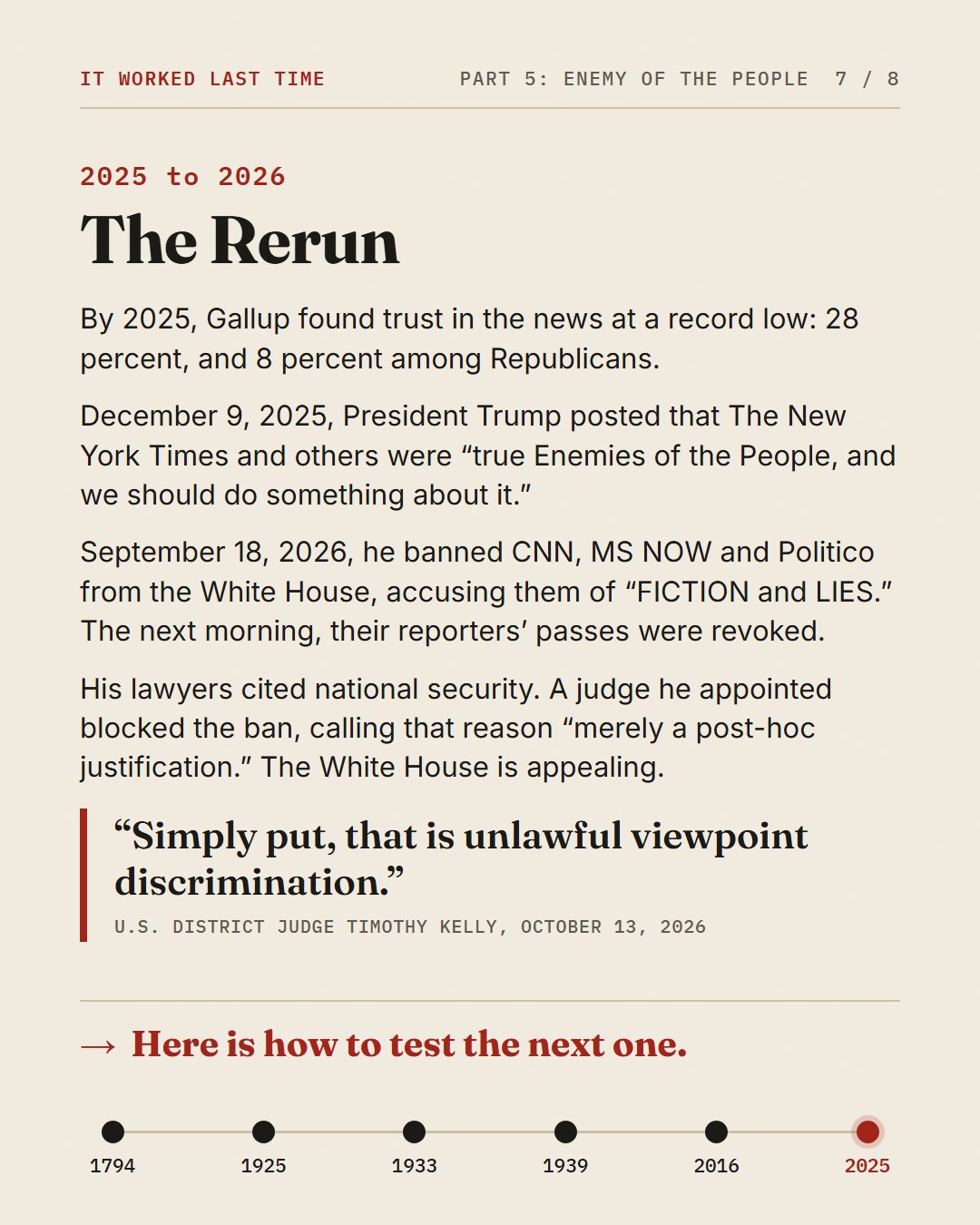
The outlets sued. Judge Timothy Kelly, whom Trump nominated in 2017, ordered their passes restored on September 24, noting that “nothing in the record that predates this suit suggests that the revocation of Plaintiffs’ hard passes was motivated by national security concerns”3536. On October 13, he extended the order: “President Trump’s own comments suggest that he intended the revocation of Plaintiffs’ hard passes to alter their reporting on him.” And: “Simply put, that is unlawful viewpoint discrimination”3738. The Justice Department appealed the next day38.
Trust in the news hit a record low of 28 percent in 2025, with Republicans at 8 percent28. In a poll finished just before the 2026 ban, it rose to 33 percent, almost all of the gain among Republicans29. The record on intent is his own: his posts, his words in the Oval Office, the reason Stahl says he gave her, and a federal judge’s findings.
Their Defense
The Nazi government’s defense is printed in its law. The decree was “a defensive measure against Communist acts of violence that endanger the state”5. The Editors Law ordered editors “to treat their subjects truthfully,” so long as the truth did not “weaken the strength of the German Reich”11.
Trump’s defense has been consistent. In 2017, he said reporters had left out a word: “They dropped off the word ‘fake.’” And: “So I’m not against the media. I’m not against the press. I don’t mind bad stories if I deserve them”22. The post he was defending named five major news organizations as the fake news21.
In 2026, asked whether the ban was meant to intimidate the press, he answered, “No, no, no, no,” and “I dislike dishonest press, like you”34. His lawyers cited national security and argued that “Access to the White House is a privilege, not a right”3536. The judge called the national security reason “merely a post-hoc justification”38.
There is a fair point inside the defense. Made-up stories exist, and “fake news” can describe them. The test is whether a charge names an error and asks for a correction, or labels a whole newsroom the enemy.
How Not to Fall for It
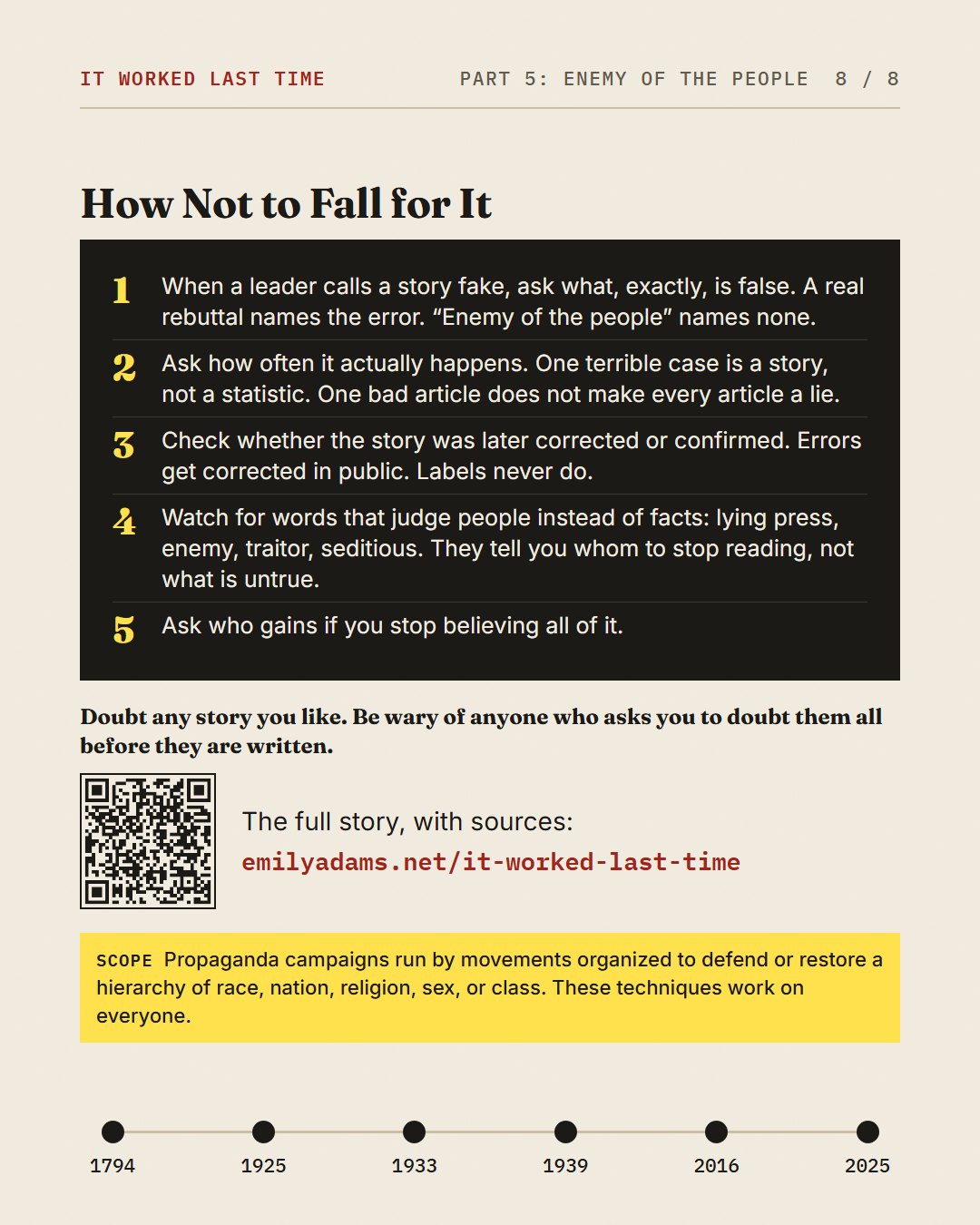
When a leader calls a story fake, ask what, exactly, is false. A real rebuttal names the error. “Enemy of the people” names none.
Ask how often it actually happens. One terrible case is a story, not a statistic. One bad article does not make every article a lie.
Check whether the story was later corrected or confirmed. The “nine people” story Trump mocked in 2017 was confirmed by his own White House21.
Watch for words that judge people instead of facts: lying press, enemy of the people, traitor, seditious. They tell you whom to stop reading, not what is untrue.
Ask who gains if you stop believing all of it. By Lesley Stahl’s account, Trump said it plainly: so that “no one will believe you”24.
Doubt any single story you like. Be wary of anyone who asks you to doubt them all before they are written.
Sources
- 1The Press in the Third Reich. United States Holocaust Memorial Museum, Holocaust Encyclopedia. encyclopedia.ushmm.org/content/en/article/the-press-in-the-third-reich
- 2The Nazi Rise to Power. United States Holocaust Memorial Museum, Holocaust Encyclopedia. encyclopedia.ushmm.org/content/en/article/the-nazi-rise-to-power
- 3Mein Kampf. United States Holocaust Memorial Museum, Holocaust Encyclopedia. encyclopedia.ushmm.org/content/en/article/mein-kampf
- 4Mein Kampf, Volume 1, Chapter X, "Why the Second Reich Collapsed" (James Murphy translation, 1939). Adolf Hitler; Project Gutenberg Australia. 1925. gutenberg.net.au/ebooks02/0200601h.html
- 5Decree of the Reich President for the Protection of the People and State ("Reichstag Fire Decree"). German History in Documents and Images (GHDI), German Historical Institute. 1933-02-28. germanhistorydocs.org/en/nazi-germany-1933-1945/decree-of-the-reich-pr
- 6Reichstag Fire Decree. United States Holocaust Memorial Museum, Holocaust Encyclopedia. encyclopedia.ushmm.org/content/en/article/reichstag-fire-decree
- 7Das Andere Deutschland, front page of March 11, 1933, with the police ban of March 3, 1933 (file page and translation). Wikimedia Commons. 1933-03-11. commons.wikimedia.org/wiki/File:Verboten_Zeitung_1933.jpg
- 8Lying press. Wikipedia. en.wikipedia.org/wiki/Lying_press
- 9Carl von Ossietzky (biography). German Resistance Memorial Center (Gedenkstätte Deutscher Widerstand), Berlin. gdw-berlin.de/en/recess/biographies/index-of-persons/biographie/view-b
- 10Fritz Gerlich (biography). German Resistance Memorial Center (Gedenkstätte Deutscher Widerstand), Berlin. gdw-berlin.de/en/recess/biographies/index-of-persons/biographie/view-b
- 11Editorial Law of 4 October 1933 (Nuremberg document 2083-PS, translation). Avalon Project, Yale Law School (Nazi Conspiracy and Aggression, Vol. IV). 1933-10-04. avalon.law.yale.edu/imt/2083-ps.asp
- 12Joseph Goebbels, Die Zeit ohne Beispiel: Reden und Aufsätze aus den Jahren 1939/40/41 (Zentralverlag der NSDAP, 1941). Internet Archive (full text). 1939-05-01. archive.org/stream/DieZeitOhneBeispiel/GoebbelsJoseph-DieZeitOhneBeisp
- 13The Law of 22 Prairial (1794). Alpha History (English translation of the law). 1794-06-10. alphahistory.com/frenchrevolution/law-of-22-prairial-1794/
- 14An Enemy of the People (R. Farquharson Sharp translation). Henrik Ibsen; Project Gutenberg. 1882. gutenberg.org/ebooks/2446
- 15Decree on the Arrest of the Leaders of the Civil War Against the Revolution. V. I. Lenin, Collected Works, Vol. 26; Marxists Internet Archive. 1917-11-28. marxists.org/archive/lenin/works/1917/nov/28.htm
- 16Nikita Khrushchev, Secret Speech to the Twentieth Party Congress (excerpts). Internet Modern History Sourcebook, Fordham University. 1956-02-25. sourcebooks.web.fordham.edu/mod/1956khrushchev-secret1.asp
- 17Donald Trump Supporters Are Using a Nazi Word to Attack Journalists. Time (Jeff Nesbit). 2016-10-25. time.com/4544562/donald-trump-supporters-lugenpresse/
- 18Did Alt-Right Conference Attendees Give a Nazi-Style Salute to Donald Trump?. Snopes. 2016-11-21. snopes.com/fact-check/alt-right-hail-trump-salute/
- 19Trump 'disavows and condemns' his vocal alt-right supporters. Christian Science Monitor. 2016-11-22. csmonitor.com/USA/Politics/2016/1122/Trump-disavows-and-condemns-his-v
- 20Americans' Trust in Mass Media Sinks to New Low. Gallup (Art Swift). 2016-09-14. news.gallup.com/poll/195542/americans-trust-mass-media-sinks-new-low.a
- 21FactChecking Trump's CPAC Speech. FactCheck.org. 2017-02-24. factcheck.org/2017/02/factchecking-trumps-cpac-speech/
- 22Remarks at the Conservative Political Action Conference in National Harbor, Maryland. The American Presidency Project, UC Santa Barbara. 2017-02-24. presidency.ucsb.edu/node/323723
- 23Lesley Stahl: Trump admitted mission to "discredit" press. CBS News. 2018-05-23. cbsnews.com/news/lesley-stahl-donald-trump-said-attacking-press-to-dis
- 24'60 Minutes' Correspondent Lesley Stahl Says Trump Confessed Constant Press Attacks Are Meant to 'Discredit' Journalists. NBC Bay Area. 2018-05-23. nbcbayarea.com/news/national-international/60-minutes-correspondent-st
- 25Statement of A.G. Sulzberger, Publisher, The New York Times, in Response to President Trump's Tweet About Their Meeting. The New York Times Company. 2018-07-29. nytco.com/press/statement-of-a-g-sulzberger-publisher-the-new-york-tim
- 26Man arrested after threatening to shoot and kill Boston Globe staffers (incident record). U.S. Press Freedom Tracker. 2019-10-02. pressfreedomtracker.us/all-incidents/man-arrested-after-threatening-sh
- 2734 arrests, 44 physical attacks, and more chilling numbers from the U.S. Press Freedom Tracker's first year. Freedom of the Press Foundation (Peter Sterne). 2018-01-17. freedom.press/news/34-arrests-44-physical-attacks-and-more-chilling-nu
- 28Trust in Media at New Low of 28% in U.S.. Gallup (Megan Brenan). 2025-10-02. news.gallup.com/poll/695762/trust-media-new-low.aspx
- 29U.S. Media Trust: Edges Up From Record Low. Gallup (Lydia Saad). 2026-09-29. news.gallup.com/poll/714938/trust-news-media-edges-slightly-higher.asp
- 30Truth Social Posts of November 26, 2025. The American Presidency Project, UC Santa Barbara. 2025-11-26. presidency.ucsb.edu/documents/truth-social-posts-november-26-2025
- 31Truth Social Posts of December 9, 2025. The American Presidency Project, UC Santa Barbara. 2025-12-09. presidency.ucsb.edu/documents/truth-social-posts-december-9-2025
- 32New York Times, after Trump post, says it won't be deterred from writing about his health. Associated Press (David Bauder), via News4Jax. 2025-12-10. news4jax.com/business/2025/12/10/new-york-times-after-trump-post-says-
- 33What 3,725 (and counting) of Trump's anti-press posts look like. U.S. Press Freedom Tracker (Kirstin McCudden). 2026-08-31. pressfreedomtracker.us/blog/what-3725-and-counting-of-trumps-anti-pres
- 34Trump says he's banning CNN, Politico and MS NOW from the White House. CBS News (Kathryn Watson). 2026-09-19. cbsnews.com/news/trump-banning-cnn-ms-now-politico-white-house/
- 35CNN, MS NOW and Politico allowed back into the White House after judge orders Trump admin to restore access. CNN. 2026-09-24. cnn.com/2026/09/24/politics/trump-press-lawsuit-ruling-white-house-acc
- 36Judge orders White House to restore access to CNN, MS NOW and Politico. Associated Press, via PBS News. 2026-09-24. pbs.org/newshour/politics/judge-orders-white-house-to-restore-access-t
- 37Judge extends block on Trump White House ban of MS NOW, CNN and Politico. CNBC (Dan Mangan). 2026-10-13. cnbc.com/2026/10/14/trump-white-house-msnow-cnn-politico-media-ban.htm
- 38Trump to appeal order blocking White House from banning MS NOW, CNN and Politico. CNBC (Kevin Breuninger). 2026-10-14. cnbc.com/2026/10/14/trump-appeals-white-house-ban-judge.html
- 39Cologne puts Germany's 'lying press' on defensive. Politico Europe (Matthew Karnitschnig). 2016-01-20. politico.eu/article/cologne-puts-germany-lying-media-press-on-defensiv
- 40President Trump Holds a Press Conference (video). The White House, via Wikimedia Commons. 2017-02-16. commons.wikimedia.org/wiki/File:President_Trump_Holds_a_Press_Conferen
Image Credits
- Reichsgesetzblatt Teil I, No. 17, February 28, 1933, p. 83: Verordnung des Reichspräsidenten zum Schutz von Volk und Staat (Reichstag Fire Decree). German Reich government (Reichsministerium des Innern); scan by Wikimedia Commons user Rob Irgendwer. 1933-02-28. Public domain (PD-GermanGov, official German government work), via Wikimedia Commons. Source
- Das Andere Deutschland, front page of March 11, 1933, printing the Berlin police ban of March 3, 1933. Das Andere Deutschland; ban order signed for the Berlin police president by Rudolf Diels. 1933-03-11. Public domain (PD-GermanGov), via Wikimedia Commons. Note: 528 px wide; used small.. Source
- Carl von Ossietzky im KZ (Carl von Ossietzky as a prisoner at Esterwegen concentration camp). Unknown photographer; German Federal Archives (Bundesarchiv), Bild 183-R70579. 1934. CC BY-SA 3.0 DE. Attribution: Bundesarchiv, Bild 183-R70579 / CC-BY-SA 3.0. Note: 800 px wide.. Source
- President Trump Holds a Press Conference (still frame, 1280 x 720, at 10:00). The White House. 2017-02-16. Public domain (PD-USGov-POTUS, work of the U.S. federal government), via Wikimedia Commons. Source
- Pegida Banner, Lügenpresse Banner (Pegida demonstration in Frankfurt am Main). Opposition24.de (via Flickr). 2015-04-21. CC BY 2.0, via Wikimedia Commons (Flickr review passed). Faces blurred by the photographer.. Source