Doubt Is Our Product
In 1954, cigarette makers learned they did not have to win the argument. They only had to convince the public that the experts were still arguing. A 1969 company presentation called it “Doubt is our product,” and the same move later shaped the climate debate.

The Graphics
Swipe through the slides as they appear on Instagram and Facebook. Tap any slide to open it full size.
The Carousel

The Meeting at the Plaza Hotel
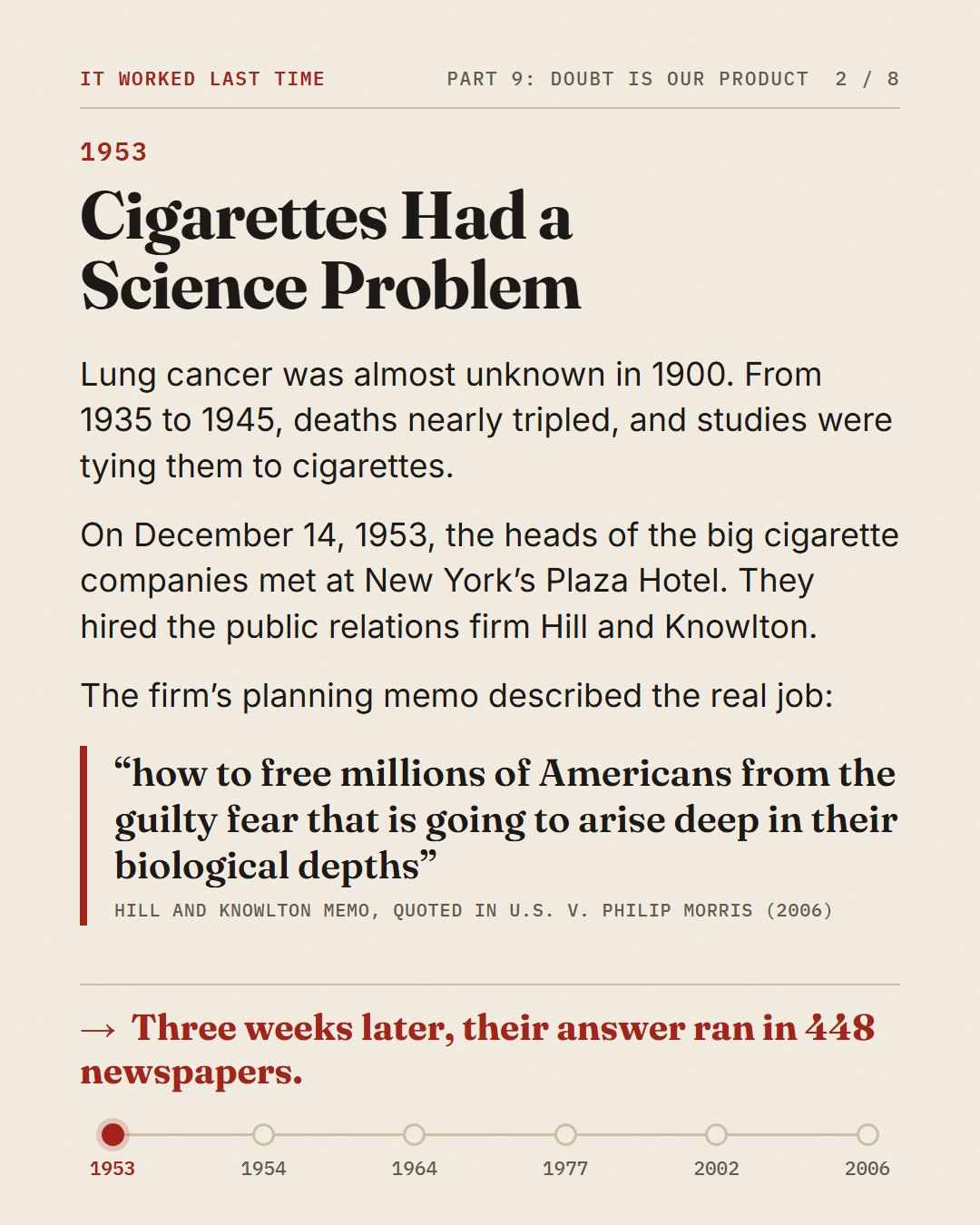
On December 14, 1953, the heads of America’s biggest cigarette companies met at the Plaza Hotel in New York City. Paul Hahn, president of the American Tobacco Company, had invited them by telegram to plan an industry response to the studies linking cigarettes to lung cancer2.
The fear had a real cause. Before 1900, lung cancer was almost unknown as a cause of death in the United States. By 1935 it killed an estimated 4,000 Americans a year, and by 1945 that number had almost tripled2. Smoking soared over the same years, from about 49 cigarettes per person per year in 1900 to more than 3,000 in 19502. Large studies tied the two together, and popular magazines carried the findings to the public2.
The next day, several executives met John W. Hill, president of the public relations firm Hill and Knowlton, at the same hotel2. They told him they saw the problem “as being extremely serious and worthy of drastic action”2. On December 24, the firm sent its plan: form a joint industry research committee, announce it in news stories and paid advertisements, and recruit an advisory board of distinguished scientists2.
A Frank Statement
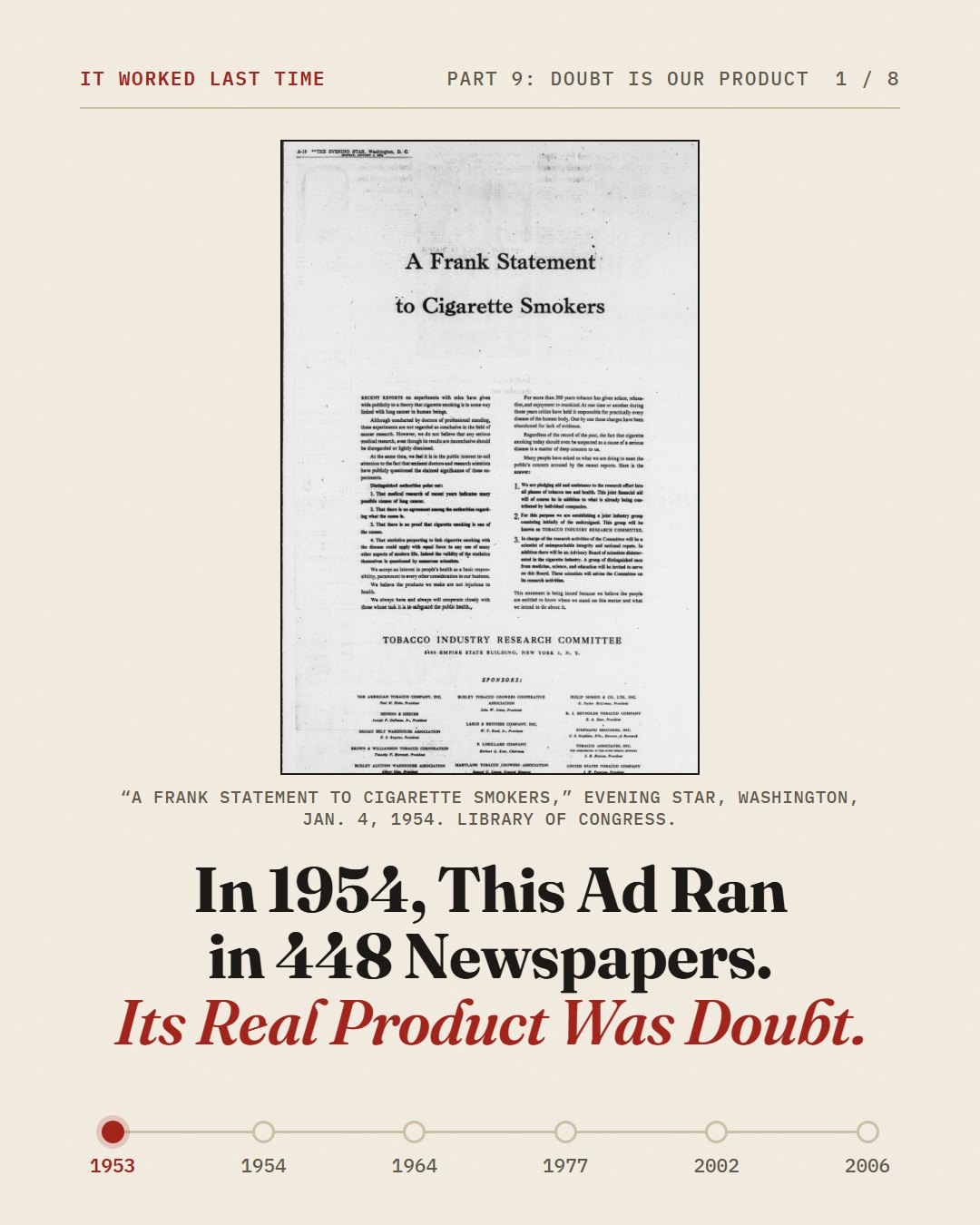
On Monday, January 4, 1954, readers of 448 newspapers found a full-page advertisement titled “A Frank Statement to Cigarette Smokers”2. In Washington, it filled page A-16 of the Evening Star1. The presidents of the major cigarette makers signed it, along with growers’ and warehouse groups, under the name of a new Tobacco Industry Research Committee1. The Associated Press covered it the same day3.
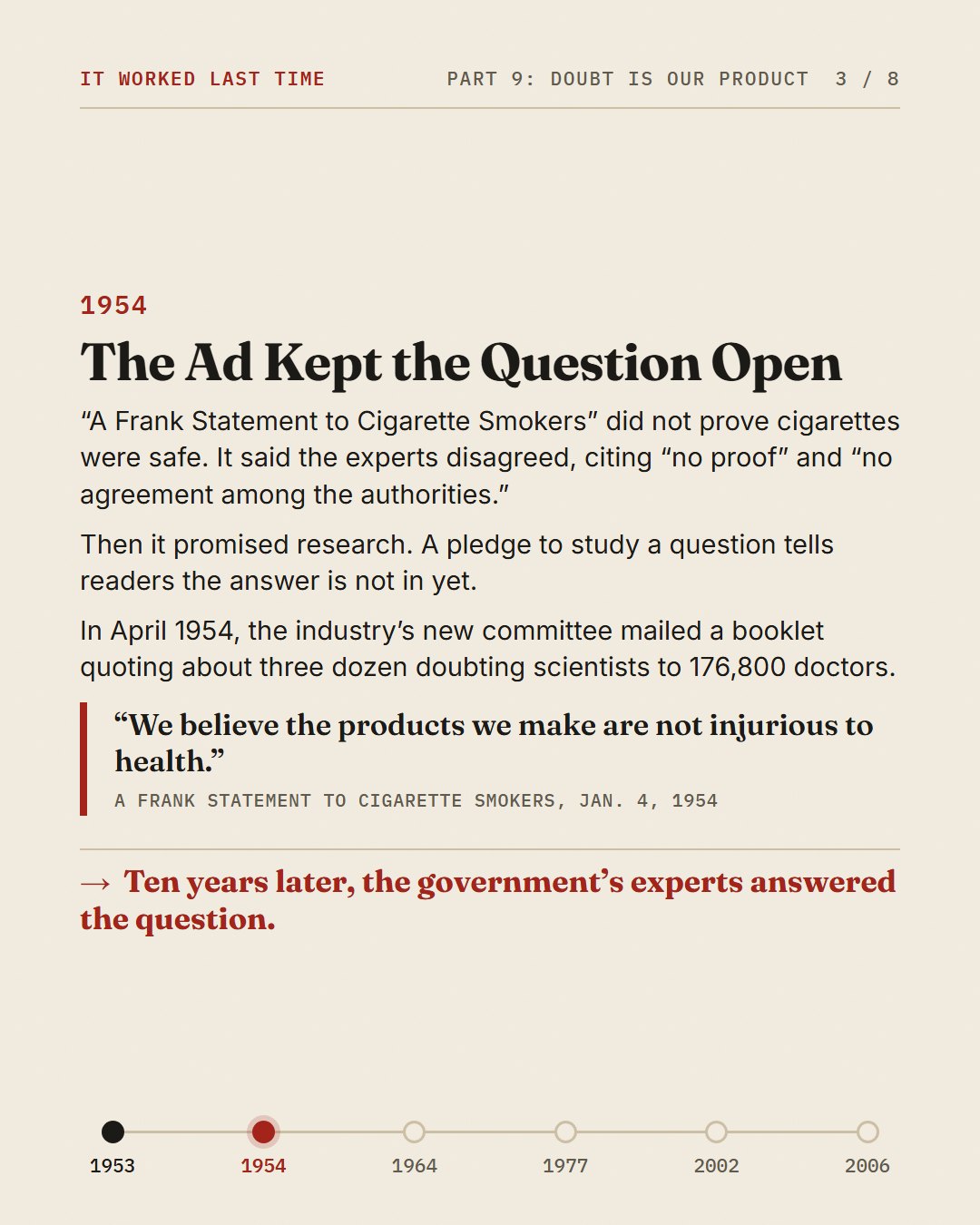
The ad did not claim cigarettes had been proven safe. It claimed the question was open. Under the line “Distinguished authorities point out,” it listed: “That there is no agreement among the authorities regarding what the cause is” and “That there is no proof that cigarette smoking is one of the causes”1. Then came the reassurance: “We believe the products we make are not injurious to health”1. The companies pledged “aid and assistance to the research effort into all phases of tobacco use and health”1.
Read literally, the ad promises to find the truth. It worked as something else. A pledge to fund research tells a reader the answer is not in yet. A list of doubting authorities tells her the experts are split. Neither claim has to be proven. The smoker only has to leave the page believing the jury is still out, and keep buying cigarettes while it deliberates.
The receipts surfaced decades later, in court. Minutes of the first meeting show the executives wanted to enlist the National Institutes of Health because it “would give to the program an aspect of independence”2. John Hill doubted that simply calling the harms “unproven” would persuade anyone, so he advised putting the word “research” in the committee’s name2. A Hill and Knowlton planning memo described the real assignment: how “to free millions of Americans from the guilty fear” that would rise “every time they light a cigarette”2. The judge who later heard the case found the executives had not met “in an altruistic response” to scientists; they had “convened a strategy meeting”2.
The cigarette companies paid for all of it. The target was the smoker, reached through the people smokers trusted. In April 1954, the committee mailed a booklet quoting “some three dozen scientists and researchers” who questioned the evidence to 176,800 doctors, and to 15,000 editors, broadcasters, and members of Congress2. As for the promised research, an internal industry evaluation later conceded that most of it was “of a broad, basic nature not designed to specifically test the anti-cigarette theory”4.
Ten years later, the government’s own experts took up the question the ad called open.
Doubt Is Our Product
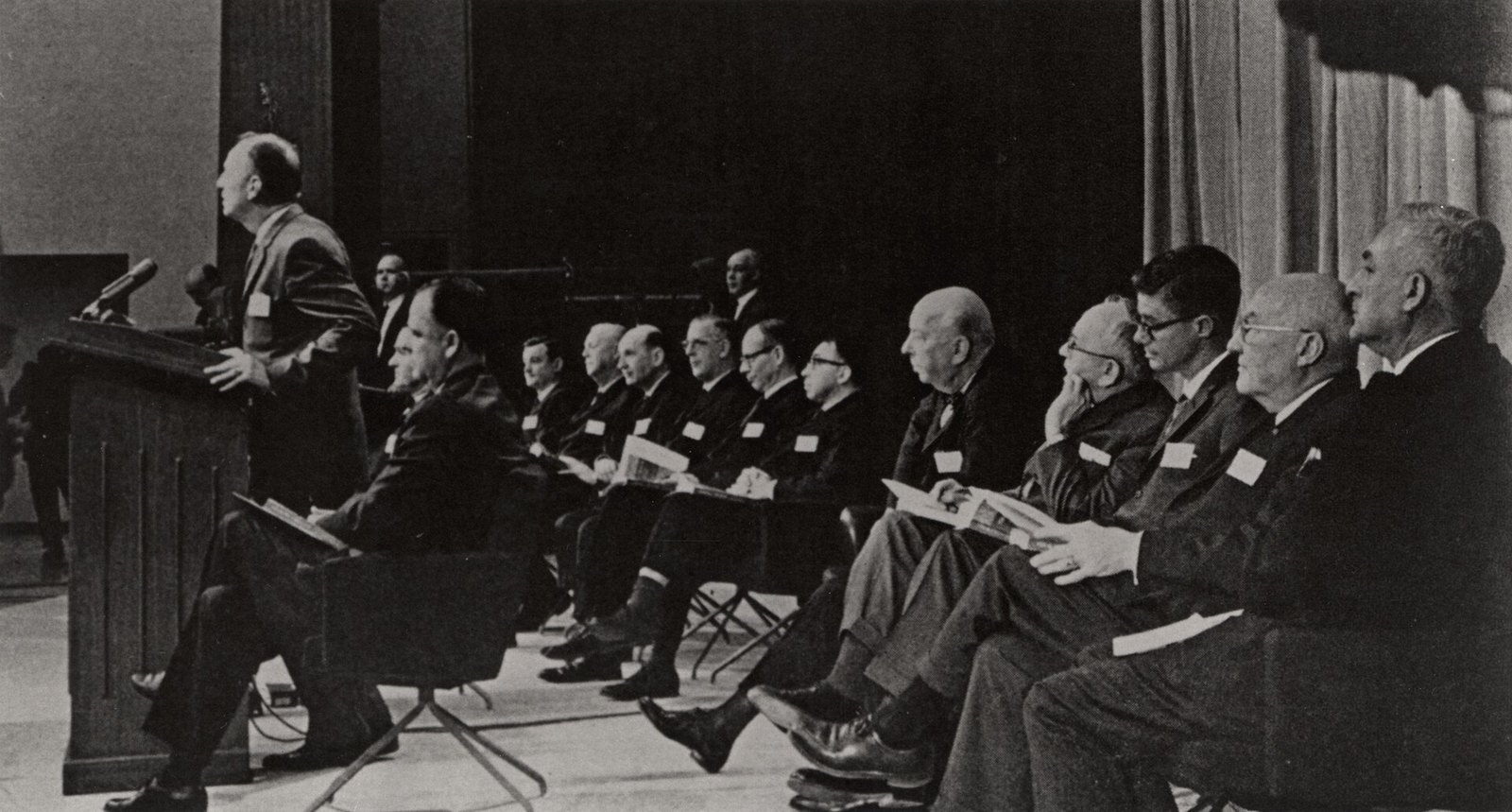

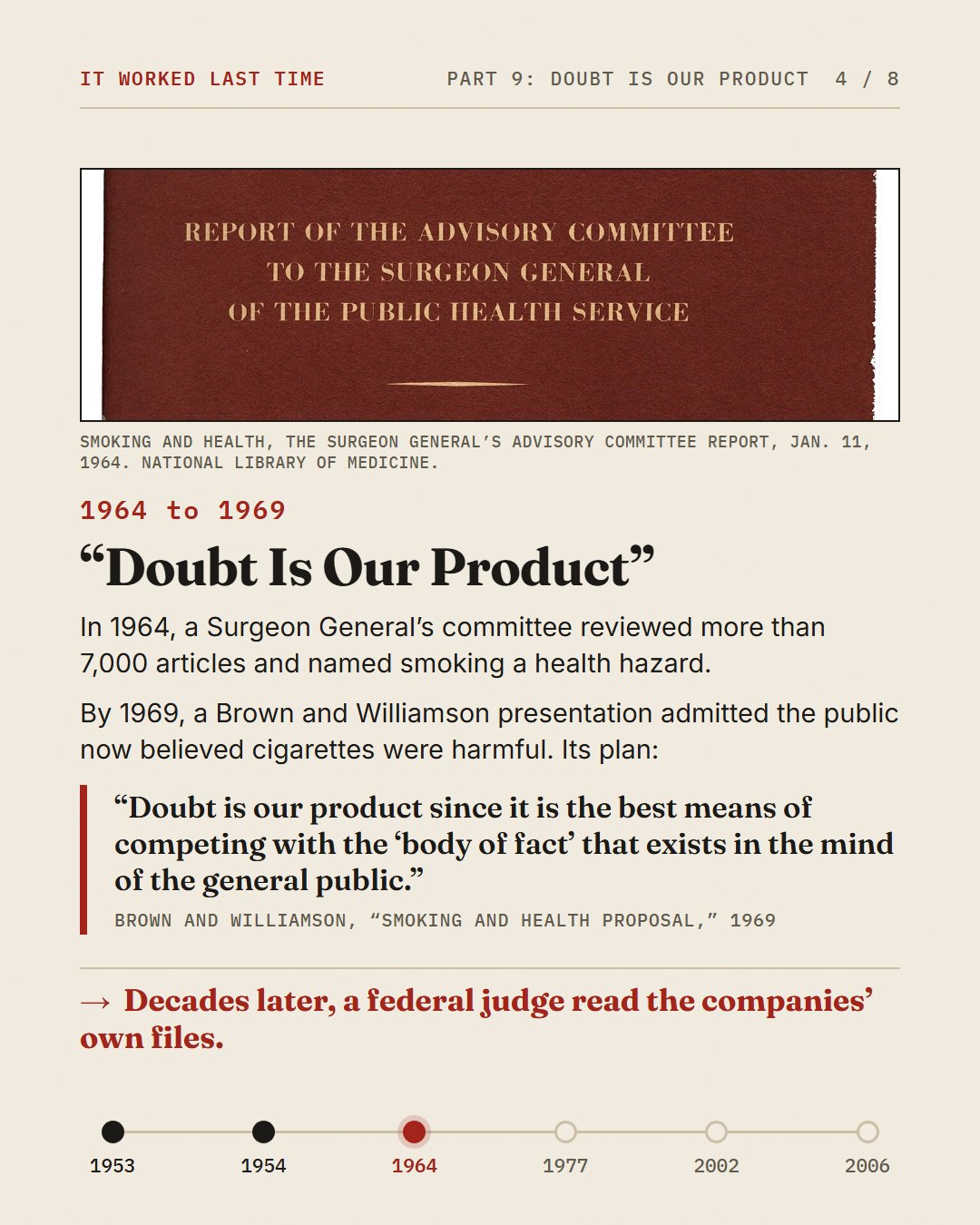
On Saturday, January 11, 1964, Surgeon General Luther Terry released Smoking and Health. His ten-member advisory committee had reviewed more than 7,000 scientific articles5. The Tobacco Institute, the industry’s lobby, had been invited to nominate members, and no one who had already taken a stand on tobacco could serve5. The report concluded that “cigarette smoking is a health hazard of sufficient importance in the United States to warrant appropriate remedial action”5. The public moved: in 1958, 44 percent of Americans told Gallup that smoking caused cancer, and by 1968, 78 percent did5.
In 1969, an internal Brown and Williamson presentation titled “Smoking and Health Proposal” treated the problem like the launch of a new brand. “Our consumer I have defined as the mass public, our product as doubt, our message as truth,” it said6. Then it named the method: “Doubt is our product since it is the best means of competing with the ‘body of fact’ that exists in the mind of the general public. It is also the means of establishing a controversy”62.
The same pages explain why. The presentation admits that “with the general public the consensus is that cigarettes are in some way harmful to the health,” and that the company could not argue the opposite: “No information that we have supports such a claim”6. So it would not try to win the argument. It would keep one going, aimed at the public because the public is “the prime force in influencing Congress and federal agencies”6. A 1968 Tobacco Institute memo gave the press the same treatment: “The most important type of story is that which casts doubt on the cause and effect theory of disease and smoking”2.
For decades, those files stayed private. Then the government took the companies to court.
The Receipt in Court
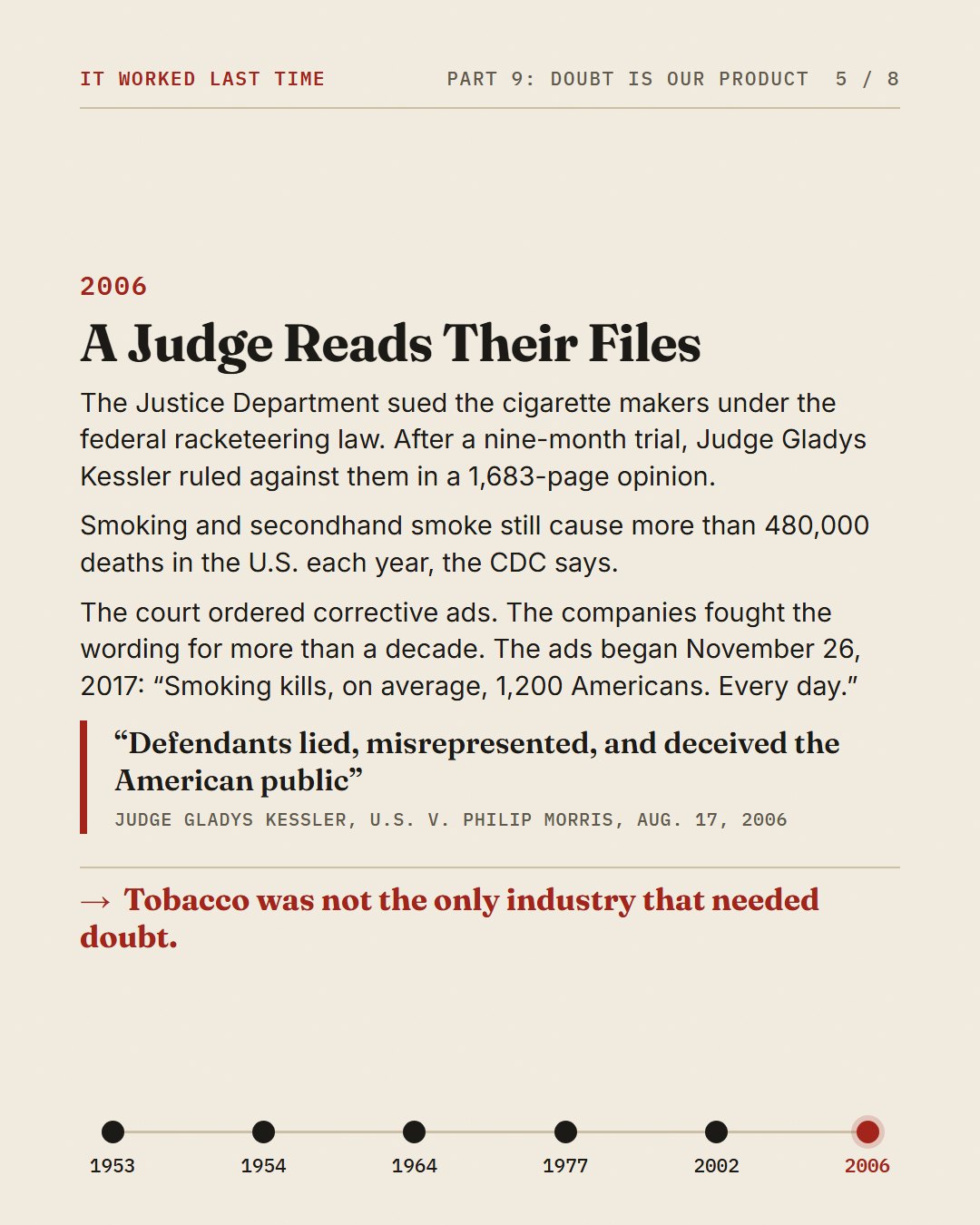
In 1999, the Justice Department sued the major cigarette makers under the federal racketeering law, known as RICO9. The trial ran about nine months, with 84 witnesses testifying in open court2. On August 17, 2006, Judge Gladys Kessler issued a 1,683-page opinion. As she later summarized it, the court found that the companies “had for decades conspired to deny the health effects of smoking in violation of RICO”29.
Her findings retell this story from the companies’ own files, from the Plaza Hotel to the “Doubt is our product” presentation2. Then she put it in plain words: “Put more colloquially, and less legalistically, over the course of more than 50 years, Defendants lied, misrepresented, and deceived the American public, including smokers and the young people they avidly sought as ‘replacement smokers,’ about the devastating health effects of smoking and environmental tobacco smoke”2.
The cost is counted in lives. The CDC says smoking and secondhand smoke cause more than 480,000 deaths in the United States each year7. In the half century after the 1964 report, it counts 20 million deaths from smoking, including 2.5 million nonsmokers killed by secondhand smoke8.
The judge ordered the companies to publish corrective statements9. They fought over the wording for more than a decade10. The appeals court agreed with them on one point, that the opening words “Here is the truth” implied past wrongdoing, and otherwise largely affirmed her911. The statements finally began running in newspapers on November 26, 2017, and on prime-time television over the following year10. One begins: “Smoking kills, on average, 1,200 Americans. Every day.”9
Tobacco was not the only industry that needed doubt.
What Exxon’s Scientists Knew
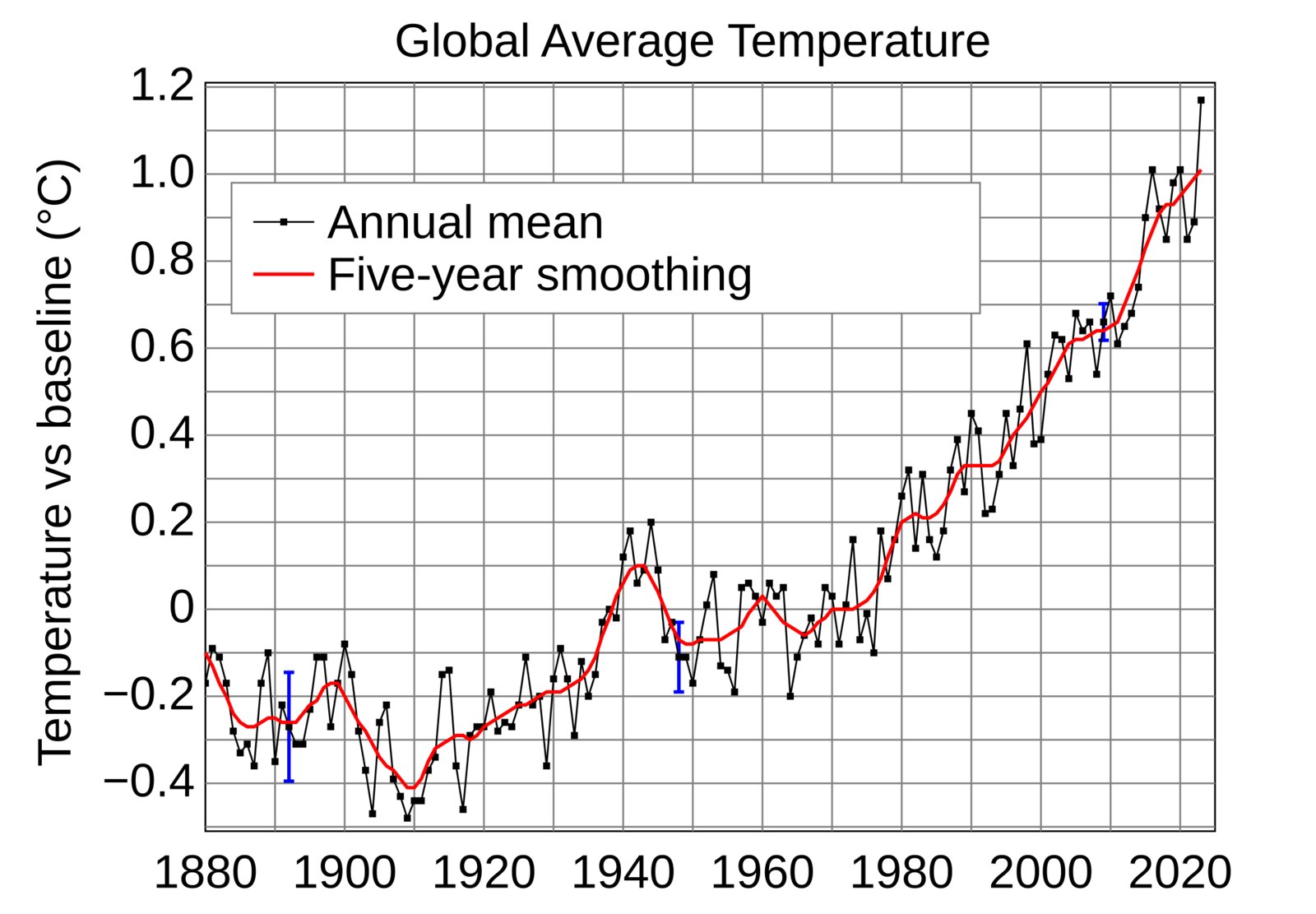

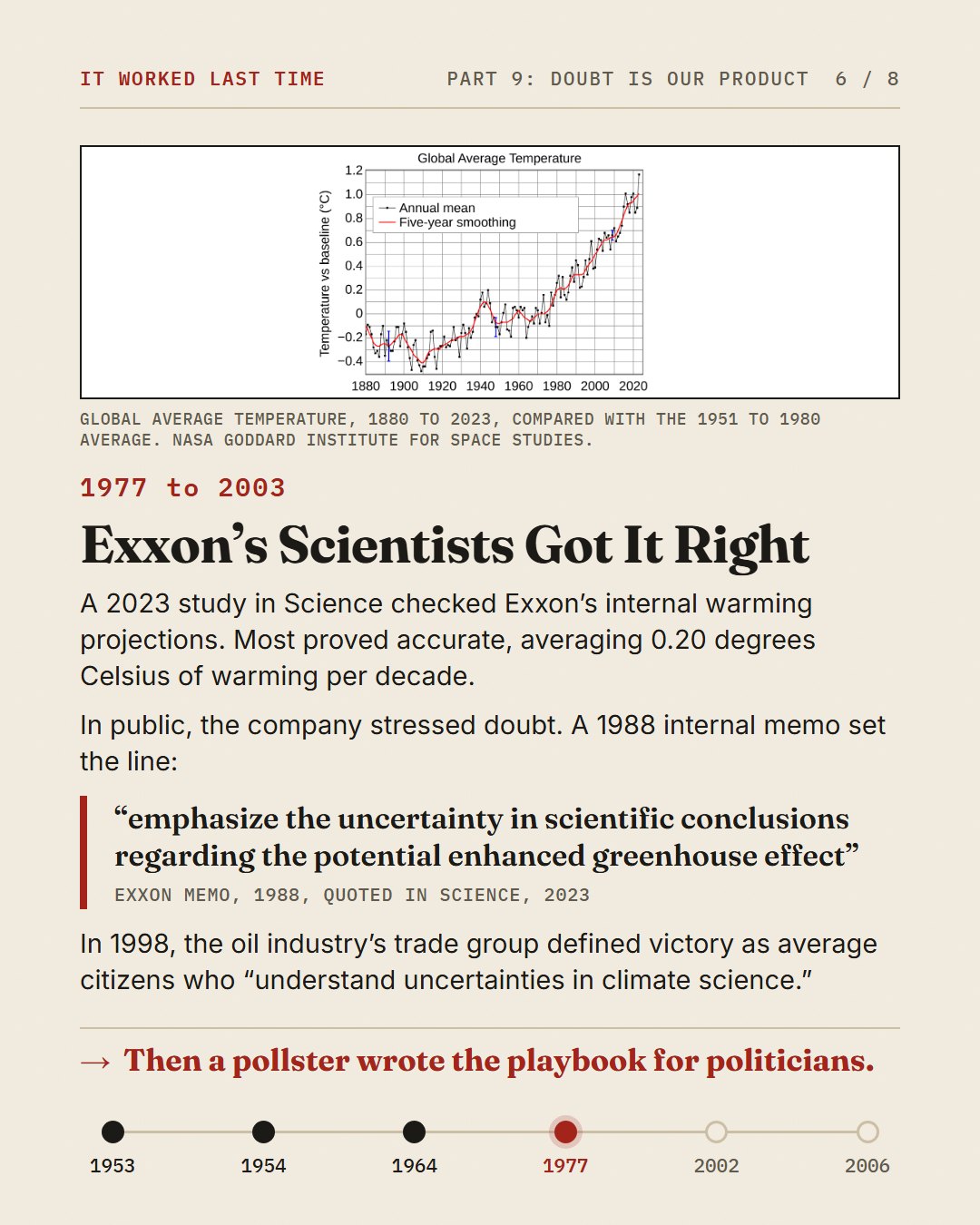
In the late 1970s and 1980s, Exxon ran its own climate research. Its scientists built their own models and published in peer-reviewed journals12. In January 2023, the journal Science published an analysis by Geoffrey Supran, Stefan Rahmstorf, and Naomi Oreskes of all available global warming projections that Exxon and ExxonMobil scientists reported between 1977 and 200312.
The projections were right. Depending on the measure, 63 to 83 percent accurately forecast the warming that followed. On average, they projected 0.20 degrees Celsius of warming per decade, about the same as independent government and academic models12. The company’s scientists also rejected the idea of a coming ice age and predicted that human-caused warming would first be detectable around the year 2000, give or take five years12.
The company’s public voice said something else. A 1988 internal memo described its public affairs strategy: to “emphasize the uncertainty in scientific conclusions regarding the potential enhanced greenhouse effect”12. In 1999, chief executive Lee Raymond said future climate “projections are based on completely unproven climate models, or, more often, sheer speculation”12. An earlier study by Supran and Oreskes found that most of the company’s public communications promoted doubt, while its internal documents and published papers overwhelmingly said climate change was real and human-caused12.
The doubt had organized backing. In April 1998, months after the Kyoto climate agreement, the American Petroleum Institute, the oil industry’s trade group, circulated a “Global Climate Science Communications Action Plan” developed with people from Exxon, Chevron, and the Southern Company14. It defined success in one sentence: “Victory will be achieved when average citizens understand uncertainties in climate science, recognition of uncertainties becomes part of the conventional wisdom”1514. That is the 1969 presentation with new nouns. The goal was not to prove the planet was not warming. It was to make voters believe the experts had not made up their minds. The warming arrived as the company’s own scientists had projected12.
In 2002, a pollster wrote the same advice for politicians.
The Playbook Goes to Washington


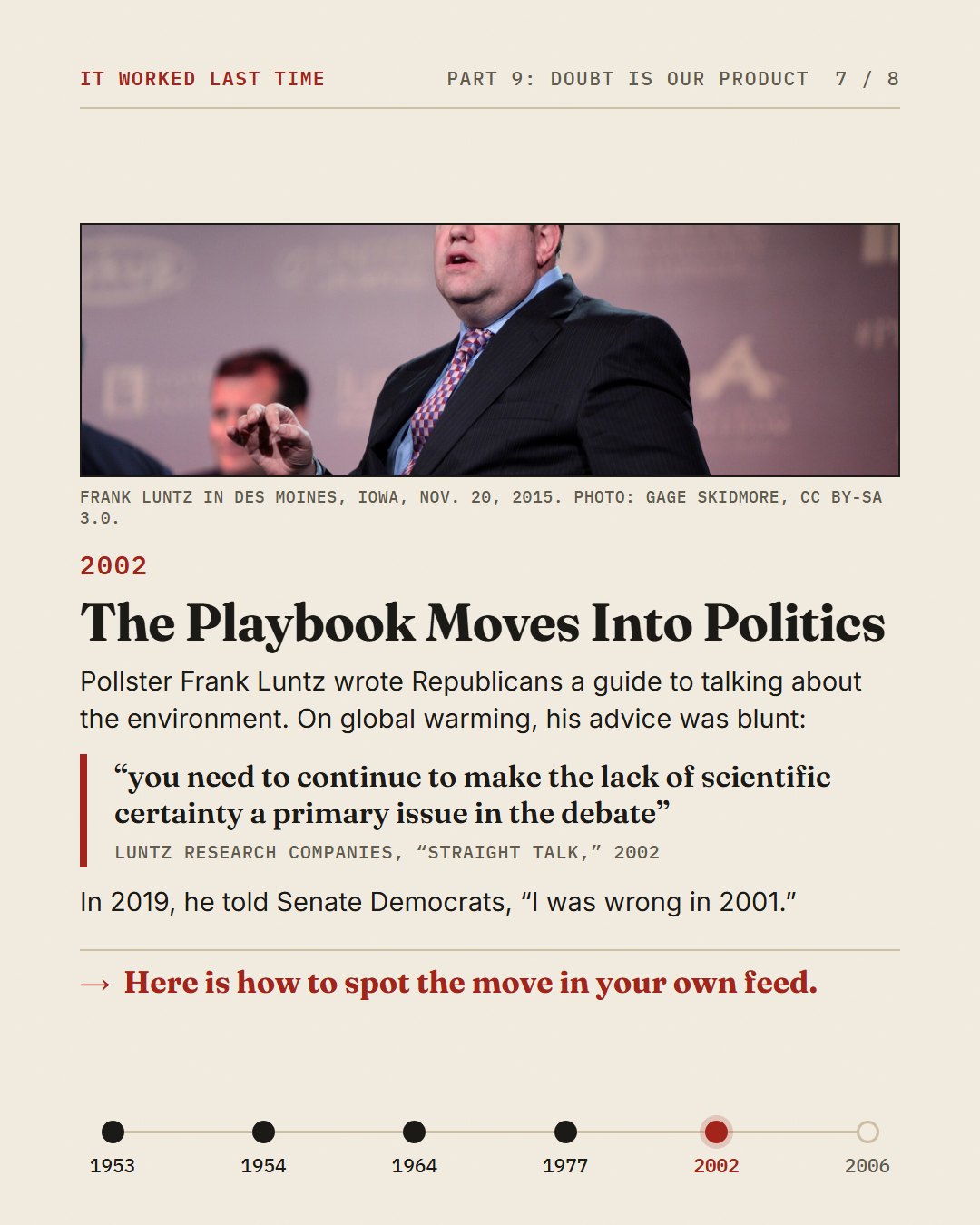
In 2002, the Republican consultant and pollster Frank Luntz wrote Republicans a messaging guide titled “The Environment: A Cleaner, Safer, Healthier America,” part of his firm’s Straight Talk briefing book16. The Guardian reported its contents in March 2003, after the Environmental Working Group obtained a copy17.
Its climate page, headed “Winning the Global Warming Debate,” states the move plainly: “Voters believe that there is no consensus about global warming within the scientific community. Should the public come to believe that the scientific issues are settled, their views about global warming will change accordingly. Therefore, you need to continue to make the lack of scientific certainty a primary issue in the debate, and defer to scientists and other experts in the field”16.
The next page adds: “The scientific debate is closing [against us] but not yet closed. There is still a window of opportunity to challenge the science”16. It urges “recruiting experts who are sympathetic to your view” and supplies a ready-made line: “After all, just 20 years ago scientists were worried about a new Ice Age”16. Exxon’s own scientists had rejected that ice age claim years earlier12. The guide even explains why the approach works: “A compelling story, even if factually inaccurate, can be more emotionally compelling than a dry recitation of the truth”16.
The same approach appeared inside the government. Philip Cooney spent more than 15 years at the American Petroleum Institute, the oil industry’s trade group, then served from 2001 to 2005 as chief of staff of the White House Council on Environmental Quality15. Under oath in 2007, he confirmed that he had inserted the words “indicated as potentially” into a draft of the government’s climate science strategic plan, ahead of effects scientists had linked to recent warming15. A committee member counted 181 of his edits to that plan that added uncertainty15. NASA climate scientist James Hansen testified that such edits “consistently are always of one nature, and that is to raise doubt”15. By 2007, Cooney worked for ExxonMobil15.
Strip away the names and the decades, and the same steps repeat.
The Pattern
The move is simple. You do not need to win the argument. You only need people to believe the experts are still arguing. A smoker who thinks the jury is out keeps smoking. A voter who thinks scientists disagree does not demand action. Delay is the goal, and doubt is how it is delivered.
It runs in the same steps each time. Find a real uncertainty at the edges of the science, because every science has some. Quote or fund the few experts who dissent, and give them equal billing. Promise more research, which signals the answer is not in. Dress it in the language of fairness: “sound science,” “all the facts,” both sides. Aim it at the public, which in turn moves lawmakers.
The numbers on each side were never close. In 1954, the industry’s booklet quoted about three dozen doubters2. In 1964, the Surgeon General’s committee weighed more than 7,000 articles5. In climate science, a 2021 review of 88,125 papers published since 2012 put agreement that humans are causing climate change above 99 percent; in a random sample of 3,000 of those papers, the authors found four that rejected it21. One dissenting expert is a story, not a statistic.
Decent people believed it for decent reasons. Science really does revise itself. Fairness says to hear both sides. Smokers had every reason to hope the doubters were right, and few readers had time to count studies. The move borrows real virtues, open-mindedness and caution, and turns them into a reason to wait. And it travels: a sales problem for cigarette makers became, by 2002, written advice for a political party, and by 2003, edits to a federal science plan1615.
The Rerun
On July 29, 2025, the Department of Energy published “A Critical Review of Impacts of Greenhouse Gas Emissions on the U.S. Climate,” written by five scientists chosen by Energy Secretary Chris Wright: John Christy, Judith Curry, Steven Koonin, Ross McKitrick, and Roy Spencer2223. That summer, the Environmental Protection Agency cited it when it proposed repealing the agency’s 2009 finding that greenhouse gases endanger public health and welfare2928.
The report says it “reviews scientific certainties and uncertainties,” and it states that “Attribution of climate change or extreme weather events to human CO2 emissions is challenged by natural climate variability, data limitations, and inherent model deficiencies”23. In his foreword, Wright wrote: “Climate change is real, and it deserves attention. But it is not the greatest threat facing humanity.”23
The independent record answered within weeks. On September 2, 2025, more than 85 climate scientists, edited by Andrew Dessler and Robert Kopp, published a review finding the report’s key assertions “misleading or fundamentally incorrect”24. On September 17, 2025, the National Academies of Sciences, Engineering, and Medicine concluded that the evidence of harm to Americans’ health and welfare from human-caused greenhouse gases “is beyond scientific dispute,” and that the 2009 finding “was accurate, has stood the test of time, and is now reinforced by even stronger evidence”25.
On January 30, 2026, federal judge William G. Young ruled that the group “was not exempt from the requirements of FACA,” the Federal Advisory Committee Act, a 1972 law that requires advisory panels to meet in public and keep open records2627. When the EPA finalized the repeal in February 2026, it rested on a legal argument about the agency’s authority and said it was “not relying on” the Energy Department report “for any aspect of this final action”28.
The count is in the record: five authors on one side; on the other, a review by more than 85 scientists and a report from the National Academies232425. The record shows the process and the numbers. It does not show anyone’s private intent.
Their Defense
The cigarette makers’ defense in 1954 was the ad itself: “We always have and always will cooperate closely with those whose task it is to safeguard the public health”1. In court, they suggested the 1953 meetings were a response to scientists asking the industry to fund research; the judge rejected that account2. On the corrective statements, they argued that the words “Here is the truth” implied past wrongdoing, and the appeals court agreed9.
ExxonMobil answered the 2023 study through spokesperson Todd Spitler: “Exxon Mobil’s understanding of climate science has developed along with that of the broader scientific community.” He said “our answer is the same: Those who talk about how ‘Exxon Knew’ are wrong in their conclusions”13.
Philip Cooney told the House committee that his comments “were aligned with the findings of the National Academy of Sciences in June 2001.” Asked about the oil industry’s 1998 plan, he said: “It had truly nothing to do with my prior employment at the American Petroleum Institute”15.
Frank Luntz recanted. In July 2019, he told the Senate Democrats’ Special Committee on the Climate Crisis: “I’m here before you to say that I was wrong in 2001.” He added: “Just stop using something that I wrote 18 years ago, because it’s not accurate today”1819. His written testimony that day said “America believes climate change is real, that it is man-made”20. He dated the memo to 2001; The Guardian reported it was produced in 200217.
Secretary Wright’s defense is in his foreword: “I exerted no control over their conclusions,” he wrote, and “To correct course, we need open, respectful, and informed debate”23.
How Not to Fall for It
Ask how many experts are on each side. Count studies and scientific bodies, not quoted spokesmen. Three dozen quotes against more than 7,000 articles, or four papers in a sample of 3,000, is not a debate2521.
Ask who paid. A “research committee” or a working group can be a sales tool. Check who funds it and who chose its members.
Ask what “more research” would settle. Honest uncertainty points to a specific open question. A doubt campaign asks for more study no matter what the last study found.
Notice fairness words. “Sound science,” “all the facts,” and “both sides” are good ideas. They become tools when one side is a handful of people and the other is nearly everyone in the field.
Ask what you are being asked to do. Doubt campaigns rarely ask you to believe anything. They ask you to wait. In this story, the waiting was counted in lives.
Sources
- 1"A Frank Statement to Cigarette Smokers" (advertisement), Evening Star, Washington, D.C., January 4, 1954, page A-16. Library of Congress, Chronicling America. 1954-01-04. loc.gov/resource/sn83045462/1954-01-04/ed-1/?sp=16
- 2United States v. Philip Morris USA Inc., Final Opinion, Civil Action No. 99-2496 (GK), Document 5732, 449 F. Supp. 2d 1. U.S. District Court for the District of Columbia, via GovInfo. 2006-08-17. govinfo.gov/content/pkg/USCOURTS-dcd-1_99-cv-02496/pdf/USCOURTS-dcd-1_
- 3"Cigarette Makers Plan Own Research On Cancer Question" (Associated Press), Evening Star, January 4, 1954, page A-6. Library of Congress, Chronicling America. 1954-01-04. loc.gov/resource/sn83045462/1954-01-04/ed-1/?sp=6
- 4Inventing Conflicts of Interest: A History of Tobacco Industry Tactics (Allan M. Brandt), American Journal of Public Health 102(1):63 to 71. American Public Health Association, via PubMed Central. 2012-01. pmc.ncbi.nlm.nih.gov/articles/PMC3490543/
- 5The Reports of the Surgeon General: The 1964 Report on Smoking and Health. National Library of Medicine, Profiles in Science. profiles.nlm.nih.gov/spotlight/nn/feature/smoking
- 6Smoking and Health Proposal (Brown and Williamson), Bates 690010951 to 690010959. UCSF Truth Tobacco Industry Documents (document psdw0147). 1969. industrydocuments.ucsf.edu/docs/psdw0147
- 7Cigarette Smoking. Centers for Disease Control and Prevention. 2024-09-17. cdc.gov/tobacco/about/index.html
- 850th Anniversary Surgeon General's Report on Smoking and Health. Centers for Disease Control and Prevention (archived page). 2014. archive.cdc.gov/www_cdc_gov/tobacco/sgr/50th-anniversary/index.htm
- 9United States v. Philip Morris USA Inc., Memorandum Opinion, Document 6209. U.S. District Court for the District of Columbia, via GovInfo. 2017-06-27. govinfo.gov/content/pkg/USCOURTS-dcd-1_99-cv-02496/pdf/USCOURTS-dcd-1_
- 10Tobacco Companies Begin Issuing Corrective Statements (Robert Croyle and Michele Bloch), Cancer Currents blog. National Cancer Institute. 2017-11-28. cancer.gov/news-events/cancer-currents-blog/2017/tobacco-corrective-st
- 11United States v. Philip Morris USA Inc., Memorandum Opinion and Order, Document 6249. U.S. District Court for the District of Columbia, via GovInfo. 2018-02-27. govinfo.gov/content/pkg/USCOURTS-dcd-1_99-cv-02496/pdf/USCOURTS-dcd-1_
- 12Assessing ExxonMobil's global warming projections (G. Supran, S. Rahmstorf, N. Oreskes), Science 379, eabk0063. Science (AAAS). 2023-01-13. doi.org/10.1126/science.abk0063
- 13Exxon's own models predicted global warming. It ignored them. (Chelsea Harvey, Lesley Clark, Benjamin Storrow). E&E News. 2023-01-13. eenews.net/articles/exxons-own-models-predicted-global-warming-it-igno
- 141998 American Petroleum Institute Global Climate Science Communications Team Action Plan. Climate Files (Climate Investigations Center). 1998-04-03. climatefiles.com/trade-group/american-petroleum-institute/1998-global-
- 15Allegations of Political Interference with Government Climate Change Science, Hearing, Committee on Oversight and Government Reform, Serial No. 110-21. U.S. House of Representatives, via GovInfo. 2007-03-19. govinfo.gov/content/pkg/CHRG-110hhrg37415/pdf/CHRG-110hhrg37415.pdf
- 16The Environment: A Cleaner, Safer, Healthier America, in Straight Talk (The Luntz Research Companies), pages 131 to 145. Scan hosted by DeSmog. 2002. desmog.com/wp-content/uploads/files/Luntz%20Memo.pdf
- 17Memo exposes Bush's new green strategy (Oliver Burkeman), The Guardian, March 4, 2003 (reprinted by CorpWatch). The Guardian, via CorpWatch. 2003-03-04. corpwatch.org/article/usa-memo-exposes-bushs-new-greenwash-strategy
- 18The GOP's most famous messaging strategist calls for climate action (Kate Yoder). Grist. 2019-07-25. grist.org/article/the-gops-most-famous-messaging-strategist-calls-for-
- 19Luntz: 'I was wrong' on climate change (Anthony Adragna, Politico). Politico, via Yahoo News. 2019-08. yahoo.com/news/luntz-wrong-climate-change-161103780.html
- 20Testimony of Dr. Frank I. Luntz, Senate Democrats' Special Committee on the Climate Crisis. Office of Sen. Brian Schatz. 2019-07-25. schatz.senate.gov/download/frank-luntz-testimony?download=1
- 21Greater than 99% consensus on human caused climate change in the peer-reviewed scientific literature (M. Lynas, B. Z. Houlton, S. Perry), Environmental Research Letters 16, 114005. IOP Publishing. 2021-10-19. doi.org/10.1088/1748-9326/ac2966
- 22Department of Energy Issues Report Evaluating Impact of Greenhouse Gasses on U.S. Climate, Invites Public Comment. U.S. Department of Energy. 2025-07-29. energy.gov/node/4851912
- 23A Critical Review of Impacts of Greenhouse Gas Emissions on the U.S. Climate (Climate Working Group). U.S. Department of Energy. 2025-07-23. energy.gov/sites/default/files/2025-07/DOE_Critical_Review_of_Impacts_
- 24Climate Experts' Review of the DOE Climate Working Group Report (A. E. Dessler and R. E. Kopp, editors). Texas A&M University site. 2025-09-02. sites.google.com/tamu.edu/doeresponse
- 25National Academies Publish New Report Reviewing Evidence for Greenhouse Gas Emissions and U.S. Climate, Health, and Welfare. National Academies of Sciences, Engineering, and Medicine. 2025-09-17. nationalacademies.org/news/national-academies-publish-new-report-revie
- 26Climate Working Group Violated Federal Law, Court Declares (Shayna Greene). Bloomberg Law. 2026-01-30. news.bloomberglaw.com/environment-and-energy/climate-working-group-vio
- 27Trump DOE's climate skepticism effort violated federal law, judge rules (Hayley Smith, Los Angeles Times). Los Angeles Times, via Society of Environmental Journalists. 2026-01-30. sej.org/node/52079
- 28Rescission of the Greenhouse Gas Endangerment Finding and Motor Vehicle Greenhouse Gas Emission Standards Under the Clean Air Act (final rule). Federal Register (EPA). 2026-02-18. federalregister.gov/documents/2026/02/18/2026-03157/rescission-of-the-
- 29Trump Administration Dropped Controversial Climate Report From Its Decision to Rescind EPA Endangerment Finding (Dennis Pillion). Inside Climate News. 2026-02-13. insideclimatenews.org/news/13022026/controversial-climate-report-dropp
Image Credits
- "A Frank Statement to Cigarette Smokers" (full-page advertisement), Evening Star, Washington, D.C., page A-16, cropped to the ad. Tobacco Industry Research Committee (advertiser); page scan by the Library of Congress, National Digital Newspaper Program. 1954-01-04. Public domain in the U.S.: the ad was published in 1954 with no copyright notice (Wikimedia Commons hosts the same ad as PD-US-no-notice, File:A_Frank_Statement.png). The Library of Congress states Chronicling America newspapers are believed to be public domain or to have no known copyright restrictions.. Source
- Cover of Smoking and Health: Report of the Advisory Committee to the Surgeon General of the Public Health Service. U.S. Public Health Service, Office of the Surgeon General; scan by the National Library of Medicine. 1964-01-11. Public domain (U.S. federal government work, PD-US NIH), via Wikimedia Commons; original at https://collections.nlm.nih.gov/catalog/nlm:nlmuid-101584932X814-img. Source
- U.S. Surgeon General Luther Terry at the 1964 Smoking and Health press conference. National Institutes of Health. 1964-01-11. Public domain (U.S. federal government work, PD-US NIH), via Wikimedia Commons; source credited as https://www.govinfo.gov/features/anniversary-report-smoking-health. Source
- Global Average Temperature (land-ocean temperature index, 1880 to 2023, 1951 to 1980 baseline). NASA Goddard Institute for Space Studies (chart redrawn from GISS data by Wikimedia contributors). 2024-01-28 (latest data update of the chart). Public domain (NASA data and graphic, PD-USGov-NASA), via Wikimedia Commons; rendered to PNG at 1920 px. Source
- Frank Luntz speaking at an event in Des Moines, Iowa. Gage Skidmore. 2015-11-20. CC BY-SA 3.0 (attribution required: Gage Skidmore), via Wikimedia Commons. Source
