International Bankers
A forged Russian document “proved” a secret Jewish plot to rule the world through money, and Henry Ford’s newspaper spread it across America and, in translation, into Germany, where it helped shape a future Nazi youth leader. The plot survived its exposure under a polite name: “international bankers.”
The Graphics
Swipe through the slides as they appear on Instagram and Facebook. Tap any slide to open it full size.
The Carousel




The Book on the Witness Stand
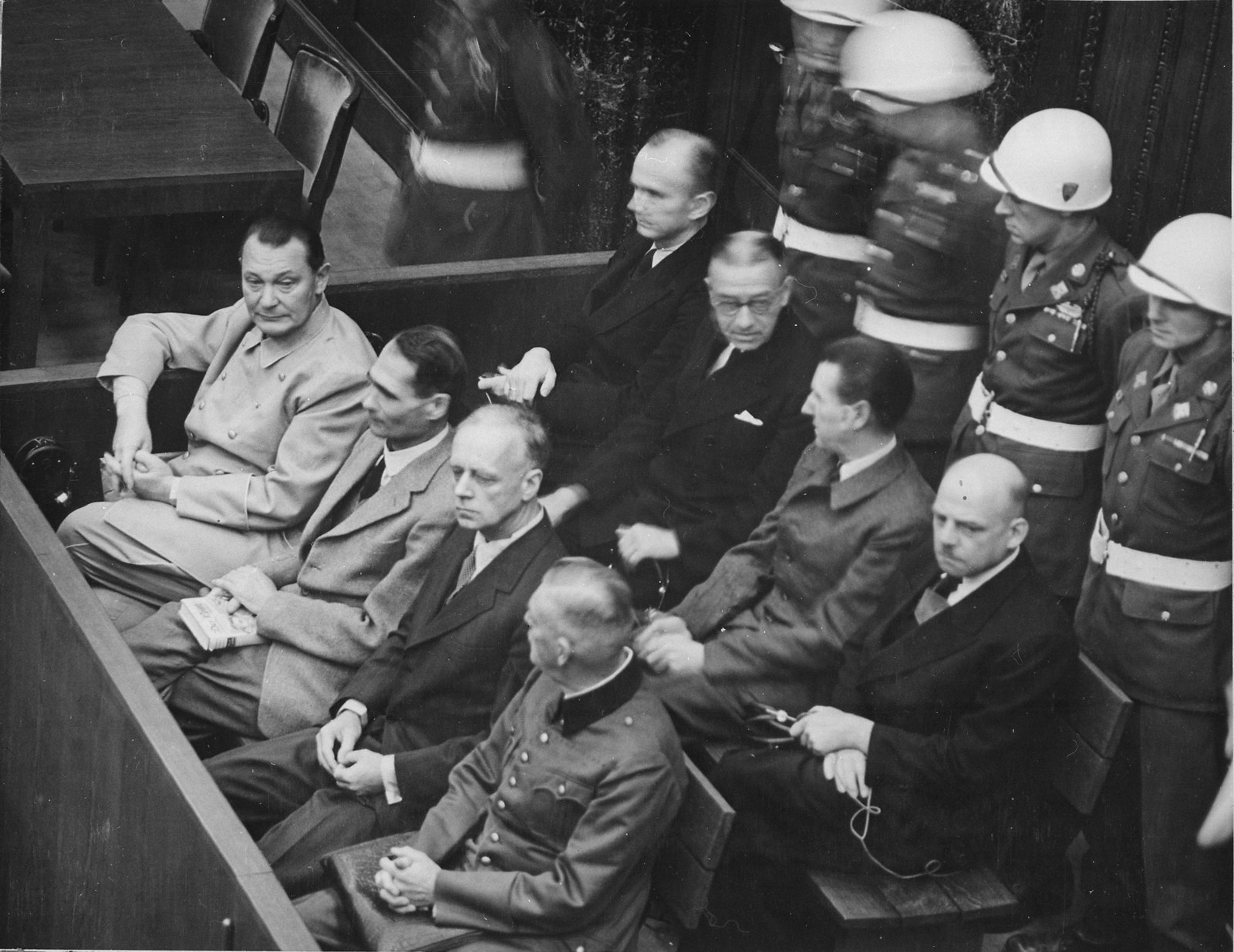

On May 23, 1946, in the courtroom at Nuremberg, Baldur von Schirach took the stand in his own defense1. He had led every youth organization of the Nazi Party, including the Hitler Youth, from 1931, and in 1940 he became the Nazi governor of Vienna2.
His lawyer asked how he had become an antisemite. Schirach began listing the books he read as a young man, and the president of the tribunal cut him off: the court did not want “the full story of the defendant’s education”1. Schirach got one more answer in. “The decisive anti-Semitic book which I read at that time and the book which influenced my comrades... was Henry Ford’s book, The International Jew; I read it and became anti-Semitic,” he said. “In those days this book made such a deep impression on my friends and myself because we saw in Henry Ford the representative of success, also the exponent of a progressive social policy”1.
Schirach was not on trial for what he read. The tribunal found that, as governor of Vienna, he took part in deporting the city’s Jews, and it sentenced him to 20 years in prison2,3. But his answer raises a question. How did a book from a Michigan carmaker’s newspaper become, by a Nazi leader’s own account, the book that made him hate Jews? It started with a forgery.
A Meeting That Never Happened


In April 1903, in the city of Kishinev in the Russian Empire, residents turned on their Jewish neighbors for three days. They wounded hundreds and murdered more than 404. Antisemitic articles in a newspaper owned by Pavel Krushevan helped incite the attack4.
That fall, another Krushevan paper, Znamia (The Banner) in St. Petersburg, serialized a document it presented as the record of secret meetings of Jewish leaders4. In it, the “Elders of Zion” laid out plans to control world politics, the economy, financial markets, the press, and education, and to profit from keeping the world at war4. In 1905, the Russian mystic Sergei Nilus printed the text as an appendix to a book about the coming of the Antichrist4.
The meetings never took place, and the elders never existed4. Historians still debate who wrote the text; some scholars are convinced it was Krushevan himself4. The format was the trick. A rumor asks you to trust the person telling it. A “document” looks like proof that someone else discovered, and it turns every grievance a reader already has about money, newspapers, war, or revolution into the work of one hidden author.
The text drew little attention until after the Russian Revolution of 19176. Then fear that communist revolution would spread made its story of a Jewish plot behind upheaval easy to sell4. Translations appeared in Germany, France, Britain, the United States, Japan, Italy, and Poland4. Even The Times of London wavered: in 1920 its editor, Henry Wickham Steed, “neither endorsed nor rejected it,” the historian André Liebich writes, and mused in the paper’s editorial pages about whether it might be authentic7. That same year, the plot reached the most famous businessman in America.
America’s Most Famous Businessman

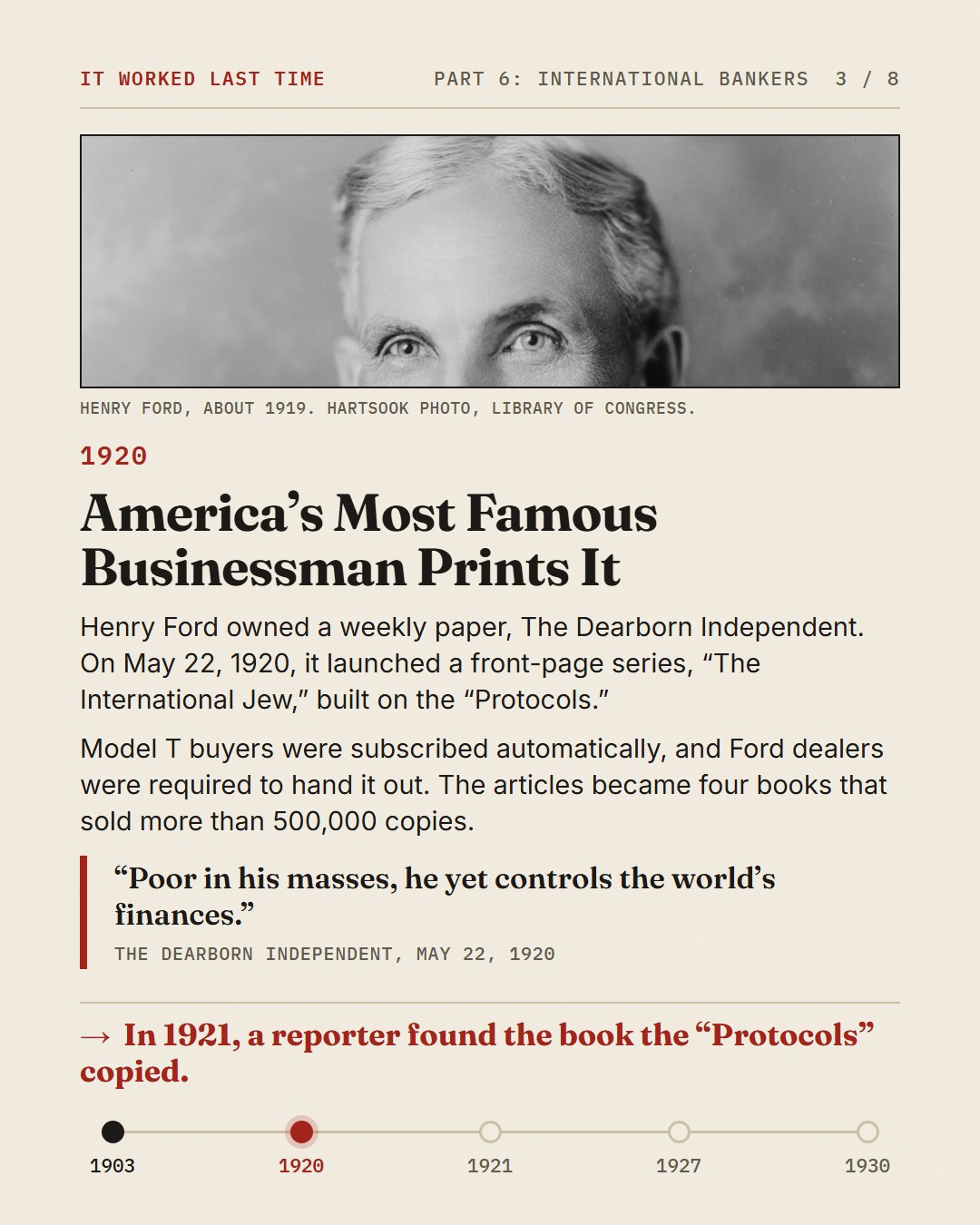
Henry Ford was one of the most famous and respected people in the United States4. He was also nursing grudges. His 1915 “Peace Ship,” a chartered voyage meant to talk Europe out of World War I, ended in public mockery, and afterward he blamed Jews for the war and for blocking peace5. In 1918 he lost a race for the U.S. Senate and blamed Jews and the press5. That November, he bought a small weekly, The Dearborn Independent9.
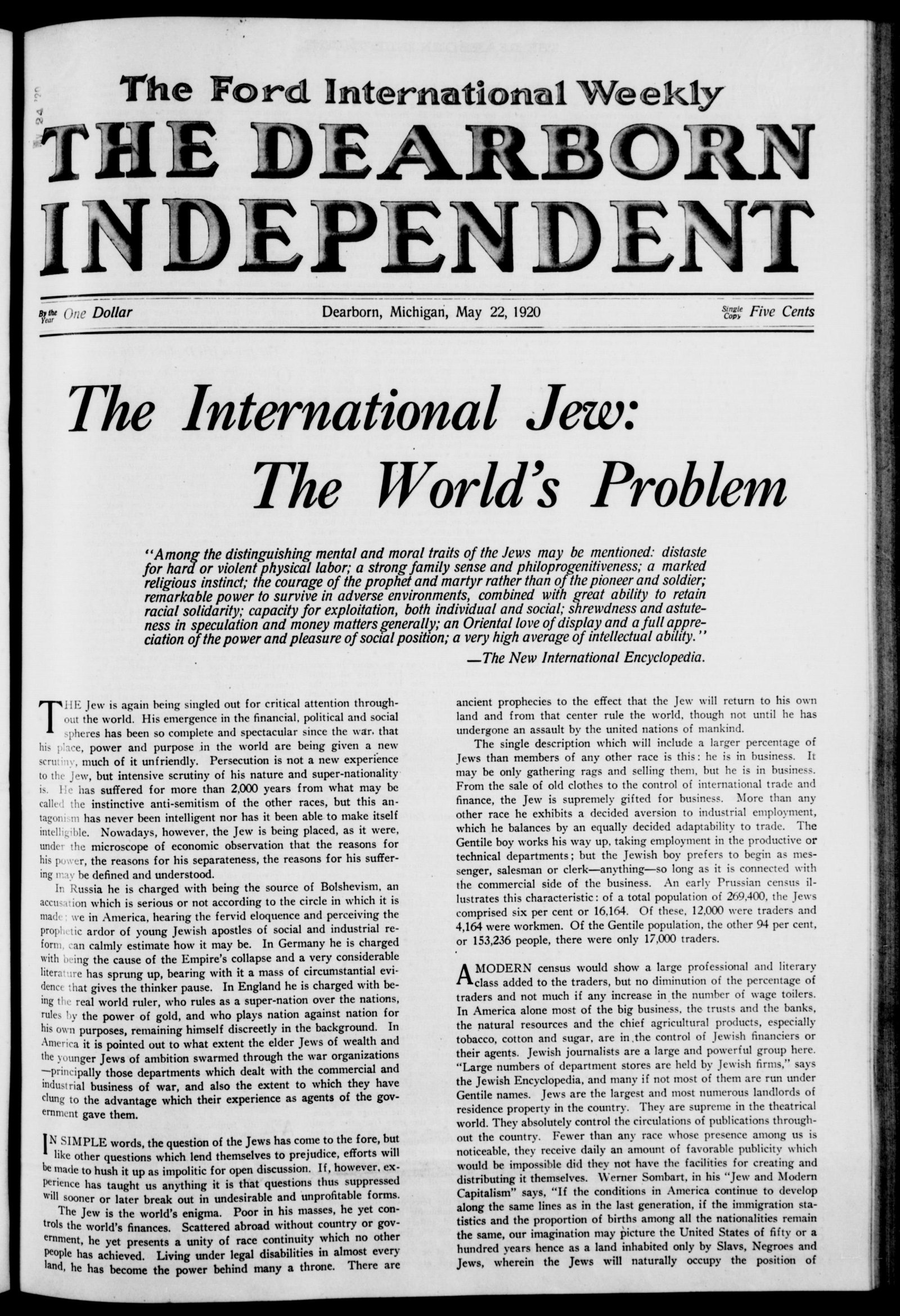
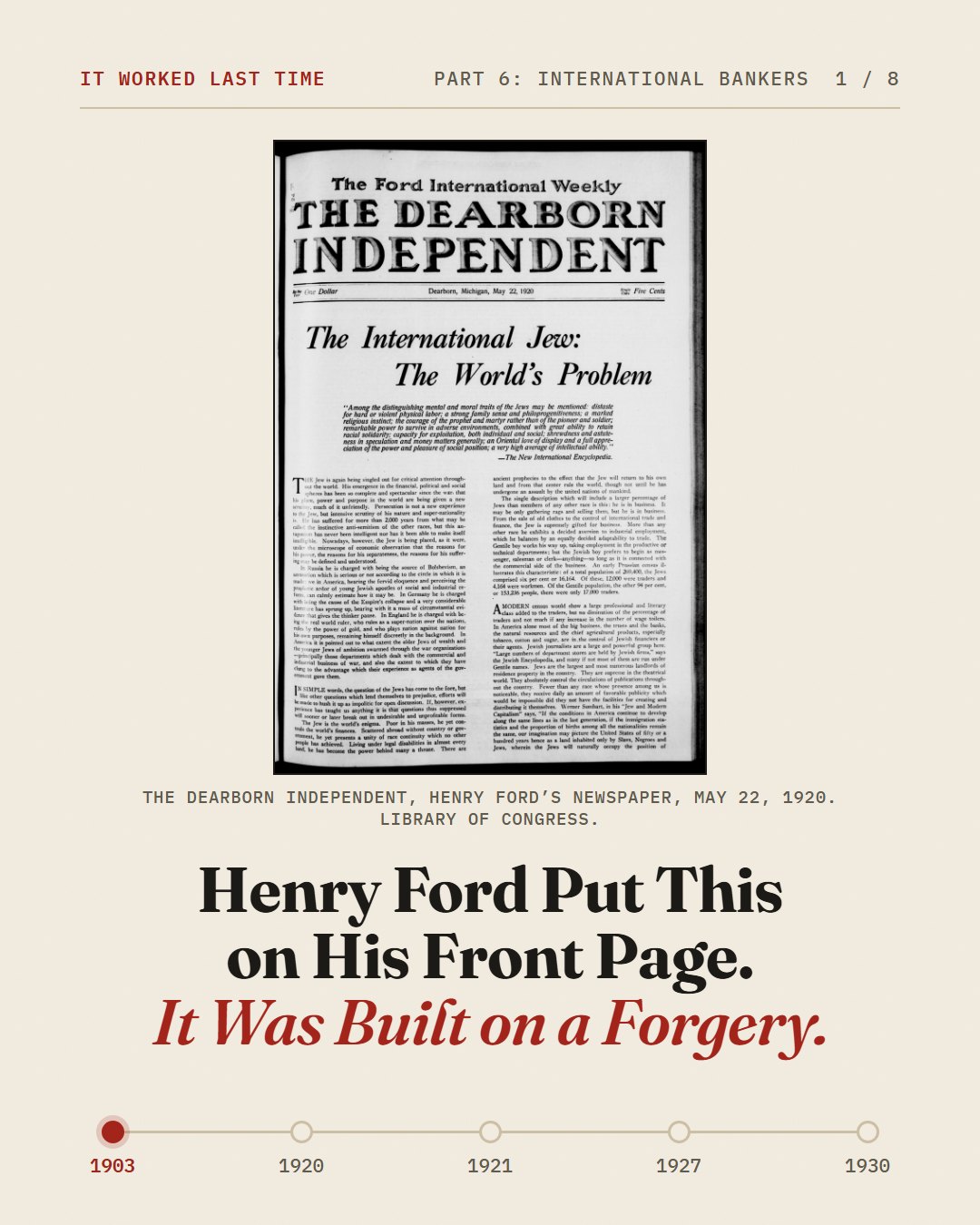
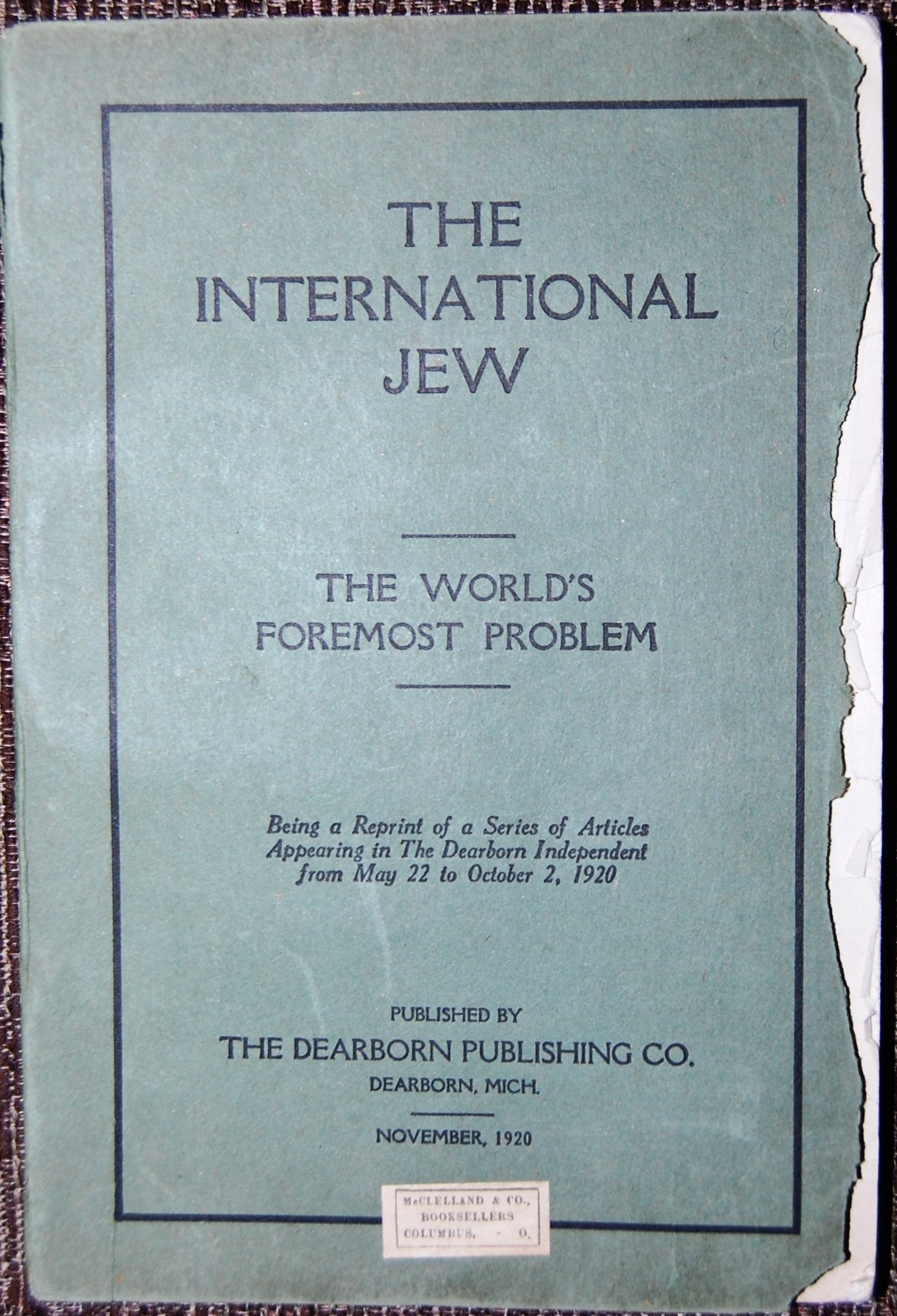
On May 22, 1920, its front page carried a new headline: “The International Jew: The World’s Problem”10. The article called the Jew “the world’s enigma” and said: “Poor in his masses, he yet controls the world’s finances”10. It reported that in England the Jew was “charged with being the real world ruler, who rules as a super-nation over the nations, rules by the power of gold”10. That June, Ford’s secretary obtained a copy of the “Protocols,” and on July 24 the paper ran “An Introduction to the ‘Jewish Protocols,’” warning that the plan “is being steadily carried out”5. One article praised the “Protocols” as “too terribly real for fiction, too well-sustained for speculation, too deep in its knowledge of the secret springs of life for forgery”11.
The word “international” did the work. It cast Jews as a nation hidden inside other nations, loyal only to each other, and it tied them to what frightened readers in 1920: big finance, a war that had just killed millions, and revolution in Russia. Jews were about 3 percent of the U.S. population, a figure the paper itself used5.
Ford paid for all of it. The paper lost $5 million over eight years, according to his own museum’s archive9. Buyers of a Model T were automatically subscribed, thousands of free copies went to clergy and community groups, and Ford dealerships were required to distribute the paper5. The company pressured dealers to buy multiple subscriptions and hand copies to customers8. At the peak, in 1925 and 1926, subscriptions exceeded 900,0009. The articles were bound into four paperback volumes between November 1920 and May 1922, which sold more than 500,000 copies and were translated into at least 16 languages11,4.
The readers were not fools. Ford was the most credible businessman alive, the paper looked like serious journalism, and the series fed real anger about bankers and a brutal war. Some pushed back: some Ford dealers refused to carry it, and some cities moved to pull it from public libraries8,5. Fifteen months after the series began, the source was found.
The Receipt
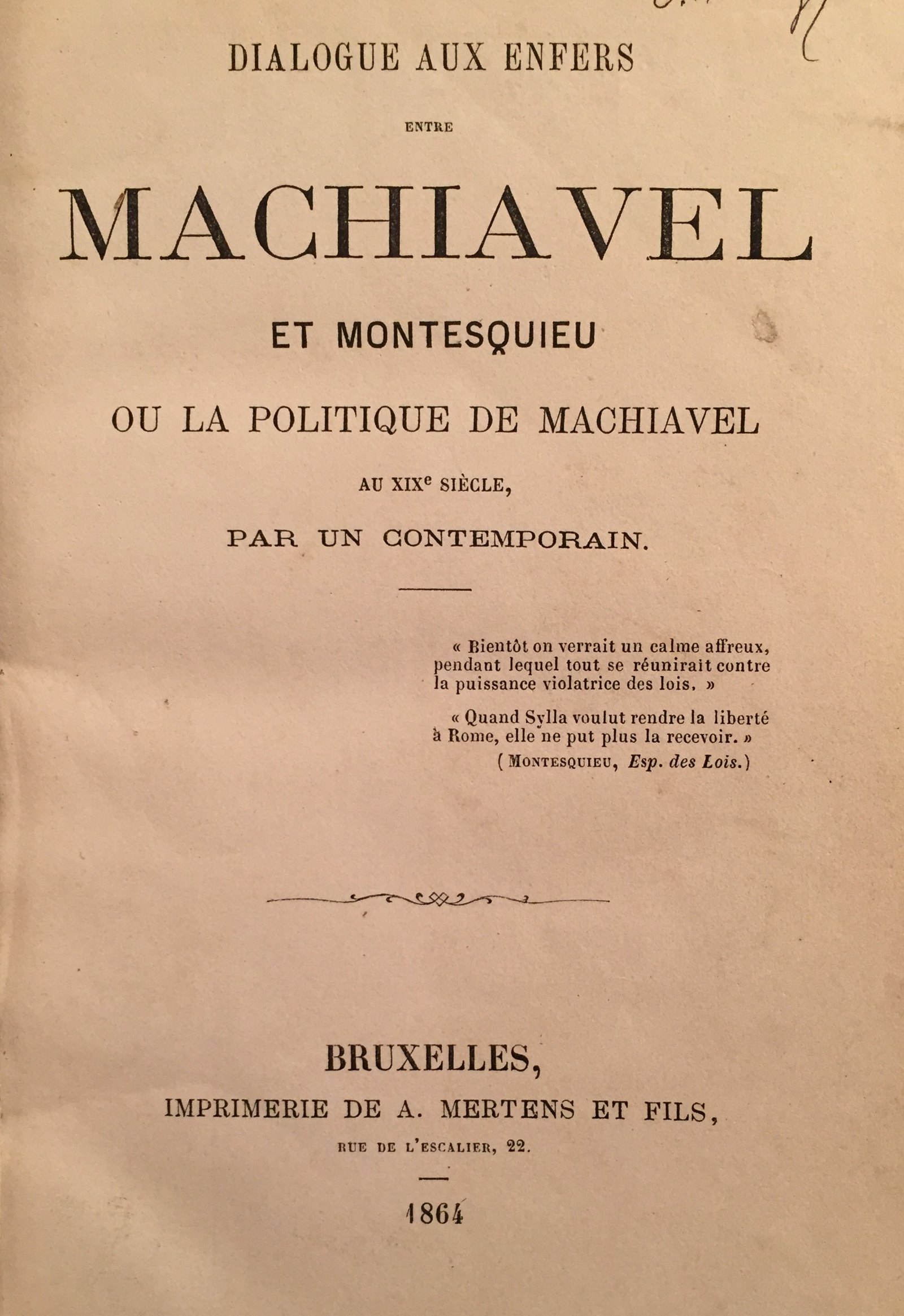

The proof came from Constantinople. A Russian landowner who had fled there after the anti-Bolshevik White forces lost in South Russia bought some old books from a former officer of the Okhrana, the tsar’s political police6. Among them was a small French volume, cheaply rebound, “lacking the title-page”6. Glancing through it one day, he was struck by a passage that resembled the “Protocols”6.
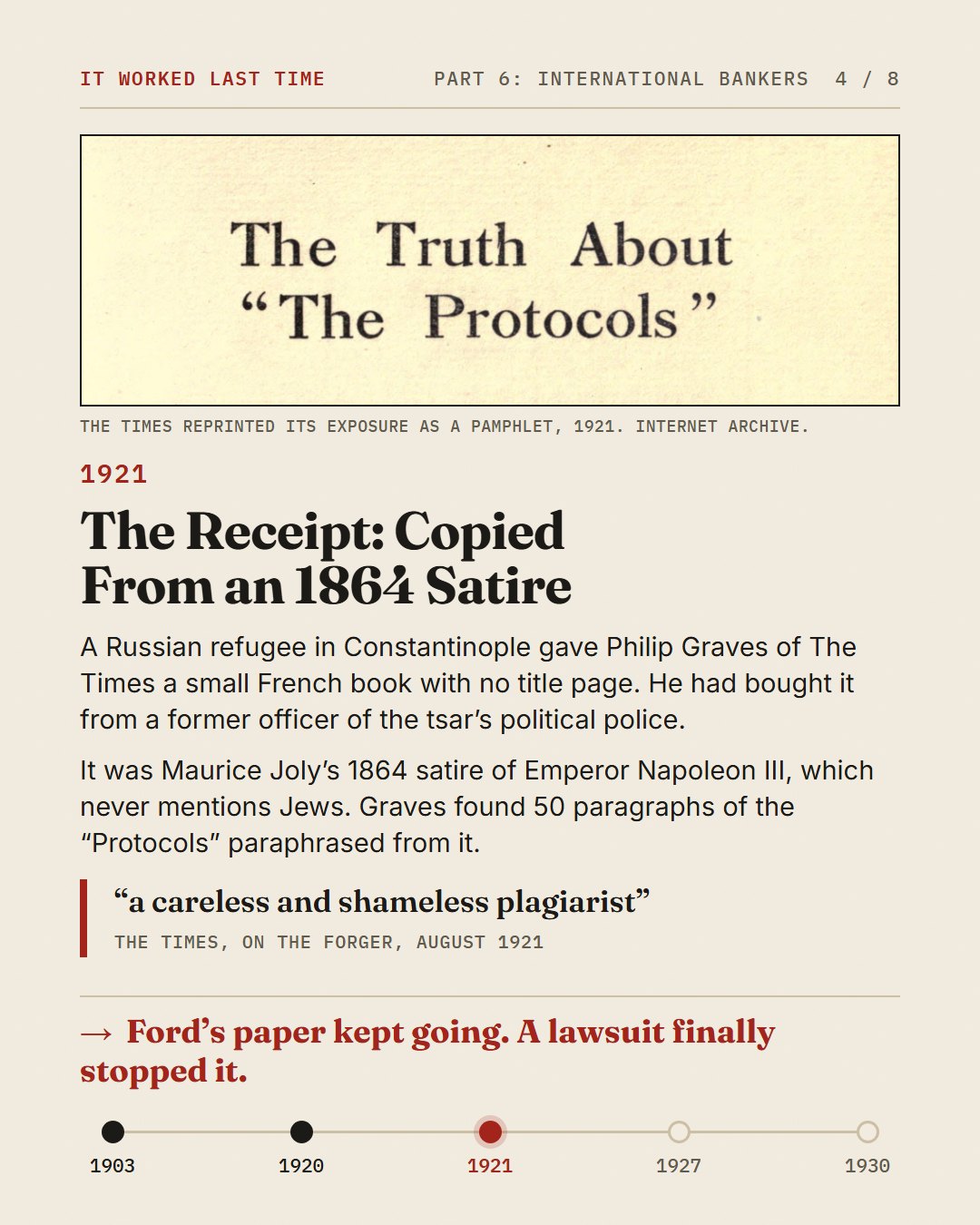
He brought it to Philip Graves, the Constantinople correspondent of The Times of London4,6. On August 16, 17, and 18, 1921, The Times ran Graves’s findings, which its editors called “conclusive proof that the document is in the main a clumsy plagiarism”6. The source was Maurice Joly’s Dialogue in Hell Between Machiavelli and Montesquieu, an 1864 attack on the French emperor Napoleon III, for which Joly was sentenced to 15 months in prison4,6. Joly’s book does not mention Jews4.
Graves set the passages side by side4. “Fully 50 paragraphs in the Protocols are simply paraphrases of passages in the Dialogues,” he wrote, and the forger was “a careless and shameless plagiarist”6. The key change was the villain: “In the Protocols this despotism has to be Jewish and hereditary. Machiavelli’s despotism is obviously Napoleonic”6.
It was not the first exposure. The British journalist Lucien Wolf had traced the text’s ideas to a German novel in 1920, and Herman Bernstein of the New York Herald published The History of a Lie in 19214. Now the proof came from the newspaper whose editor had wondered aloud whether it was real6,7. In Dearborn, the series ran until January 1922, and a fourth volume of reprints came out that May5,11.
The Lawsuit and the Apology

Ford stopped the series in January 1922 without explaining why, though antisemitic articles kept appearing5. In April 1924, the paper began accusing Aaron Sapiro, a Jewish lawyer who organized farmers into marketing cooperatives, of being part of a Jewish conspiracy to control American farmers5. Here the move shrank to a single man: one lawyer’s work for farm co-ops was offered as evidence against a whole people.
Sapiro demanded a retraction in January 1925, and Ford refused5. Sapiro sued for $1,000,000 in federal court in Detroit, listing 141 libelous statements in 21 counts5,13. The trial began in March 19275. On the stand, the paper’s editor, William J. Cameron, admitted that he and Ford had discussed the alleged “international Jewish banking ring” in “a general way”15. That spring, after charges about a juror, the judge declared a mistrial5,13.
Ford’s representatives then approached Louis Marshall, president of the American Jewish Committee. Marshall’s terms were a full retraction, an apology, withdrawal of the books, and a pledge that nothing like them would be published again12. Marshall drafted the statement, and Ford signed it on June 30, 19275,12. Newspapers printed it on July 85.
In it, Ford said he was “deeply mortified” that his paper had been used “for resurrecting exploded fictions, for giving currency to the so-called Protocols of the Wise Men of Zion, which have been demonstrated, as I learn, to be gross forgeries, and for contending that the Jews have been engaged in a conspiracy to control the capital and the industries of the world”12. That last phrase sums up the whole series: a secret plot to control money. Ford retracted it.
The Dearborn Independent printed its last issue in December 19279. Ford ordered copies of The International Jew destroyed and told foreign publishers to stop printing it. Those orders were ignored, and the book’s circulation kept growing worldwide in the 1930s5. The apology closed the paper. It did not stop the book.
Across the Ocean


In Germany, the Hammer publishing house, which the historian Stefan Link describes as a clearinghouse for the ethnic-nationalist (völkisch) movement, translated Ford’s volumes as Der internationale Jude16. The first volume appeared in the summer of 192116. A 1922 printing bills it, in German, as “the first American book on the Jewish question,” edited by Henry Ford24. By August 1925 the publisher was advertising the 23rd edition, and by April 1927 it reported 90,000 copies in circulation16.
Ford’s name was the selling point: the publisher advertised him as an eminent American industrialist, endorsing what German antisemites already believed16. In a 1923 interview with the Chicago Tribune, Hitler said, “We admire particularly his anti-Jewish policy,” and he kept a portrait of Ford in his office5. In the second volume of Mein Kampf, published in 1926, Hitler wrote: “It is Jews who govern the stock exchange forces of the American Union,” and “only a single great man, Ford, to their fury, still maintains full independence”17,18. Later printings replaced Ford’s name with “only very few”17. In 1938, on Ford’s 75th birthday, Hitler’s government gave him the Grand Cross of the German Eagle, its highest honor for a foreigner5.
Schirach read Ford’s book around 1924, his lawyer told the court, and he met Hitler in 19251. As Reich Youth Leader, he subjected German young people to “an intensive programme of Nazi propaganda,” and by 1940, 97 percent of those eligible were in the Hitler Youth2. When he took over Vienna in July 1940, only 60,000 of the city’s original 190,000 Jews remained. Their deportation began and continued until the early fall of 19422. Reports describing the mass murder of Jews by the SS killing squads reached his office2. On September 15, 1942, he defended having driven “tens of thousands upon tens of thousands of Jews into the Ghetto of the East” as “contributing to European culture”2.
By the end of the war, the Nazis and their allies and collaborators had murdered six million Jews23. One forged text and one American’s newspaper did not cause that. But they were part of the propaganda that taught Germans what to believe about their Jewish neighbors. Most Germans likely never read the “Protocols,” the Holocaust Memorial Museum notes, but they would have known its lies from relentless Nazi propaganda4.
The Pattern
Here is the move. First, a document “proves” a secret plot, so hatred looks like evidence. Second, the plot gets a polite name, so it can be repeated in places that would never print a slur.
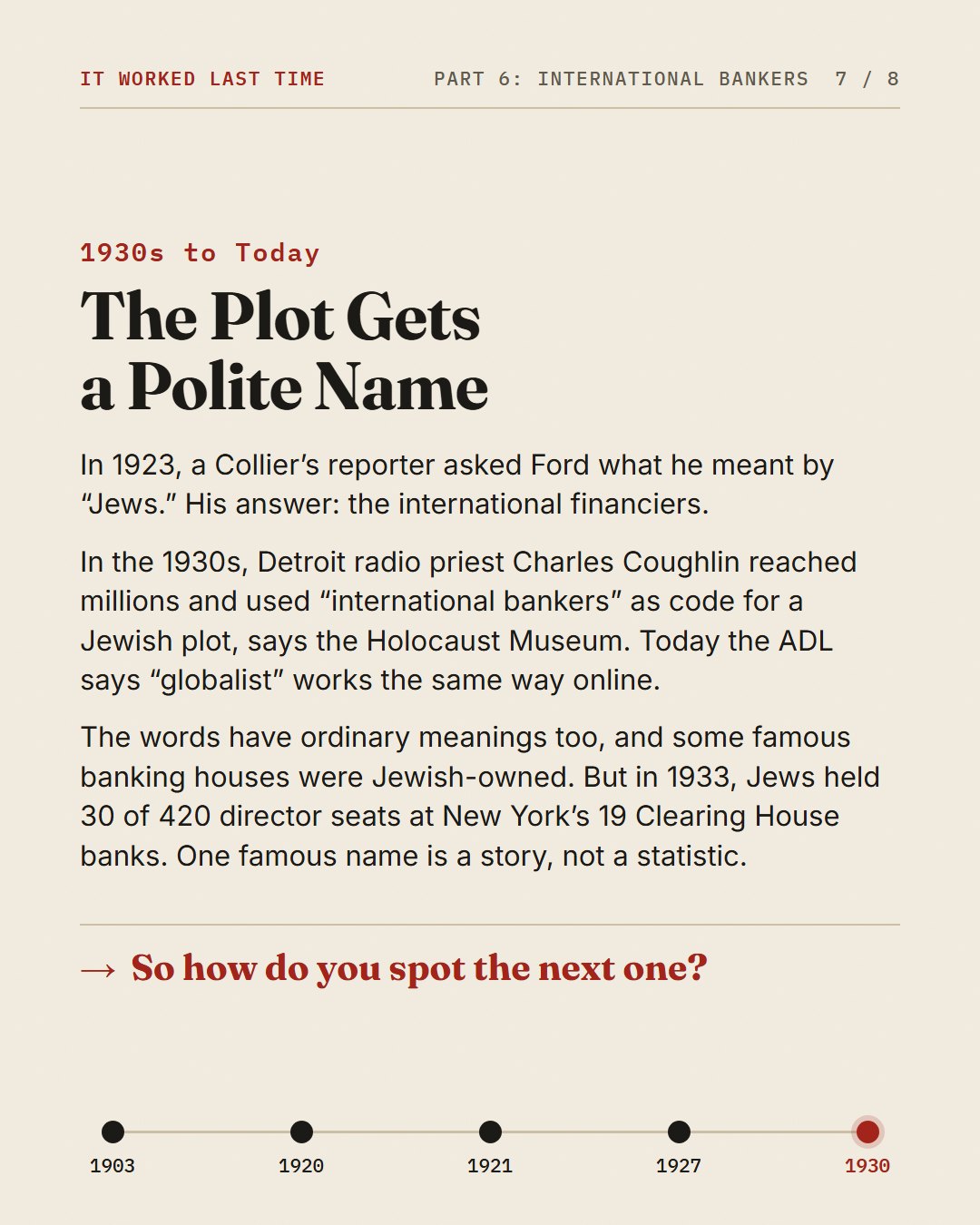
Ford explained the second step himself. In 1923, the Collier’s reporter Charles W. Wood asked him, “What do you mean by Jews?” Ford answered, “The international financers.” Wood asked, “Then why not say international financiers?” and reported: “Sometimes, after that, he did, but just as often he didn’t”14. In the same interview Ford went on: “These Jew financiers are not building anything”14. The polite word and the plain one were interchangeable in his own mouth.
The polite word outlived him. In the 1930s, Father Charles E. Coughlin, a Catholic priest broadcasting from the Detroit area, regularly had 30 million listeners19. According to the U.S. Holocaust Memorial Museum, he “frequently used the term ‘international bankers’ as a code for the false assertion that Jews controlled the banks and world financial markets”19. He did not always mention Jews, but his references were “most likely recognizable to his listeners”19. In 1938, his newspaper serialized the “Protocols”19.
Today, the ADL writes that online, “’Globalist’ functions as a codeword for Jew”20. The American Jewish Committee’s glossary gives both meanings. The ordinary one is “a person who advocates the interpretation or planning of economic and foreign policy in relation to events and developments throughout the world.” The antisemitic one claims Jews are loyal not to their countries but “to some worldwide order”21.
Those ordinary meanings are real. International banks exist, and people argue about global trade in good faith every day. The ADL notes that the power myth is sometimes “invoked unintentionally” by people who do not know its history20. The code is not the word itself. It is the job the word is given: a hidden group, loyal to no nation, secretly steering money, governments, and the press. Once a sentence describes that, it is the “Protocols” with the names taken out.
Ford’s anger at bankers was not pulled from nothing, and some well-known investment houses, such as Kuhn, Loeb and Lehman Brothers, were Jewish-owned22. But one famous name is a story, not a statistic. When Fortune magazine checked in 1936, it concluded that Jews “do not run banking.” Of the 420 directors of the 19 banks in the New York Clearing House in 1933, 30 were Jews, and the largest commercial banks had “practically no Jewish employees of any kind”22.
Their Defense
Ford had an answer for doubters. “The only statement I care to make about the Protocols is that they fit in with what is going on,” he said in 1921. “They fit it now”11. The test he offered was not whether the document was real but whether it matched what readers already feared.
Hitler used the exposure itself as evidence. In the first volume of Mein Kampf he wrote: “They are based on a forgery, the Frankfurter Zeitung moans and screams once every week: the best proof that they are authentic”17. Joseph Goebbels, years before he ran Nazi propaganda, put it in his diary: “I believe that The Protocols of the Elders of Zion is a forgery,” and “I believe in the inner, but not the factual, truth of The Protocols”4.
Ford’s defense in 1927 was that he had not known: “in the multitude of my activities it has been impossible for me to devote personal attention to their management or to keep informed as to their contents”12. The record cuts against him. His editor testified that they had discussed the “international Jewish banking ring” and that Ford had seen Sapiro’s demand for a retraction15. Four years earlier, he had told Collier’s in his own words what he meant by “Jews”14. In 1942, after the United States entered the war, he wrote to the ADL that he did not support “any agitation which would promote antagonism against my Jewish fellow citizens”11.
Schirach’s defense was that he “did not become a National Socialist because of anti-Semitism but because of Socialism”1. The tribunal convicted him of crimes against humanity2. Courts and governments kept ruling on the forgery itself: a Swiss judge called the “Protocols” “ridiculous nonsense” in 1935, and a U.S. Senate subcommittee called them “a vicious hoax” in 19644. They are still published today4.
How Not to Fall for It
Ask who wrote a “leaked” document and how you could check it. The “Protocols” came with a dramatic discovery story that even Graves called “too melodramatic to be credible,” and nothing anyone could verify6. If no one can say who wrote it or where the original is, it is a claim, not proof.
Search one distinctive line before you share. The book the “Protocols” copied was on a shelf in the British Museum6. A two-minute search today can do what took a chance discovery in 1921.
Swap the code word for the group. If “globalists” or “international bankers” can be replaced with “Jews” and the sentence keeps its meaning, or reads more naturally, you have found the message. If it names a specific bank, policy, or trade deal, it may mean exactly what it says.
Ask how often it actually happens. One terrible case is a story, not a statistic. One lawyer or one banking family is not a people.
Notice whose name is vouching for it. Ford’s fame sold a forgery to hundreds of thousands of readers. A trusted name tells you who is backing a claim, not whether it is true.
Sources
- 1Trial of the Major War Criminals before the International Military Tribunal, Vol. 14: Proceedings, 23 May 1946 (testimony of Baldur von Schirach). Avalon Project, Yale Law School. 1946-05-23. avalon.law.yale.edu/imt/05-23-46.asp
- 2Judgment of the International Military Tribunal: Von Schirach. Avalon Project, Yale Law School. 1946-10-01. avalon.law.yale.edu/imt/judschir.asp
- 3Judgment of the International Military Tribunal: The Sentences. Avalon Project, Yale Law School. 1946-10-01. avalon.law.yale.edu/imt/judsent.asp
- 4An Antisemitic Conspiracy: The Protocols of the Elders of Zion. United States Holocaust Memorial Museum, Holocaust Encyclopedia. encyclopedia.ushmm.org/content/en/article/protocols-of-the-elders-of-z
- 5Antisemitism and Henry Ford's International Jew. United States Holocaust Memorial Museum, Holocaust Encyclopedia. encyclopedia.ushmm.org/content/en/article/antisemitism-and-henry-fords
- 6The Truth About "The Protocols": A Literary Forgery. From The Times of August 16, 17, and 18, 1921. The Times (London), via Internet Archive. 1921. archive.org/details/truthaboutthepro00londiala
- 7The antisemitism of Henry Wickham Steed (abstract), by André Liebich. Geneva Graduate Institute. 2012. graduateinstitute.ch/library/publications-institute/antisemitism-henry
- 8Henry Ford and Anti-Semitism. The Henry Ford (Benson Ford Research Center). thehenryford.org/collections/explore/popular-research-topics/henry-for
- 9Finding Aid for Dearborn Independent Graphic Files, Accession 91.98. Benson Ford Research Center, The Henry Ford. 2013-09. collections-media.thehenryford.org/CollectionImages/PDF/91-98-1/Dearbo
- 10Dearborn Independent (Dearborn, Mich.), May 22, 1920, page 1. Library of Congress, Chronicling America. 1920-05-22. loc.gov/item/2013218776/1920-05-22/ed-1/
- 11The International Jew: 1920s Antisemitism Revived Online. ADL. adl.org/resources/backgrounders/the-international-jew-1920s-antisemiti
- 12Statement by Henry Ford regarding charges against Jews, with statement and reply by Louis Marshall. American Jewish Year Book, via Berman Jewish Policy Archive. 1927-06-30. bjpa.org/content/upload/bjpa/ford/Ford%20Statement.pdf
- 13Ford Again Sued for Libel by Detroit Jew. Jewish Telegraphic Agency. 1927-06-03. jta.org/archive/ford-again-sued-for-libel-by-detroit-jew
- 14Ford Still Holds "the Jews" and "International Financiers" Are Synonymous. Jewish Telegraphic Agency (reporting Collier's, August 4, 1923). 1923-08-01. jta.org/archive/ford-still-holds-the-jews-and-international-financiers
- 15Ford Discussed Alleged "Jewish Banking Ring" With Him, "Independent" Editor Admits. Jewish Telegraphic Agency. 1927-03-27. jta.org/1927/03/27/archive/ford-discussed-alleged-jewish-banking-ring-
- 16Rethinking the Ford-Nazi Connection, by Stefan Link. Bulletin of the German Historical Institute 49 (Fall 2011). 2011. zeithistorische-forschungen.de/sites/default/files/medien/material/200
- 17Mein Kampf, by Adolf Hitler, translated by Ralph Manheim (pp. 307 to 308 and 639, with translator's note). Houghton Mifflin, via Internet Archive lending library. 1943. archive.org/details/meinkampf00hitl
- 18Mein Kampf. United States Holocaust Memorial Museum, Holocaust Encyclopedia. encyclopedia.ushmm.org/content/en/article/mein-kampf
- 19The Radio Priest: Charles E. Coughlin and American Antisemitism. United States Holocaust Memorial Museum, Holocaust Encyclopedia. encyclopedia.ushmm.org/content/en/article/charles-e-coughlin
- 20Antisemitism Uncovered: Myth, Jews Have Too Much Power. ADL. antisemitism.adl.org/power/
- 21#TranslateHate Glossary: Globalist. American Jewish Committee. ajc.org/translatehate/globalist
- 22Jews in America. Fortune. 1936-02-01. fortune.com/article/jews-in-america/
- 23Documenting Numbers of Victims of the Holocaust and Nazi Persecution. United States Holocaust Memorial Museum, Holocaust Encyclopedia. encyclopedia.ushmm.org/content/en/article/documenting-numbers-of-victi
- 24Der internationale Jude, Band 1, title page (Hammer-Verlag, Leipzig, 1922). Wikimedia Commons. 1922. commons.wikimedia.org/wiki/File:Henry_Ford_Der_internationale_Jude_Ban
Image Credits
- The Dearborn Independent, May 22, 1920, page 1: "The International Jew: The World's Problem". Dearborn Publishing Co.. 1920-05-22. Public domain (U.S. newspaper published in 1920), via Library of Congress, Chronicling America. Source
- Title page of Sergei Nilus, Velikoe v malom i antikhrist (Tsarskoye Selo, 1905), as reproduced in 1920. Sergei Nilus (book); unknown. 1905. Public domain (PD-US, PD-RusEmpire), via Wikimedia Commons. Source
- Henry Ford, head-and-shoulders portrait. Hartsook (photographer), National Photo Company Collection. about 1919. No known restrictions on publication (Library of Congress); public domain (PD-old-70-1923), via Wikimedia Commons. Source
- The Truth About "The Protocols": A Literary Forgery, title page. The Times (London). 1921. Public domain in the U.S. (published 1921; marked not in copyright), University of California Libraries via Internet Archive. Source
- Title page of Maurice Joly, Dialogue aux enfers entre Machiavel et Montesquieu (Brussels, 1864). Photo by Svarshavsky. 1864 (book); 2016 (photo). CC BY-SA 3.0 (photo by Svarshavsky), via Wikimedia Commons. Source
- The International Jew: The World's Foremost Problem, volume 1, first edition. Dearborn Publishing Co. (book); photo by Fedekuki. November 1920 (book); 2015 (photo). CC BY-SA 4.0 (photo by Fedekuki), via Wikimedia Commons. Source
- Der internationale Jude, Band 1, seventh printing, title page. Hammer-Verlag (Th. Fritsch), Leipzig. 1922. Public domain (PD-ineligible), via Wikimedia Commons. Source
- Nuremberg Trials: defendants in their dock. Office of the U.S. Chief of Counsel for the Prosecution of Axis Criminality (U.S. Army). 1945 to 1946. Public domain (PD-USGov-Military-Army), National Archives 540128, via Wikimedia Commons. Source