Grouped by card. Each source has a summary of what it says, a scope line saying how far it reaches, and a link to the original.
Card 3
The Playbook
On card 3
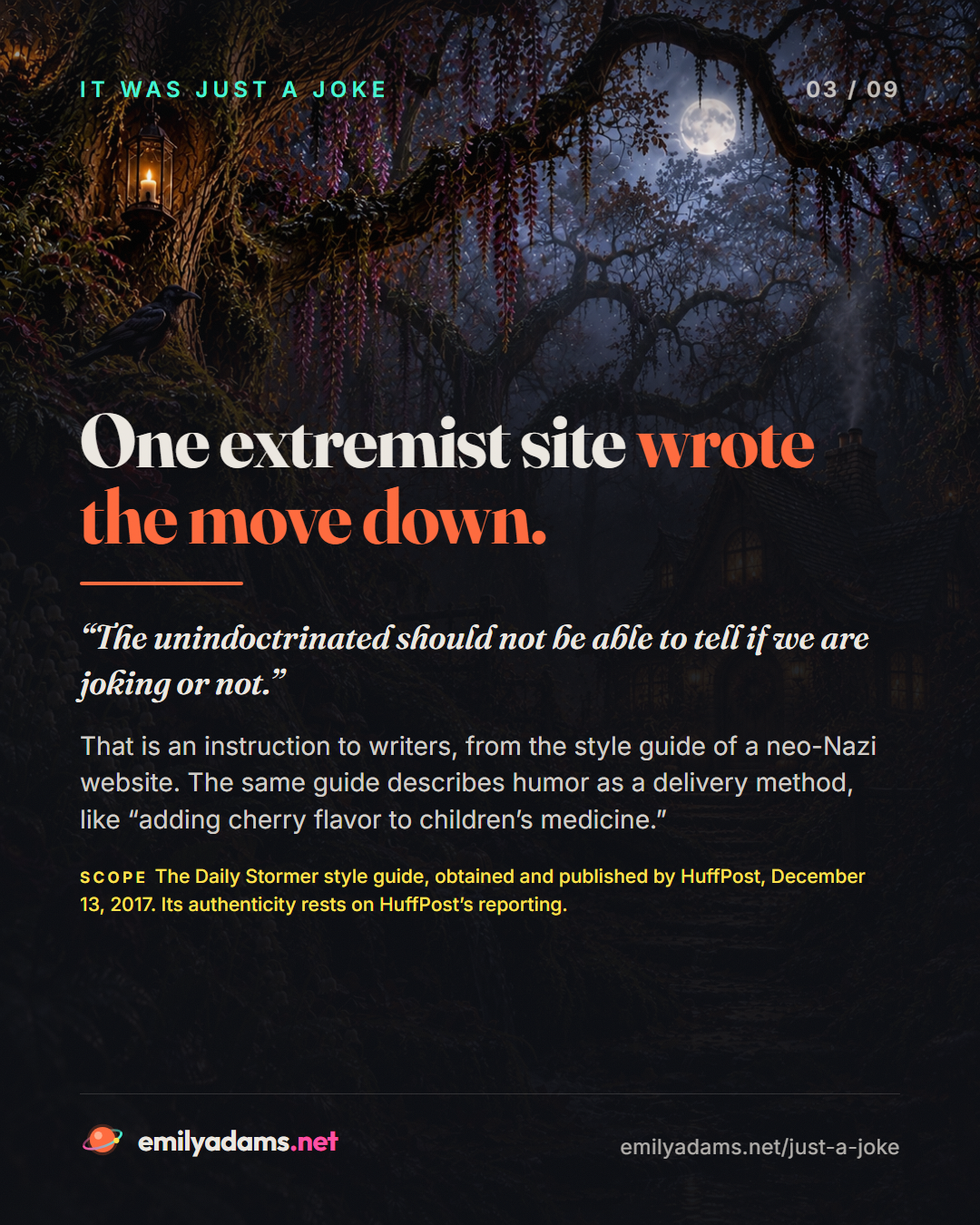
This Is The Daily Stormer’s Playbook
Feinberg, 2017 · HuffPost, December 13, 2017
HuffPost obtained and published the 17-page writers’ guide of The Daily Stormer, a neo-Nazi website. In a section on tone, the guide tells writers that the unindoctrinated should not be able to tell whether they are joking. It says the tone should be light because most people are not comfortable with open hatred, and it describes packing the message inside humor as a delivery method.
Scope Authenticity rests on HuffPost’s reporting and the leaked document. The guide also contains slurs and worse. The cards quote one sentence and one phrase about humor and nothing else.
Background context
Humour and Hatred: The Racist Jokes of the Ku Klux Klan
Billig, 2001 · Discourse and Society, 12(3), 267 to 289
An analysis of three websites that presented racist humor and sympathized with the Klan. Billig looked at the disclaimers around the jokes as closely as the jokes, and concluded that the “just a joke” framing does not hold up even on the sites’ own terms.
Scope A qualitative study of three websites from around 2000. I read the abstract, not the full paper.
Background context
“Deplorable” Satire: Alt-Right Memes, White Genocide Tweets, and Redpilling Normies
Greene, 2019 · Studies in American Humor, 5(1), 31 to 69
Greene argues that the alt-right borrows the ironic style of satire to attract and radicalize supporters while keeping deniability, and pairs right-wing and left-wing examples to show the same style used for different ends.
Scope An interpretive analysis of selected cases, not a measurement study. I read the abstract, not the full paper.
Card 4
In the Lab
On card 4
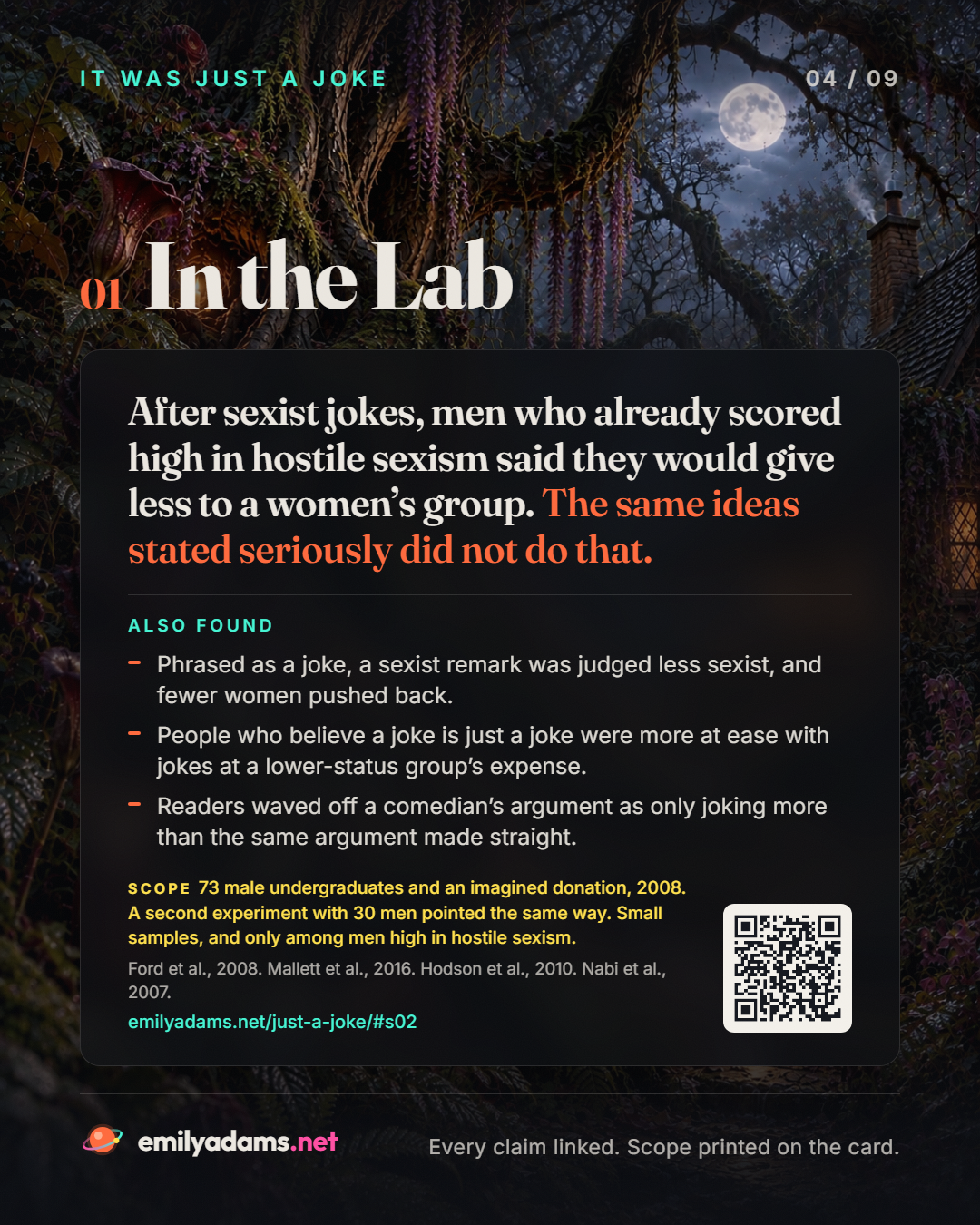
More Than “Just a Joke”: The Prejudice-Releasing Function of Sexist Humor
Ford, Boxer, Armstrong and Edel, 2008 · Personality and Social Psychology Bulletin, 34(2), 159 to 170
Two experiments with male undergraduates. In the first, with 73 men, those who scored higher in hostile sexism said they would donate less to a women’s organization after reading sexist jokes, but not after neutral jokes or after the same sexist ideas stated without humor. In the second, with 30 men, those higher in hostile sexism assigned a larger share of a budget cut to a women’s student group after sexist comedy skits than after neutral ones.
Scope Small samples from one university. The first experiment measured an imagined donation, not real money. The effect appeared only among men already high in hostile sexism; it is not a claim that such jokes change everyone.
On card 4
What Did He Mean by That? Humor Decreases Attributions of Sexism and Confrontation of Sexist Jokes
Mallett, Ford and Woodzicka, 2016 · Sex Roles, 75, 272 to 284
Women received the same sexist remark by instant message, phrased either seriously or as a joke, and their real replies were coded. The joke version made the speaker seem less sexist, and as that impression fell, so did the women’s pushback. Two experiments, with 195 and 134 women.
Scope The chain of effects appeared only among women who at least moderately endorsed hostile sexism themselves.
On card 4
A Joke Is Just a Joke (Except When It Isn’t): Cavalier Humor Beliefs Facilitate the Expression of Group Dominance Motives
Hodson, Rush and MacInnis, 2010 · Journal of Personality and Social Psychology, 99(4), 660 to 682
Across three studies in Canada, people who more strongly preferred group hierarchy reacted more favorably to jokes about a low-status group, and that link ran almost entirely through the belief that a joke is just a joke.
Scope Mostly correlational, with Canadian samples and jokes about one group. I read the abstract; a correction to one table has been published.
On card 4
All Joking Aside: A Serious Investigation into the Persuasive Effect of Funny Social Issue Messages
Nabi, Moyer-Gusé and Byrne, 2007 · Communication Monographs, 74(1), 29 to 54
Undergraduates read comedians’ monologues on social issues, or serious versions of the same arguments. The funny versions were dismissed as “just joking” more often, even though readers thought about them just as much.
Scope One condition in one study showed a delayed persuasive effect a week later, which the authors call a hint. The cards do not rely on it.
Card 5
In Politics
On card 5
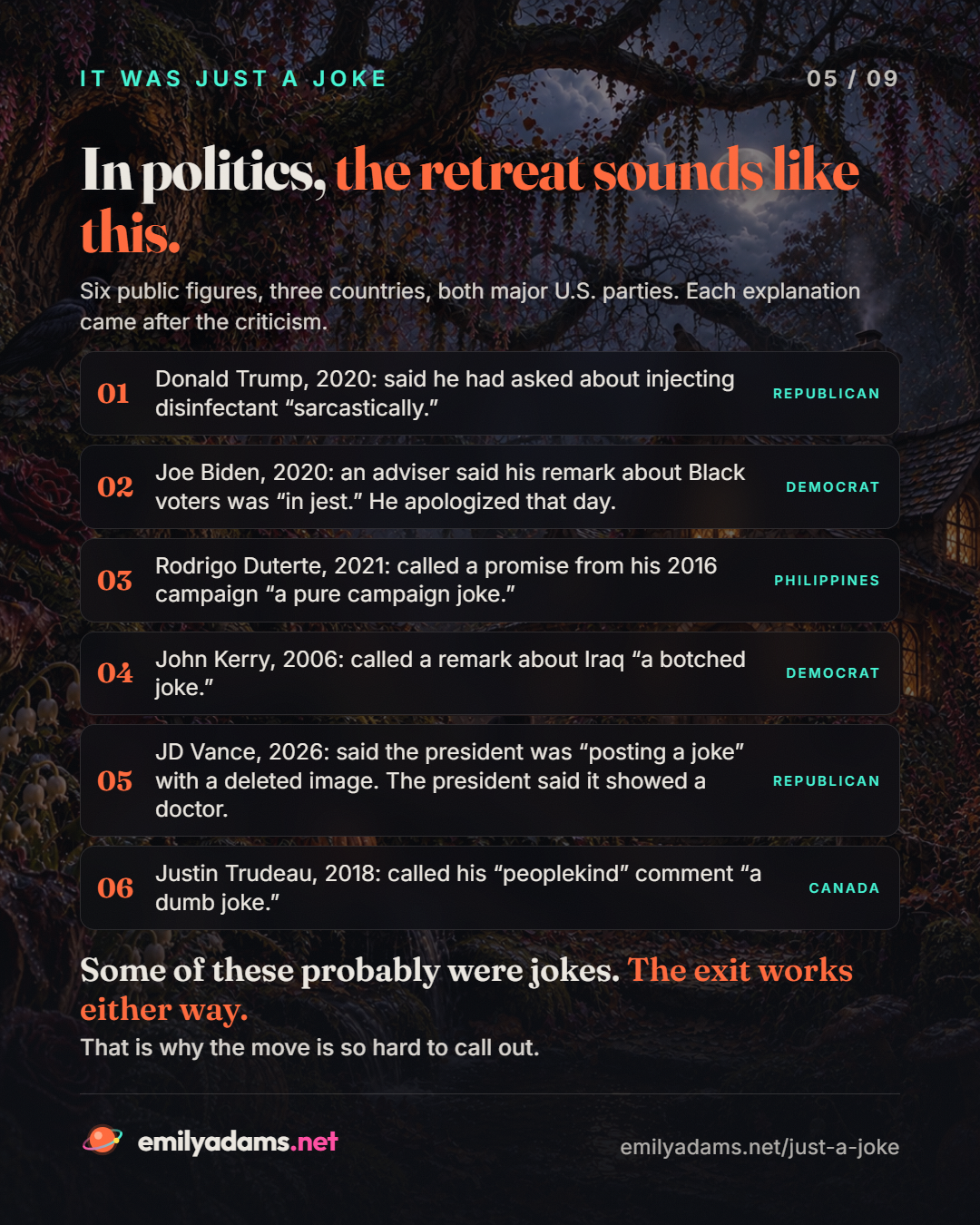
Donald Trump: Remarks of April 23 and April 24, 2020
The White House, 2020 · Official transcripts, archived Trump White House site
At a briefing on April 23, 2020, after an official described disinfectant killing the virus on surfaces, the president asked whether something like that could be done by injection. The next day, asked to clarify, he said he had been asking the question sarcastically.
Scope He put it as a question to officials and did not tell the public to inject anything. Later in the same briefing he said it would not be through injection.
On card 5
Joe Biden on The Breakfast Club, May 22, 2020
NPR, 2020 · NPR Politics Podcast transcript, with reporting by Al Jazeera and theGrio
On a radio show, Biden said that voters who had trouble choosing between him and his opponent were not Black. A senior adviser said the same day that the comments were in jest. That afternoon Biden said he should not have been such a wise guy.
Scope The “in jest” wording is his adviser’s. Biden apologized himself and did not personally call it a joke.
On card 5
Rodrigo Duterte: The Jet Ski Promise, May 10, 2021
Philstar, 2021 · Philstar, May 11, 2021, with reporting by ABS-CBN News
As a candidate in 2016, Duterte said he would ride a jet ski to disputed islands and plant the Philippine flag. In a taped address five years later, under criticism of his policy toward China, he said the promise had been a pure campaign joke.
Scope His remarks were in mixed Filipino and English, and English wordings differ slightly between outlets.
On card 5
John Kerry: The “Botched Joke,” October 30 to November 1, 2006
ABC News, 2006 · ABC News, November 1, 2006, with agency reporting
Kerry told students that if they did not make an effort in school they could get stuck in Iraq, which was heard as a slight on troops. He said he was sorry about a botched joke, and aides said he had fumbled a prepared line aimed at the president.
Scope Here the joke explanation had support: a prepared text. It is on the card as an example of the explanation being offered, not as proof it was false.
On card 5
JD Vance and Donald Trump: The Deleted Image, April 12 and 13, 2026
CBS News, 2026 · CBS News, April 13, 2026, with reporting by EWTN News
The president posted an AI-generated image of himself as a robed healer and deleted it the next morning after criticism from Christian conservatives. He told reporters he had thought it showed him as a doctor. The vice president said the same day that he thought the president was posting a joke.
Scope The vice president’s remark was read in a news report of a television interview, not a transcript. The two explanations are different, and the card gives both.
On card 5
Justin Trudeau: “Peoplekind,” February 2018
Global News, 2018 · Global News, February 7, 2018, with reporting by the Associated Press
At a town hall, Trudeau interrupted a woman who said “mankind” to suggest “peoplekind.” After several days of ridicule he said he had made a dumb joke.
Scope Low stakes, and it may well have been a joke. It is on the card because the retreat is the same shape.
Card 6
At the Store
On card 6
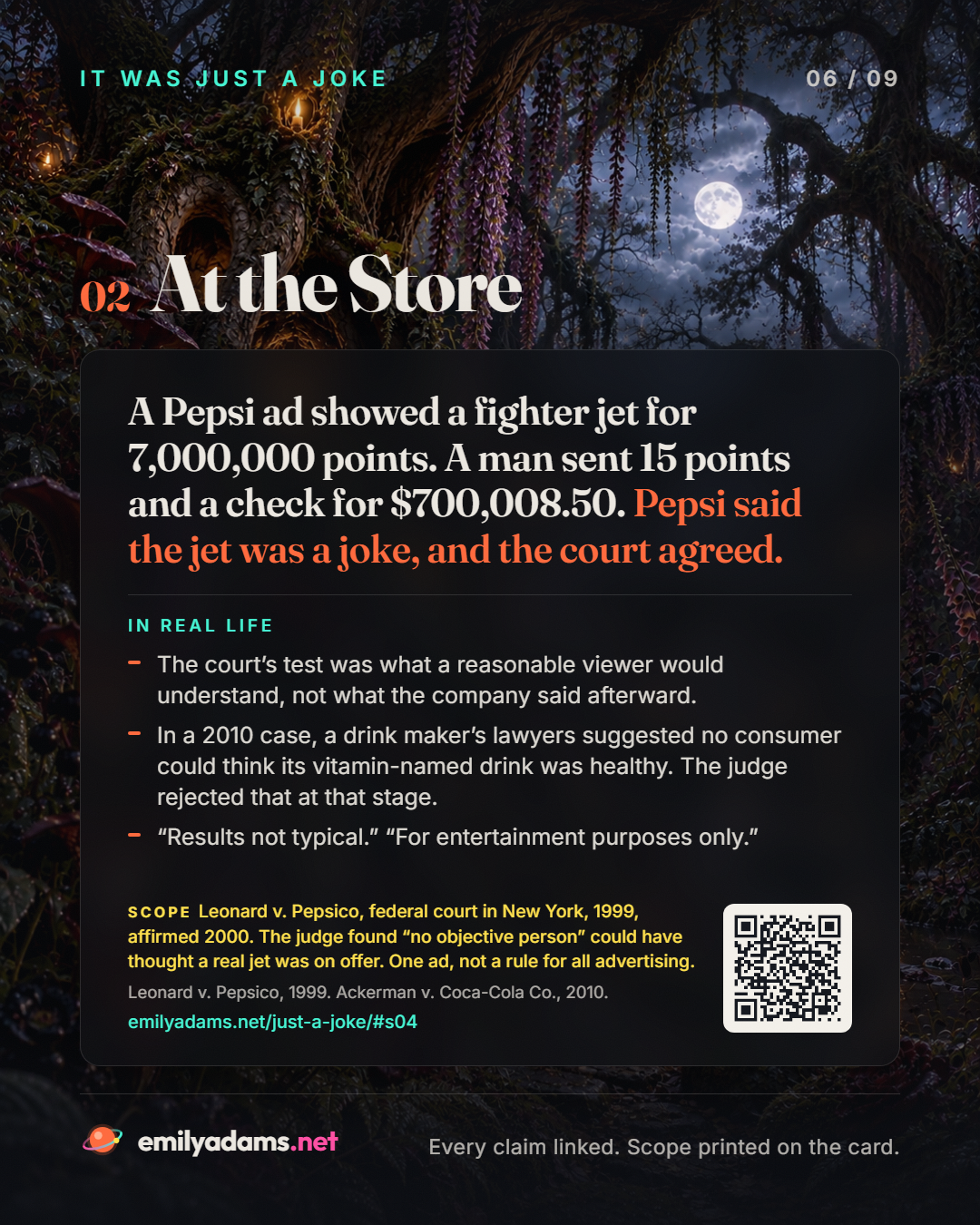
Leonard v. Pepsico, Inc.
U.S. District Court, 1999 · 88 F. Supp. 2d 116 (S.D.N.Y. 1999), Judge Kimba M. Wood; affirmed 210 F.3d 88 (2d Cir. 2000)
A Pepsi commercial showed a Harrier fighter jet with the caption 7,000,000 Pepsi Points. John Leonard sent in 15 points and a check for $700,008.50 and asked for the jet. Pepsi replied that the jet was fanciful and included to make the ad humorous, and its ad agency called it clearly a joke. The court ruled for Pepsi, finding that no objective person could reasonably have concluded the commercial offered a real jet.
Scope A contract ruling on one plainly exaggerated ad. The court judged the joke by what a reasonable viewer would understand, not by what the company said afterward, and it does not say a company can always disown its advertising.
On card 6
Ackerman v. Coca-Cola Co.
U.S. District Court, 2010 · E.D.N.Y., Memorandum and Order of July 21, 2010, Judge John Gleeson
In a lawsuit over the marketing of vitaminwater, the judge wrote that at oral argument the defendants suggested no consumer could reasonably be misled into thinking the drink was a healthy beverage, because its sweet taste puts consumers on notice that it contains sugar. He rejected the argument at that stage of the case. The case settled in 2016 with label changes.
Scope This is the judge’s summary of an argument, not a quotation of the company, and the defense was that consumers were on notice, not that the marketing was a joke. It is on the card as a company distancing itself from its own advertising.
Card 7
At Home
On card 7
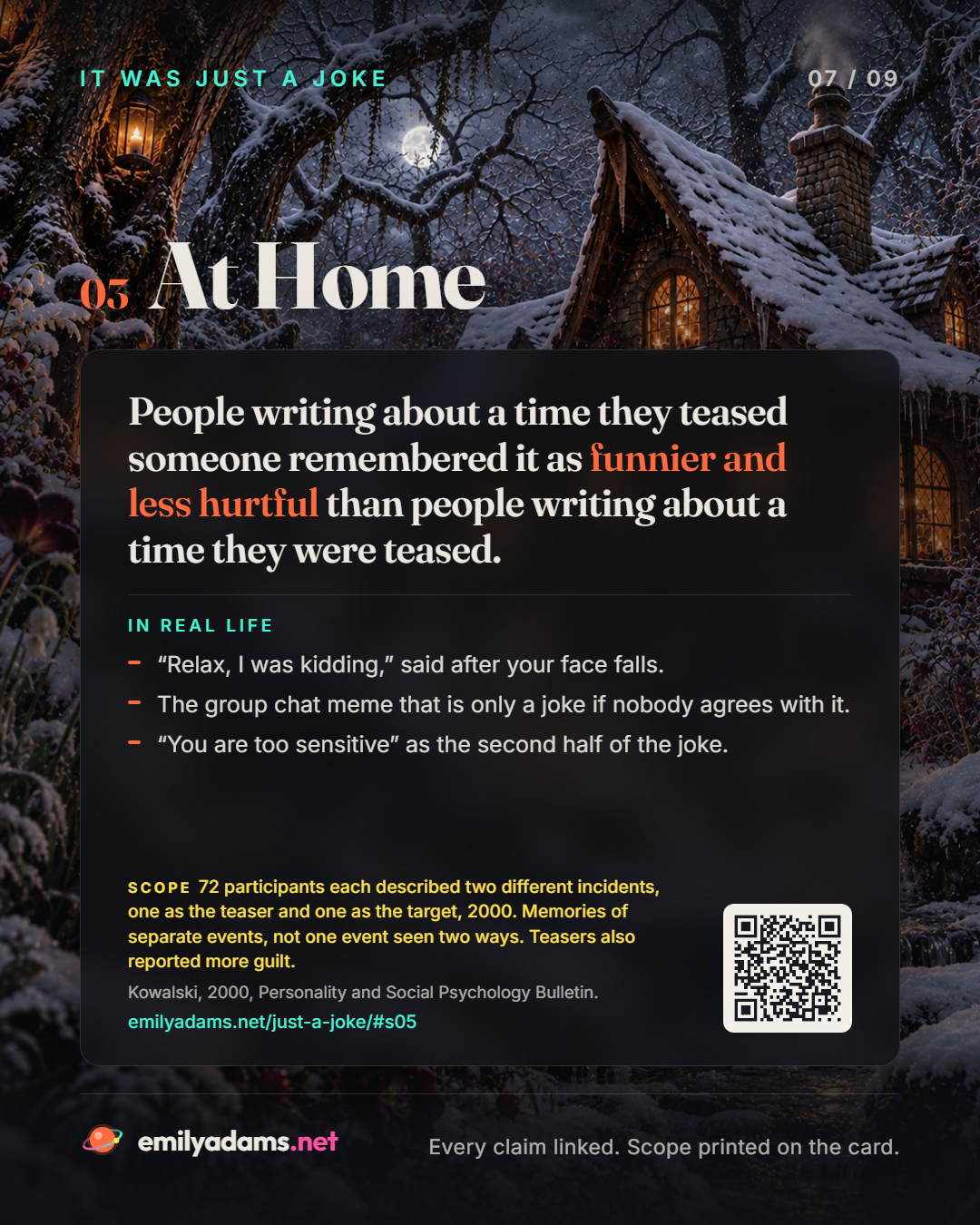
“I Was Only Kidding!”: Victims’ and Perpetrators’ Perceptions of Teasing
Kowalski, 2000 · Personality and Social Psychology Bulletin, 26(2), 231 to 241
72 participants each wrote two accounts: one of a time they were teased and one of a time they teased someone else. In the teaser role, people described the event as more humorous and less damaging than people did in the target role. Teasers also reported more guilt.
Scope Each person described two different incidents, so this compares the two roles, not two views of one event. The accounts are memories, and people chose which incidents to recall.
Card 8
How to Answer It
On card 8
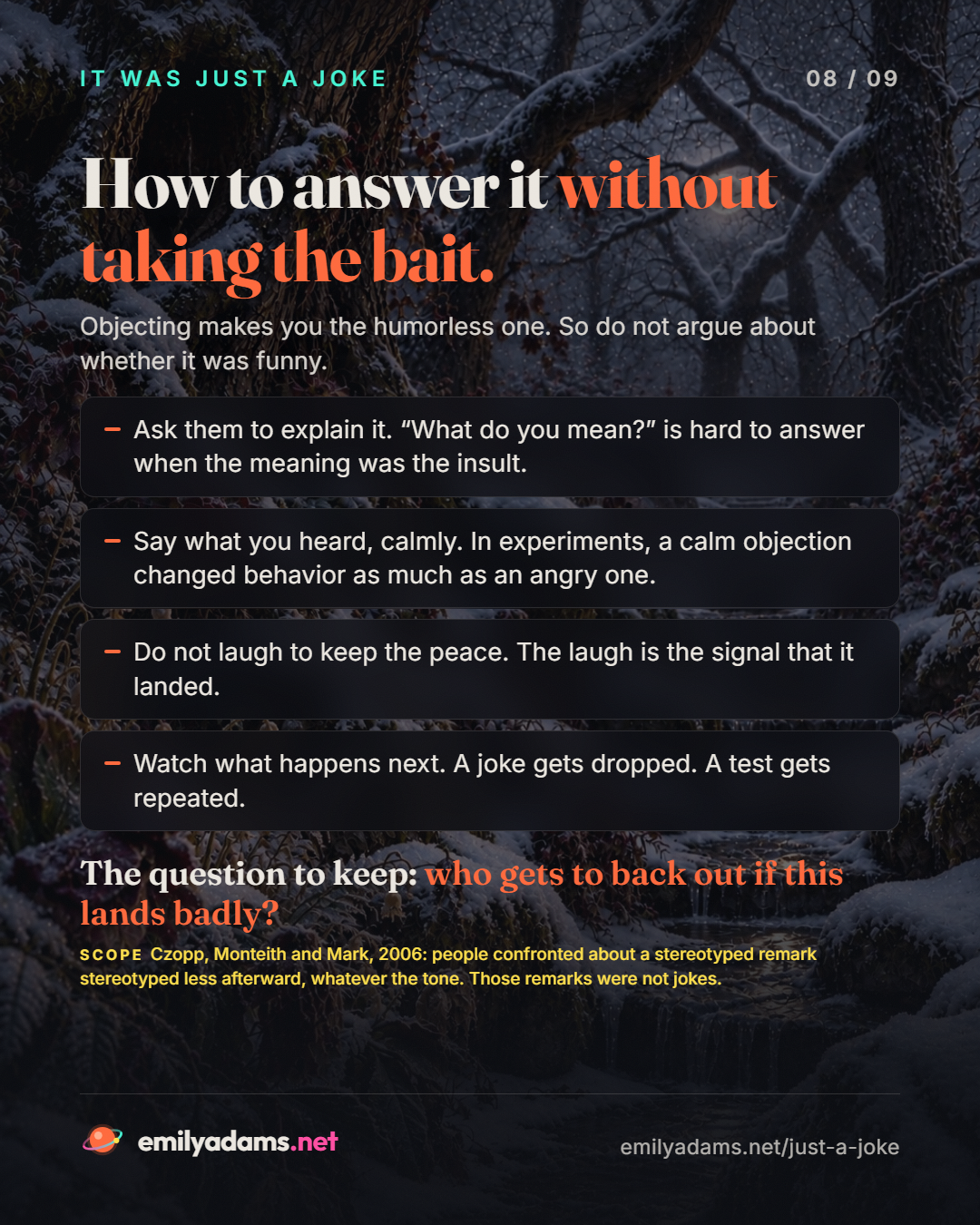
Standing Up for a Change: Reducing Bias Through Interpersonal Confrontation
Czopp, Monteith and Mark, 2006 · Journal of Personality and Social Psychology, 90(5), 784 to 803
In three experiments, people who were confronted after making a stereotyped inference were less likely to give stereotyped responses afterward, regardless of who confronted them or how hostile the confrontation was. Hostile confrontations drew more negative feelings toward the person objecting.
Scope The remark confronted was a racial stereotype in a lab task, not a joke, and the follow-up was short term. I read the abstract.
Background context
Gender Differences in Using Humor to Respond to Sexist Jokes
Woodzicka, Mallett and Melchiori, 2020 · HUMOR, 33(2), 219 to 238
164 participants read scenarios in which someone answered a sexist joke. People who answered with humor were rated more likeable but less effective than people who answered seriously.
Scope Imagined scenarios and observer ratings, not real confrontations.