Social Engineering Series, Part 1

Why literacy matters: the sources behind the cards.

A ten-slide series on what it costs when reading goes wrong, in seven parts of ordinary life: commerce, health, everyday life, government, politics, social issues, and social media. This page has every source behind the cards, what each one found, and what each one cannot tell you.

Published October 9, 2026 · Emily Adams · Figures verified against the original studies, agency pages, and court filings

The Cards

The full text of every card, in order, with the card itself under each one. Select a card to open it full size.

Card 01 of 09
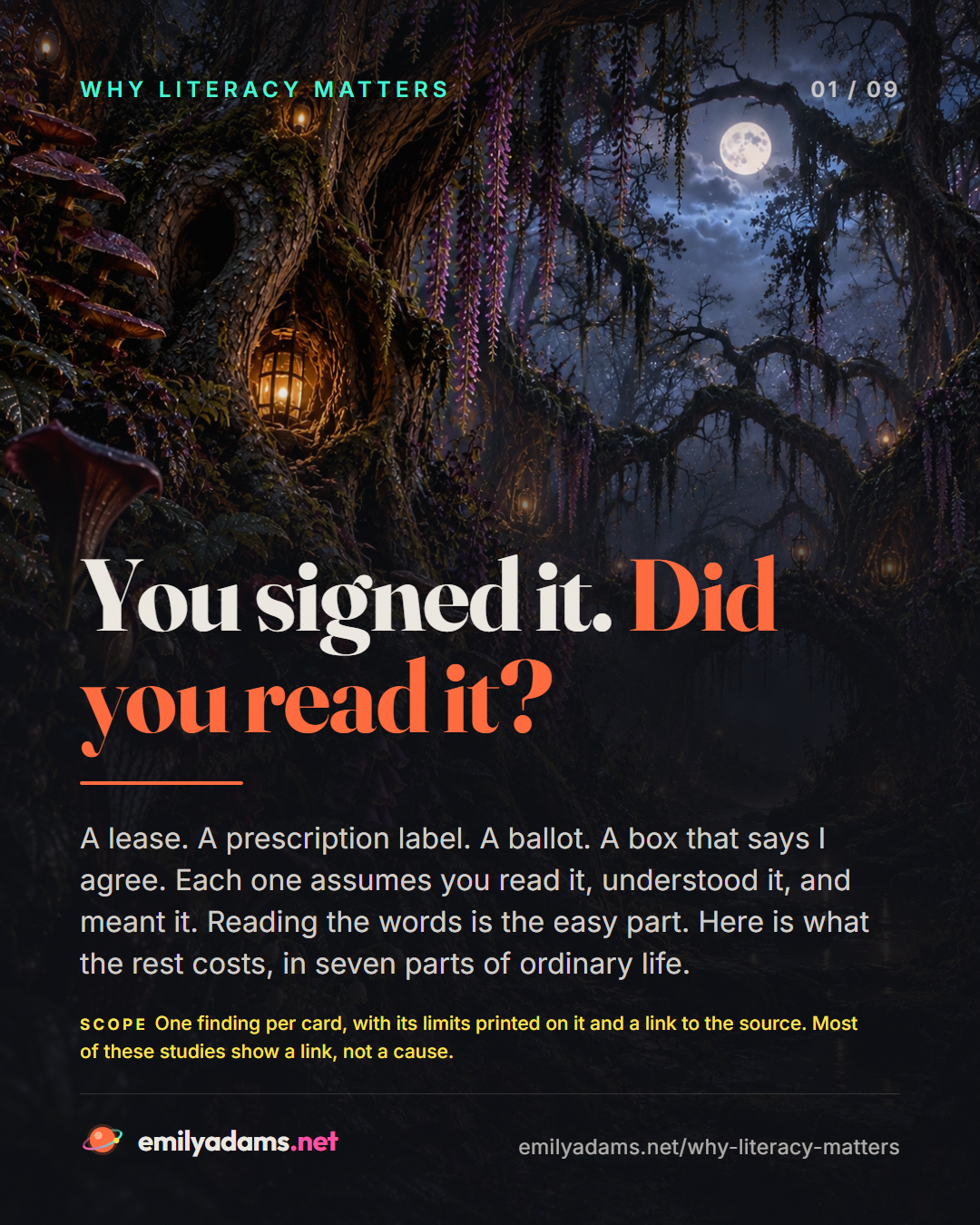
You signed it. Did you read it?
  • A lease. A prescription label. A ballot. A box that says I agree. Each one assumes you read it, understood it, and meant it. Reading the words is the easy part. Here is what the rest costs, in seven parts of ordinary life.
SCOPE One finding per card, with its limits printed on it and a link to the source. Most of these studies show a link, not a cause.
All sourcesCard 1
Card 02 of 09
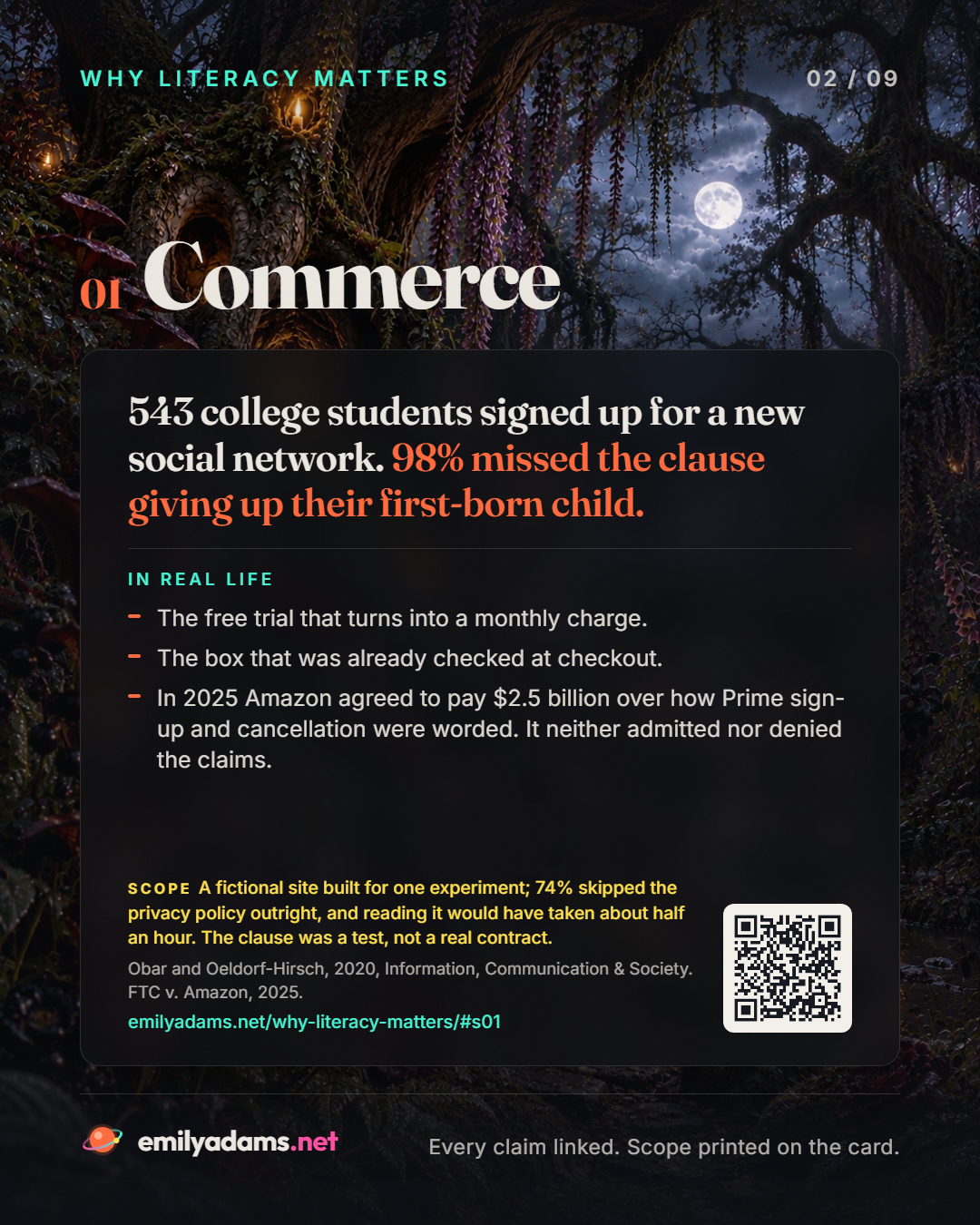
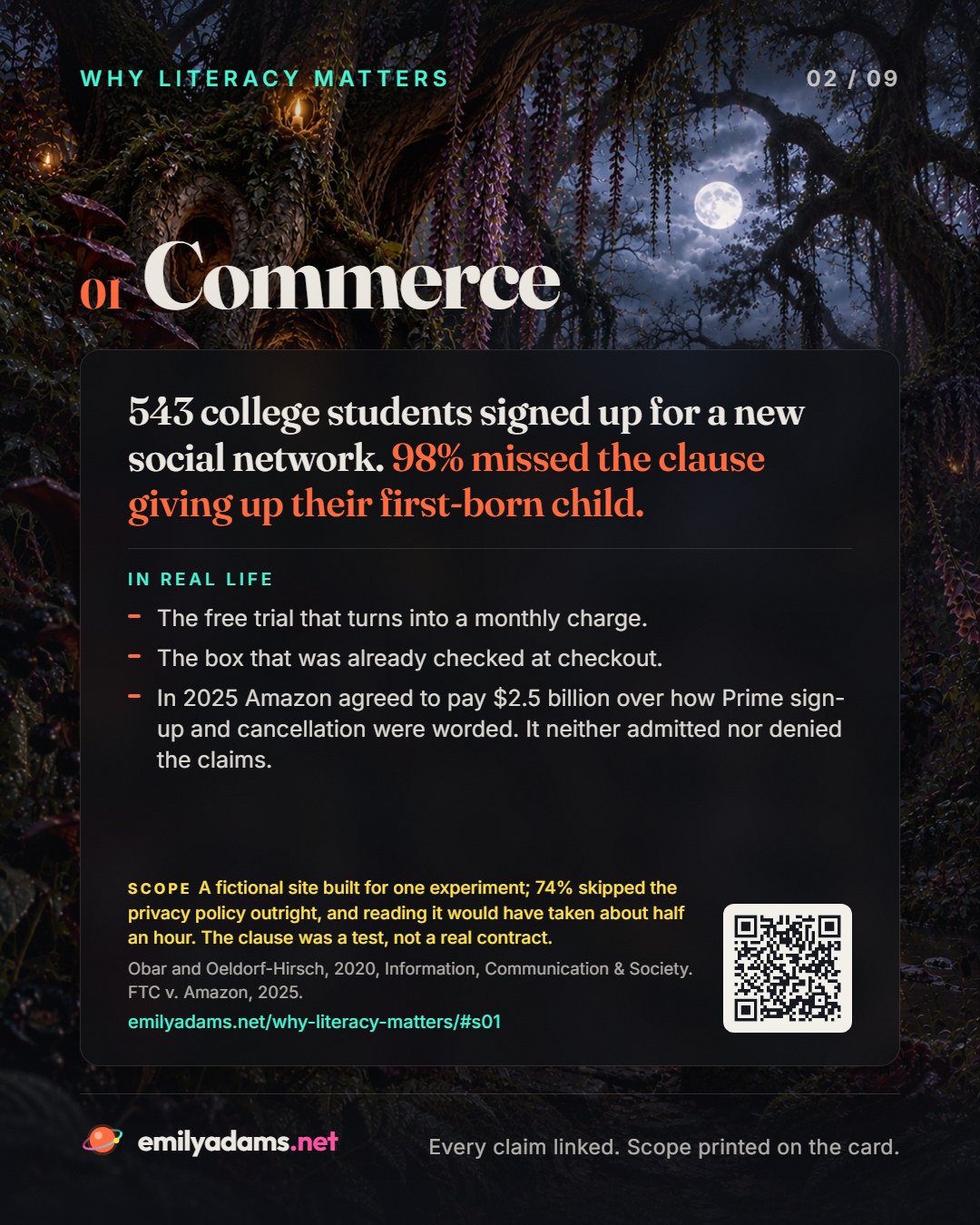
Commerce. 543 college students signed up for a new social network. 98% missed the clause giving up their first-born child.
  • The free trial that turns into a monthly charge.
  • The box that was already checked at checkout.
  • In 2025 Amazon agreed to pay $2.5 billion over how Prime sign-up and cancellation were worded. It neither admitted nor denied the claims.
SCOPE A fictional site built for one experiment; 74% skipped the privacy policy outright, and reading it would have taken about half an hour. The clause was a test, not a real contract.
Sources and linksCard 2
Card 03 of 09
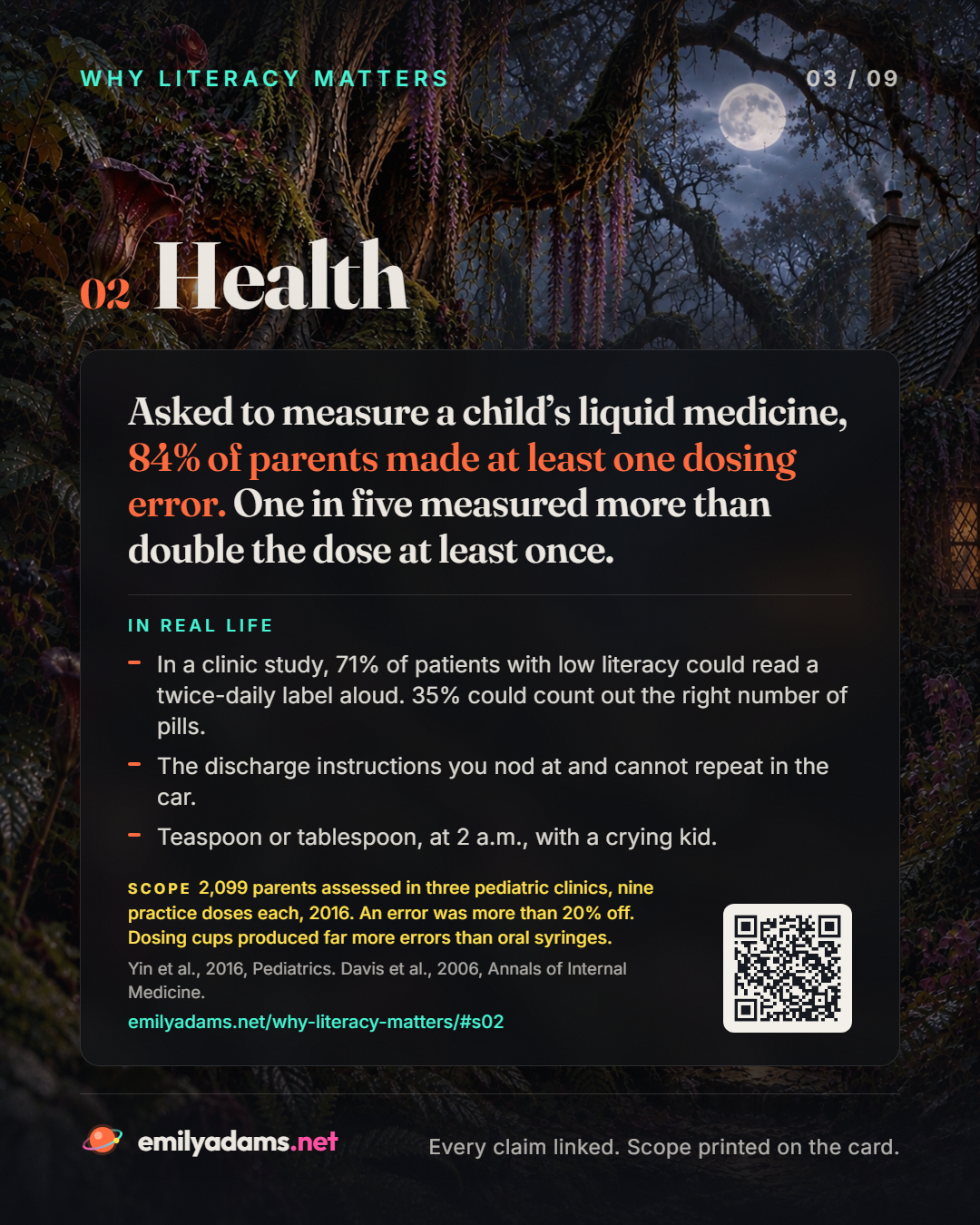
Health. Asked to measure a child’s liquid medicine, 84% of parents made at least one dosing error. One in five measured more than double the dose at least once.
  • In a clinic study, 71% of patients with low literacy could read a twice-daily label aloud. 35% could count out the right number of pills.
  • The discharge instructions you nod at and cannot repeat in the car.
  • Teaspoon or tablespoon, at 2 a.m., with a crying kid.
SCOPE 2,099 parents assessed in three pediatric clinics, nine practice doses each, 2016. An error was more than 20% off. Dosing cups produced far more errors than oral syringes.
Sources and linksCard 3
Card 04 of 09
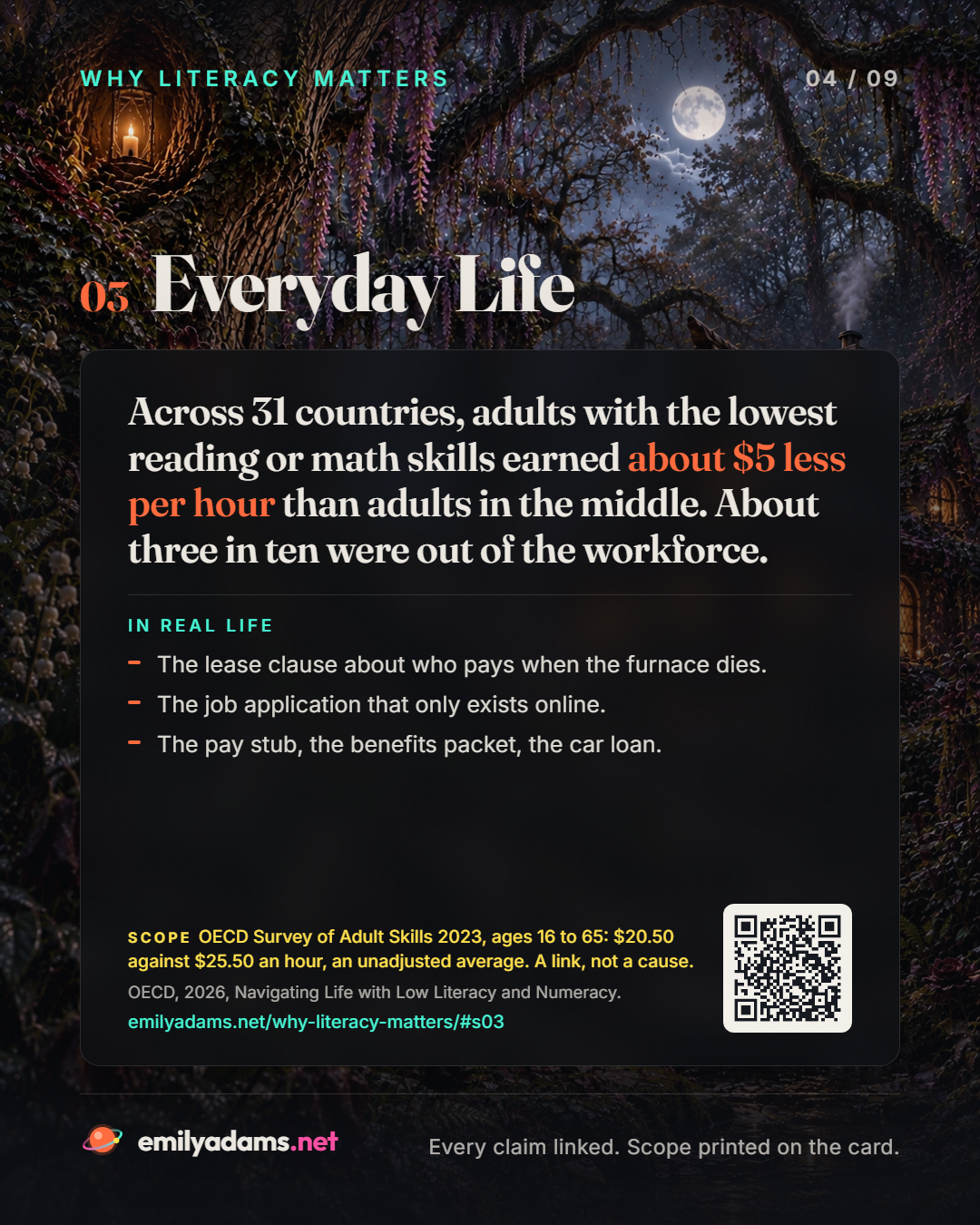
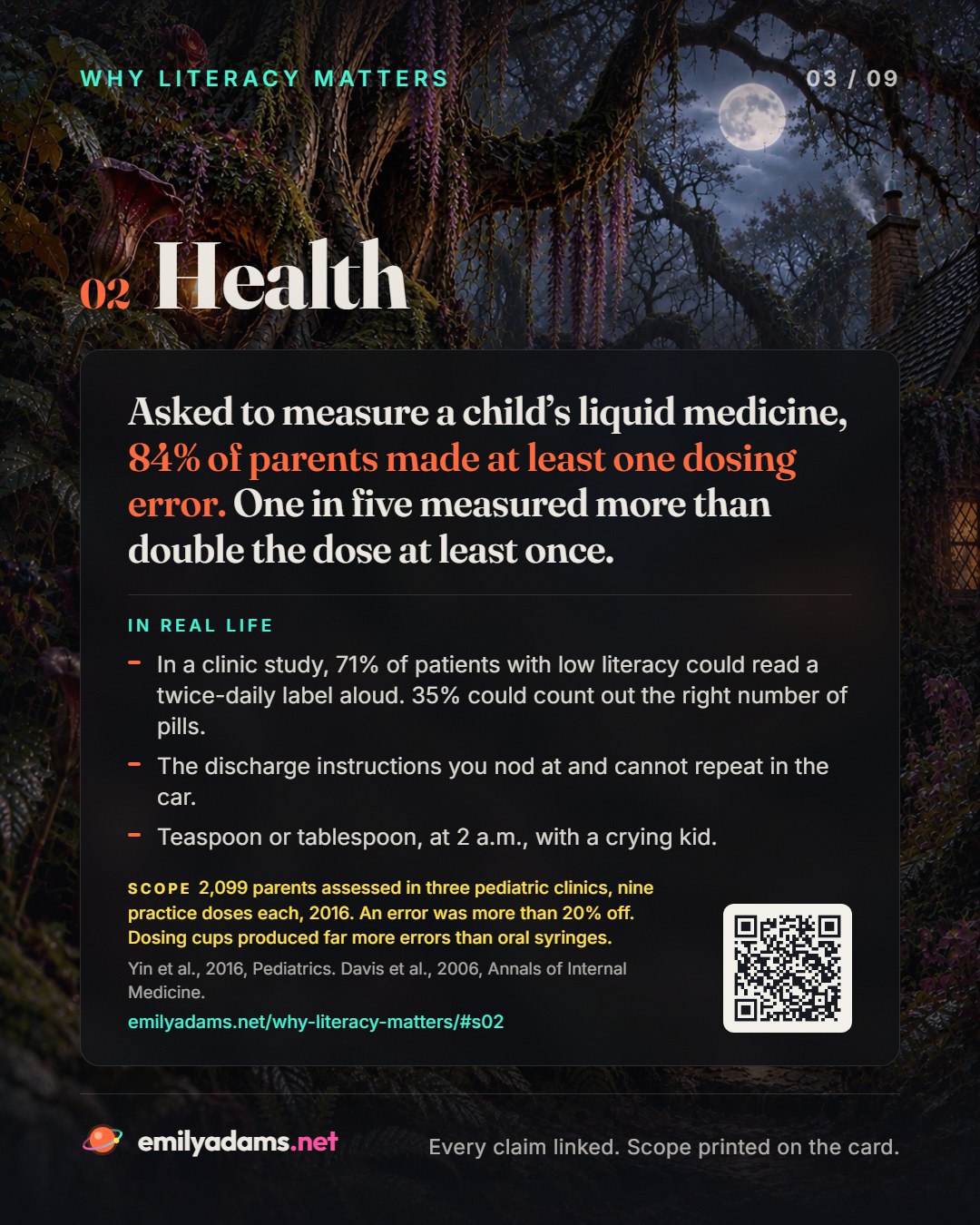
Everyday Life. Across 31 countries, adults with the lowest reading or math skills earned about $5 less per hour than adults in the middle. About three in ten were out of the workforce.
  • The lease clause about who pays when the furnace dies.
  • The job application that only exists online.
  • The pay stub, the benefits packet, the car loan.
SCOPE OECD Survey of Adult Skills 2023, ages 16 to 65: $20.50 against $25.50 an hour, an unadjusted average. A link, not a cause.
Sources and linksCard 4
Card 05 of 09
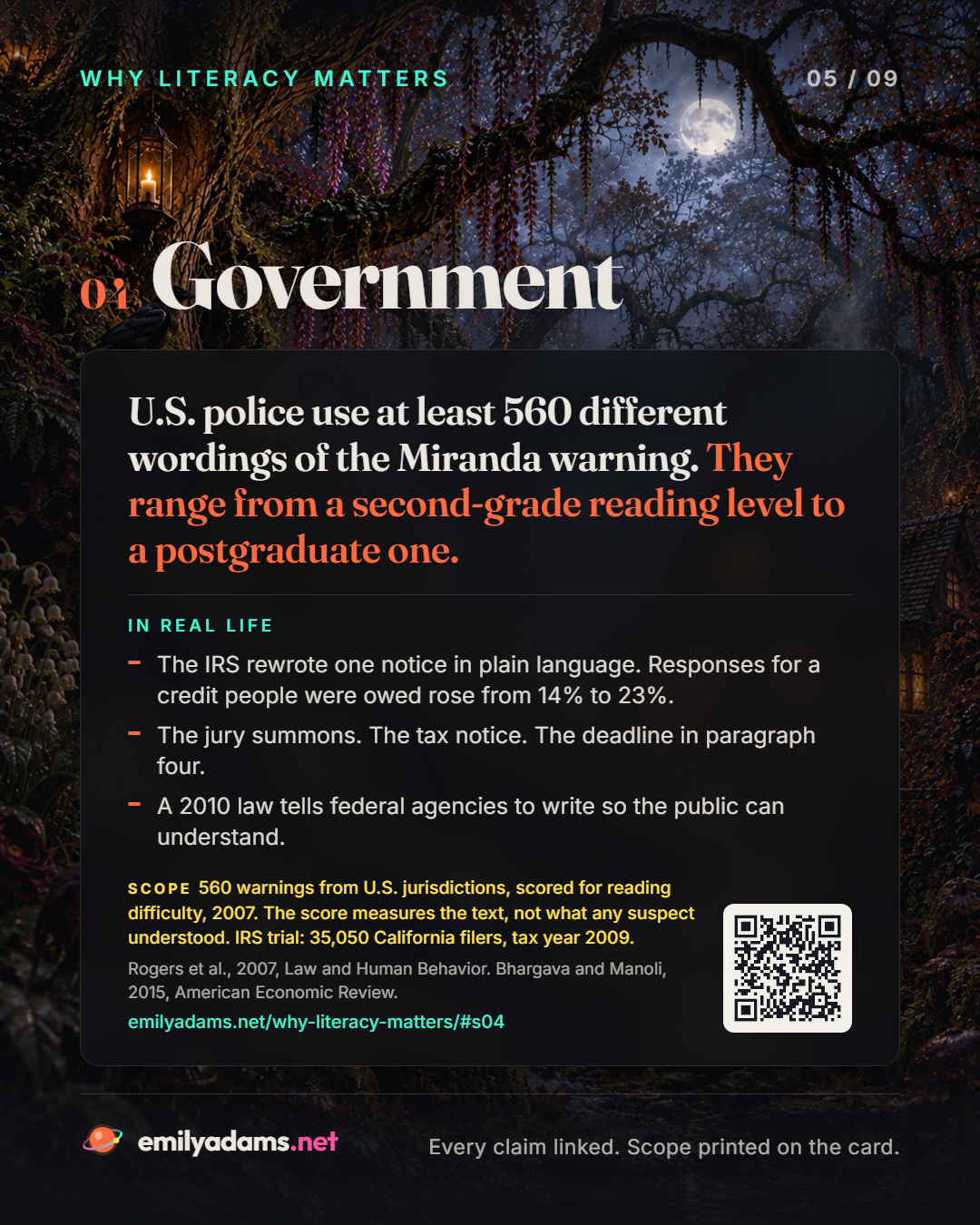
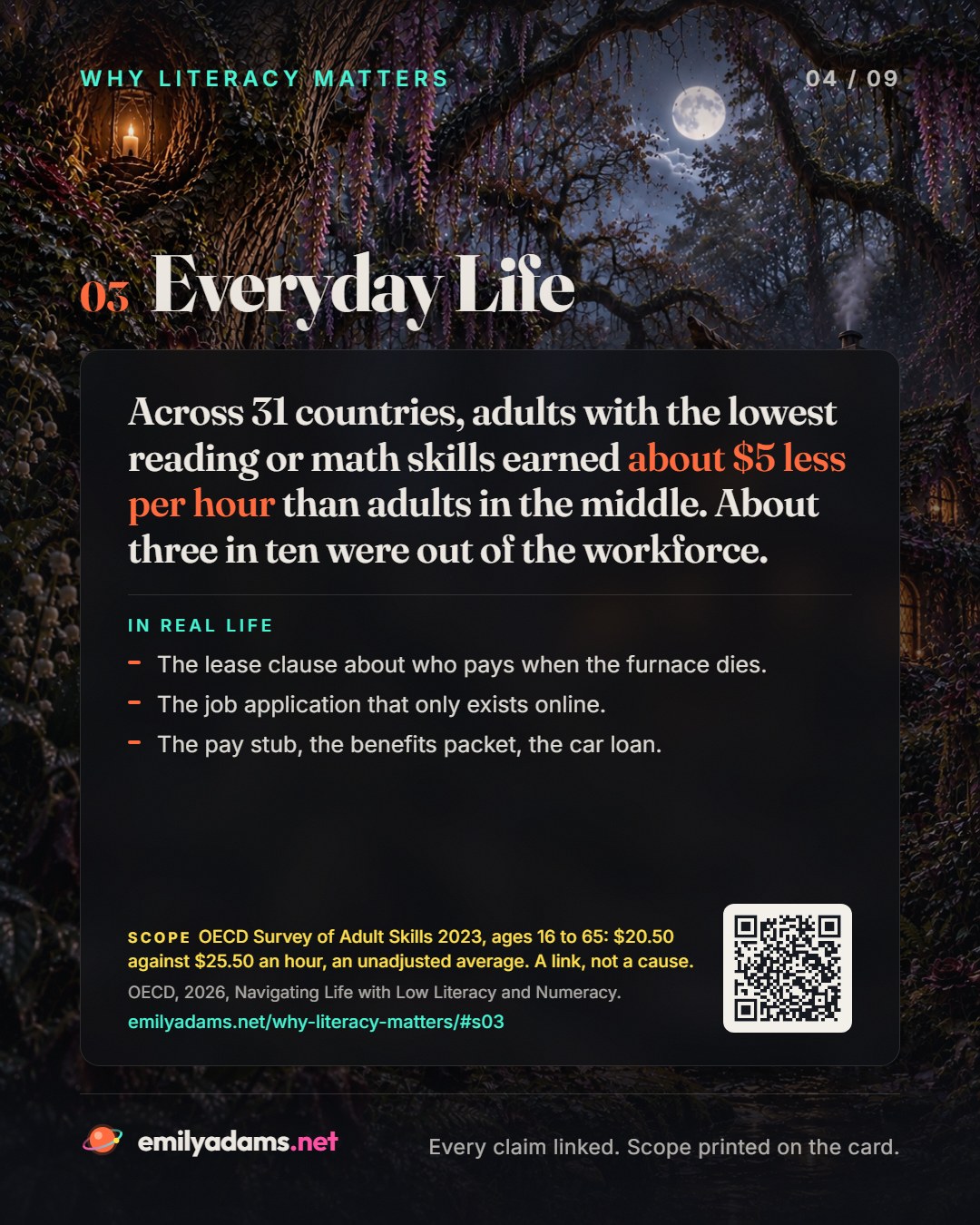
Government. U.S. police use at least 560 different wordings of the Miranda warning. They range from a second-grade reading level to a postgraduate one.
  • The IRS rewrote one notice in plain language. Responses for a credit people were owed rose from 14% to 23%.
  • The jury summons. The tax notice. The deadline in paragraph four.
  • A 2010 law tells federal agencies to write so the public can understand.
SCOPE 560 warnings from U.S. jurisdictions, scored for reading difficulty, 2007. The score measures the text, not what any suspect understood. IRS trial: 35,050 California filers, tax year 2009.
Sources and linksCard 5
Card 06 of 09
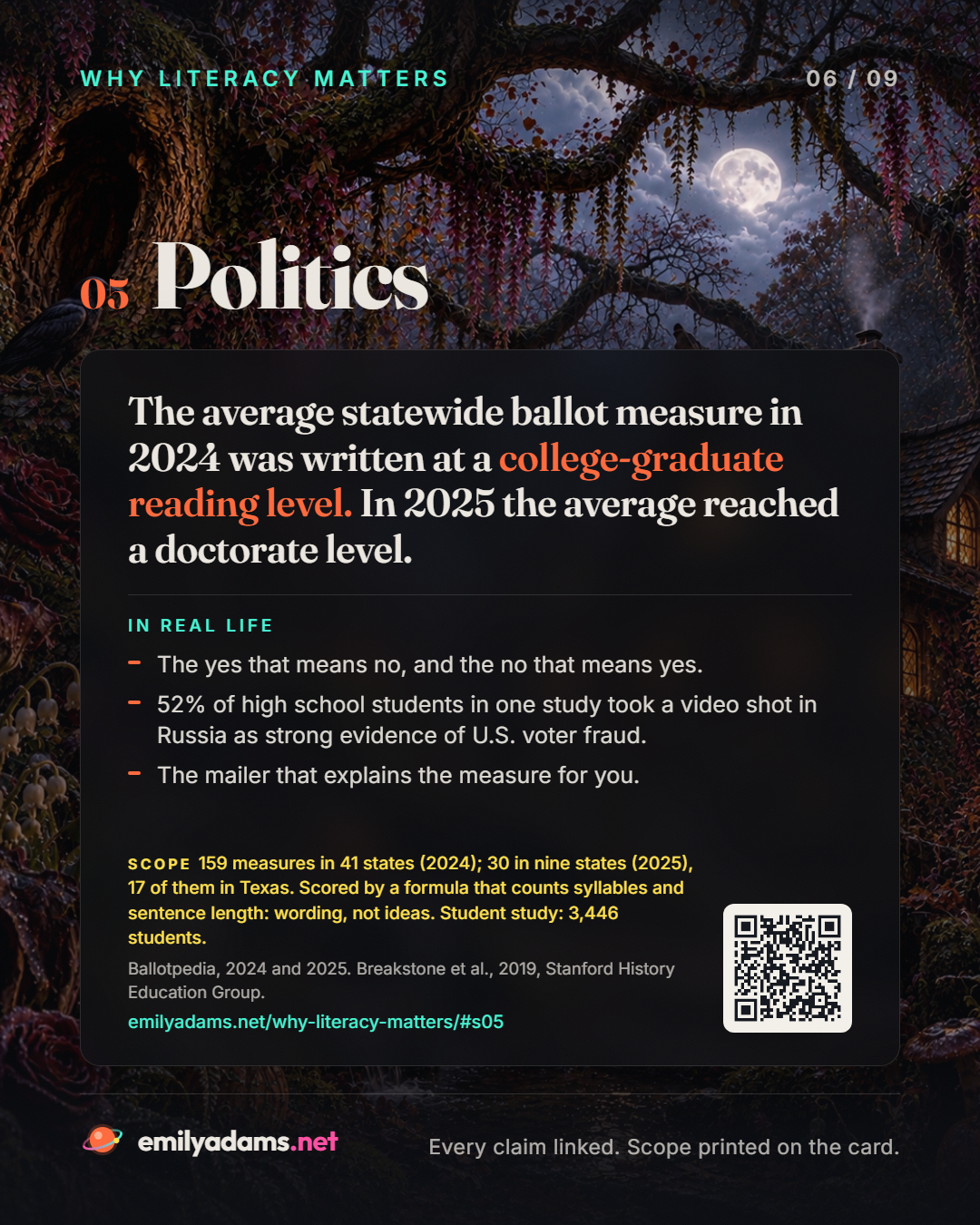
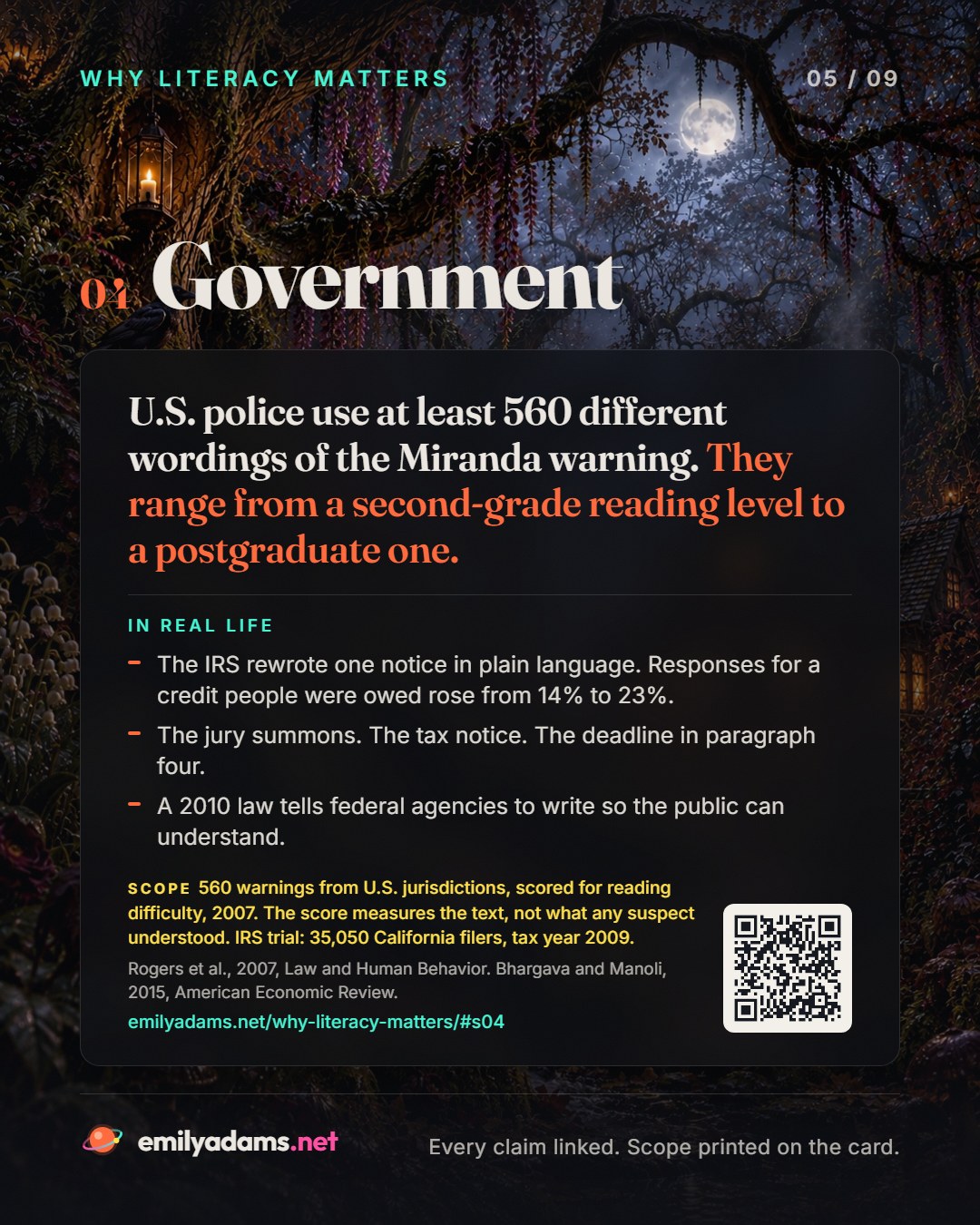
Politics. The average statewide ballot measure in 2024 was written at a college-graduate reading level. In 2025 the average reached a doctorate level.
  • The yes that means no, and the no that means yes.
  • 52% of high school students in one study took a video shot in Russia as strong evidence of U.S. voter fraud.
  • The mailer that explains the measure for you.
SCOPE 159 measures in 41 states (2024); 30 in nine states (2025), 17 of them in Texas. Scored by a formula that counts syllables and sentence length: wording, not ideas. Student study: 3,446 students.
Sources and linksCard 6
Card 07 of 09
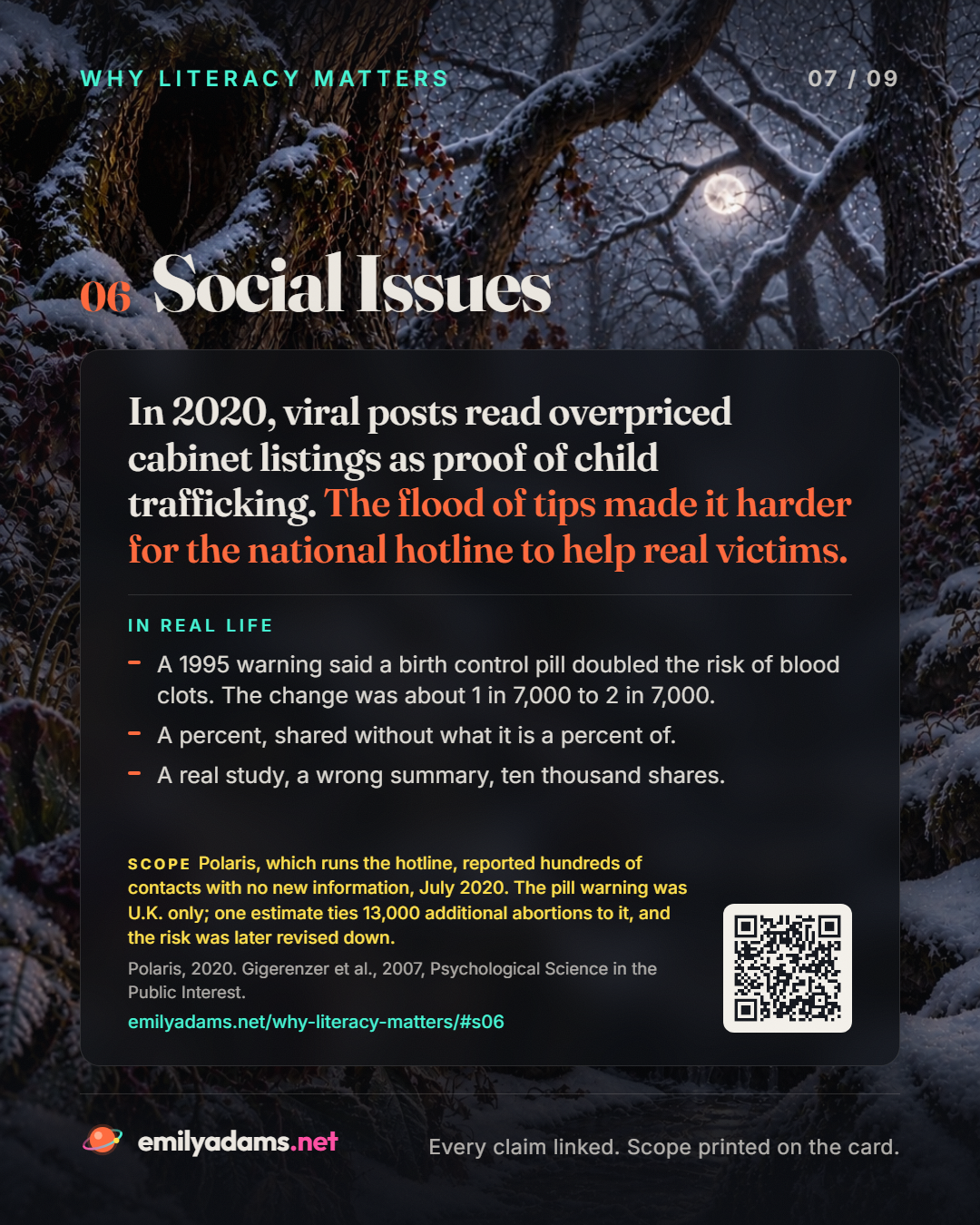
Social Issues. In 2020, viral posts read overpriced cabinet listings as proof of child trafficking. The flood of tips made it harder for the national hotline to help real victims.
  • A 1995 warning said a birth control pill doubled the risk of blood clots. The change was about 1 in 7,000 to 2 in 7,000.
  • A percent, shared without what it is a percent of.
  • A real study, a wrong summary, ten thousand shares.
SCOPE Polaris, which runs the hotline, reported hundreds of contacts with no new information, July 2020. The pill warning was U.K. only; one estimate ties 13,000 additional abortions to it, and the risk was later revised down.
Sources and linksCard 7
Card 08 of 09
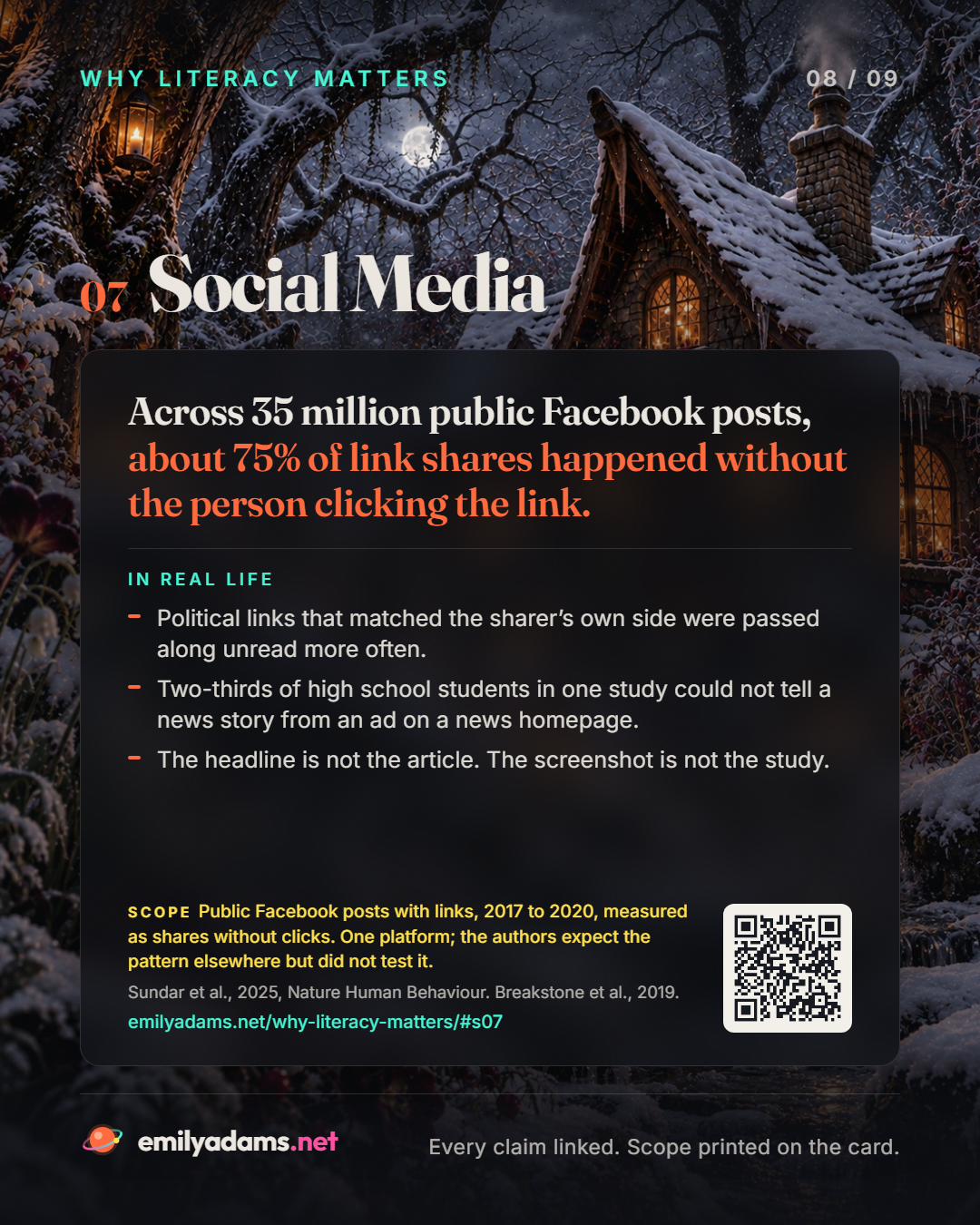
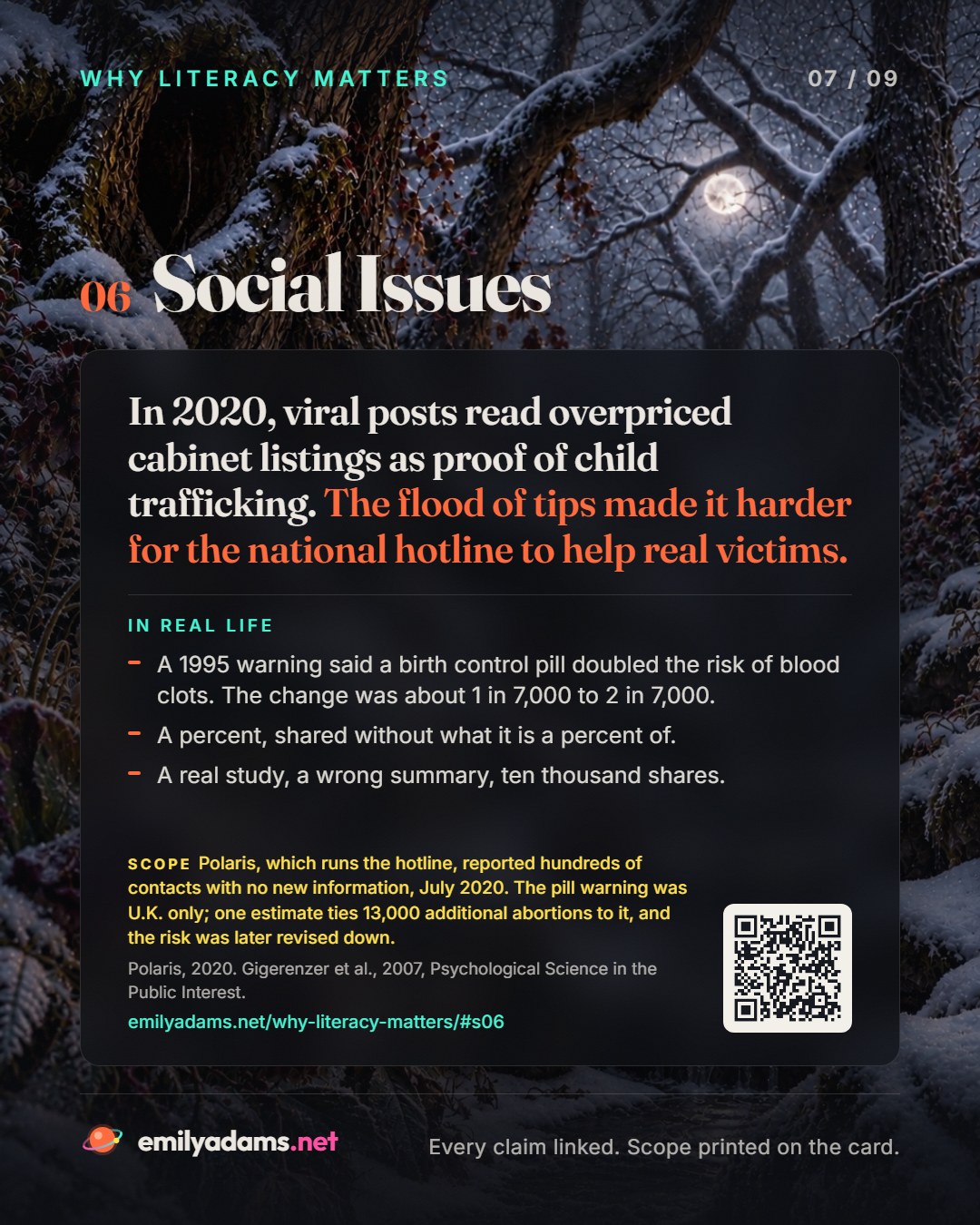
Social Media. Across 35 million public Facebook posts, about 75% of link shares happened without the person clicking the link.
  • Political links that matched the sharer’s own side were passed along unread more often.
  • Two-thirds of high school students in one study could not tell a news story from an ad on a news homepage.
  • The headline is not the article. The screenshot is not the study.
SCOPE Public Facebook posts with links, 2017 to 2020, measured as shares without clicks. One platform; the authors expect the pattern elsewhere but did not test it.
Sources and linksCard 8
Card 09 of 09
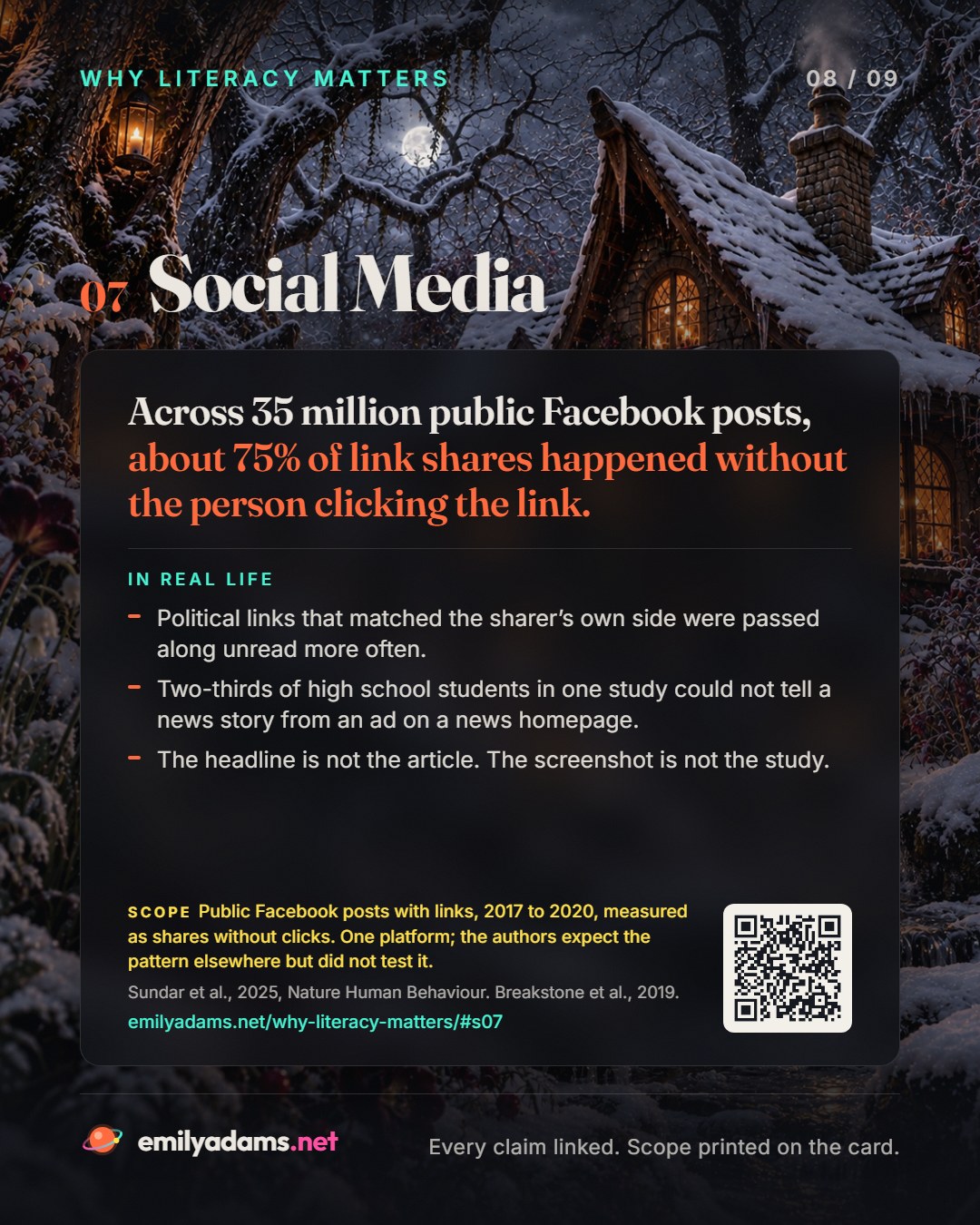
Nobody is coming to read it for you.
  • Some of this is written to be hard. That is a reason to get better at reading it, not a reason to stop.
  • Understanding what you sign, take, share, and vote on is your responsibility. No one else is going to carry it.
  • Predatory people, institutions, and businesses rely on the odds that you will not grasp the full scope of what they are saying.
  • Build the skill on purpose. Read the whole thing. Ask what a word means. Ask what was left out.
  • Make sure your kids can do it too. Do not ask whether they read it. Ask them to tell you what it means.
The space between what is written and what is understood is where social engineering works. Close it on your side.
What these numbers cannot tell youCard 9
Closing card
Reading the words is step one.
  • Next in this series: what literacy actually means, how it is measured, and the moves that work on every one of us, me included. Every number on these cards is linked, with its limits.
Closing card

The Sources

Grouped by card. Each source has a summary of what it found, a scope line saying how far the finding reaches, and a link to the original.

Card 2

Commerce

On card 2

The Biggest Lie on the Internet: Ignoring the Privacy Policies and Terms of Service Policies of Social Networking Services

Obar and Oeldorf-Hirsch, 2020 · Information, Communication and Society, 23(1), 128 to 147; published online July 3, 2018

543 undergraduates were asked to join a social network called NameDrop, which did not exist. 74% skipped the privacy policy by choosing a quick-join option. At a normal reading speed the privacy policy should have taken 29 to 32 minutes and the terms of service 15 to 17; the people who opened them spent an average of 73 seconds on the first and 51 on the second. 98% missed two clauses planted in the terms: one about sharing data with the NSA and employers, and one about providing a first-born child as payment.

Scope  One experimental survey of undergraduates signing up for a fictitious site, so the rates may not hold for other ages or for real services. The first-born clause was a test and was never a real contract.
On card 2

FTC Secures Historic $2.5 Billion Settlement Against Amazon

Federal Trade Commission, 2025 · Press release, September 25, 2025, and the stipulated order in FTC v. Amazon.com, Inc., Case No. 2:23-cv-00932-JHC (W.D. Wash.)

The FTC alleged that Amazon enrolled people in Prime without clear consent and made cancelling difficult. The settlement set a $1 billion civil penalty and a $1.5 billion fund for refunds, covering an estimated 35 million consumers. The court order requires a clear button to decline Prime and gives, as an example of wording that is no longer allowed, “no thanks, I don’t want free shipping.”

Scope  A settlement of allegations, with no court finding of liability. The order says the defendants neither admit nor deny the allegations. Refund terms have changed since: in September 2026 the FTC raised the payment cap from $51 to $200.
Card 3

Health

On card 3

Liquid Medication Errors and Dosing Tools: A Randomized Controlled Experiment

Yin and colleagues, 2016 · Pediatrics, 138(4), e20160357

2,110 parents of children eight or younger were enrolled at three pediatric clinics and randomly given different labels and dosing tools. Each measured nine doses. Of the 2,099 parents assessed, 84.4% made at least one dosing error, meaning more than 20% off, and 21.0% made at least one large error, meaning more than double the dose. Dosing cups produced far more errors than oral syringes (adjusted odds ratio 4.6).

Scope  A measuring task watched by researchers, which the authors say might not reflect how parents dose at home. The three clinics, in New York, Stanford, and Atlanta, served mostly low-income families.
On card 3

Literacy and Misunderstanding Prescription Drug Labels

Davis and colleagues, 2006 · Annals of Internal Medicine, 145(12), 887 to 894

395 English-speaking adults at three primary care clinics were asked to read and explain prescription labels. Among patients reading at or below a sixth-grade level, 70.7% correctly stated the instruction to take two tablets by mouth twice daily, but 34.7% could show how many pills that meant in a day.

Scope  Both percentages are of the low-literacy group, not of all 395 patients. The clinics, in Shreveport, Jackson, and Chicago, served mostly indigent patients, and actual drug-taking was not measured.
Card 4

Everyday Life

On card 4

Navigating Life with Low Literacy and Numeracy: New Results from the 2023 Survey of Adult Skills

OECD, 2026 · OECD Skills Studies, OECD Publishing, July 1, 2026, chapter 1

Across the 31 countries and economies in the 2023 Survey of Adult Skills, adults with low skills earned $20.50 an hour on average, against $25.50 for adults with medium skills, in purchasing-power dollars. Around 30% of adults with low skills were outside the labor market, against around 19% of those with medium skills. Low means at or below Level 1 in literacy or numeracy; medium means Level 2 or 3 in both.

Scope  Unadjusted cross-country averages, and a link, not a cause. Adults ages 16 to 65.
Background context

Highlights of the 2023 U.S. PIAAC Results

National Center for Education Statistics, 2024 · NCES, U.S. Department of Education, December 2024. Background; not on a card.

The U.S. figures from the same survey. In 2023, 28% of U.S. adults scored at Level 1 or below in literacy, up from 19% in 2017, and 44% scored at Level 3 or above. The next parts of this series explain what those levels mean.

Scope  NCES says to compare 2023 with earlier rounds with caution: the 2023 test was given on tablets, added easier questions, and included adults who spoke neither English nor Spanish. Adults ages 16 to 65.
Card 5

Government

On card 5

An Analysis of Miranda Warnings and Waivers: Comprehension and Coverage

Rogers and colleagues, 2007 · Law and Human Behavior, 31(2), 177 to 192

The researchers collected 560 Miranda warnings from across the United States and scored how hard each one was to read. The warnings ranged from very simple, a 2.8 grade level, to requiring a postgraduate education.

Scope  The score, Flesch-Kincaid, measures the written text by word and sentence length. The study did not test what actual suspects understood.
On card 5

Psychological Frictions and the Incomplete Take-Up of Social Benefits: Evidence from an IRS Field Experiment

Bhargava and Manoli, 2015 · American Economic Review, 105(11), 3489 to 3529

The IRS mailed experimental versions of a reminder to 35,050 California filers who had not claimed the Earned Income Tax Credit they qualified for in tax year 2009. With a complex notice and worksheet, 14% responded by returning the worksheet. With a simplified version, 23% did. When the notice also showed the size of the benefit, 31% did.

Scope  Filers in one state who had already ignored one IRS notice, and no version in the trial exactly duplicated the real notice. A widely quoted summary gives 17% for the standard notice; the paper’s own comparison is 14%.
On card 5

Plain Writing Act of 2010

U.S. Congress, 2010 · Public Law 111-274, approved October 13, 2010

The law’s stated purpose is to improve the effectiveness and accountability of federal agencies by promoting clear government communication that the public can understand and use.

Scope  The Act has no enforcement mechanism, and it does not cover regulations.
Card 6

Politics

On card 6

Ballot Measure Readability Scores, 2024 and 2025

Ballotpedia, 2024 and 2025 · Ballotpedia.org

Ballotpedia scores the wording of every statewide ballot question. In 2024, 159 measures in 41 states averaged a grade level of 16, about a bachelor’s degree. In 2025, 30 measures in nine states averaged 21, the highest since tracking began in 2017.

Scope  The formula counts syllables, words, and sentences. It measures wording, not how complicated the idea is. The 2025 average rests on only 30 measures, 17 of them from Texas.
On card 6

Students’ Civic Online Reasoning: A National Portrait

Breakstone and colleagues, 2019 · Stanford History Education Group, 2019; journal version in Educational Researcher, 50(8), 505 to 515, 2021

3,446 high school students, a sample matched to the national profile, completed six tasks. 52% believed a video that claimed to show ballot stuffing was strong evidence of U.S. voter fraud; the video was shot in Russia. Two-thirds could not tell news stories from ads marked as sponsored content on a news site’s home page.

Scope  High school students tested from June 2018 to May 2019. The figures describe teenagers at that time, not adults and not current students.
Card 7

Social Issues

On card 7

Polaris Statement on Wayfair Sex Trafficking Claims

Polaris, 2020 · Press release, July 20, 2020. Polaris operates the National Human Trafficking Hotline.

Viral posts claimed that high-priced cabinet listings on a retailer’s site were evidence of child trafficking. Polaris said the hotline had received hundreds of reports over several days, that none contained information beyond what was already circulating online, and that the extreme volume had made it more difficult to provide support and attention to others who needed help.

Scope  The organization’s own statement. It gives no exact count beyond hundreds and no time window beyond several days.
On card 7

Helping Doctors and Patients Make Sense of Health Statistics

Gigerenzer and colleagues, 2007 · Psychological Science in the Public Interest, 8(2), 53 to 96

In October 1995 a U.K. regulator warned that a newer generation of birth control pills doubled the risk of blood clots. In absolute terms, the authors write, about 1 in 7,000 women on the earlier pills had a clot, and that rose to 2 in 7,000. They attribute an estimated 13,000 additional abortions in England and Wales in the following year to the scare.

Scope  The 13,000 is an estimate from a before-and-after change in national counts, not a controlled study. In 1999 the regulator revised the risk down to about 1.7 times.
Card 8

Social Media

On card 8

Sharing Without Clicking on News in Social Media

Sundar and colleagues, 2025 · Nature Human Behaviour, 9(1), 156 to 168; published online November 19, 2024

An analysis of more than 35 million public Facebook posts with links, shared between 2017 and 2020, found that shares without clicks made up around 75% of forwarded links. Extreme political content, and content that matched the sharer’s own politics, received more shares without clicks. The student study on this card is listed under Politics.

Scope  Facebook only, using aggregated data supplied by Meta. A share without a click cannot show whether the person had read the article somewhere else.

What These Numbers Cannot Tell You

Most of this is a link, not a cause. Lower literacy travels with lower pay and worse health outcomes in these sources. None of them proves that one produces the other.
The samples are specific. College undergraduates on a made-up website. Parents at three pediatric clinics. High school students in 2018 and 2019. California tax filers who had already ignored one letter. Each number describes those people in that setting, and the cards say which.
A reading level measures wording. The Miranda and ballot findings come from a formula that counts syllables and sentence length. It says how hard the text is to read. It does not say how well any one person understood it.
A settlement is not a verdict. Amazon neither admitted nor denied the FTC’s allegations, and no court ruled on them.
The everyday lines are examples. Under each finding the cards list situations such as a free trial, a lease clause, or a ballot mailer. The lines without a number are illustrations of where the skill shows up, not findings.
Hard documents are real, and they are not an excuse. Several of these sources point at the document: a policy that takes half an hour to read, a ballot written at a doctorate level, a dosing cup that makes errors likely. Card 9 is not a finding. It is my own conclusion: understanding what you read is still your responsibility, and your kids’ understanding is yours to build.

Why a series on social engineering starts with reading.

I work in marketing. Part of the job is knowing how people actually read: fast, on a phone, between other things. So when I set out to write about social engineering, the ways people get steered without noticing, I kept running into the same thing first. Before anyone manipulates you there is a document, a label, a ballot, or a feed, and a gap between what it says and what you take from it.

I went looking for what that gap costs, and I expected to find a story about people who cannot read. That is not what the sources show. The students who signed away a first-born child were in college. The parents measuring medicine were doing their best with a cup that makes errors likely. The ballot questions were written at a level most college graduates would find hard.

Literacy matters because every part of adult life runs on documents, and some of those documents are written to be hard. When the IRS rewrote one letter, more people got money they were owed. Writers can close part of the gap. Most of them will not.

So the rest is on us. Predatory people, institutions, and businesses rely on the odds that you will not grasp the full scope of what they are saying. Getting better at reading is how you stop being the easy mark, and making sure your kids understand what they read is part of the same job.

The rest of this series is about what moves into that gap, and how to see it coming.