The full text of every card, in order, with the card itself under each one. Select a card to open it full size.
Card 01 of 09
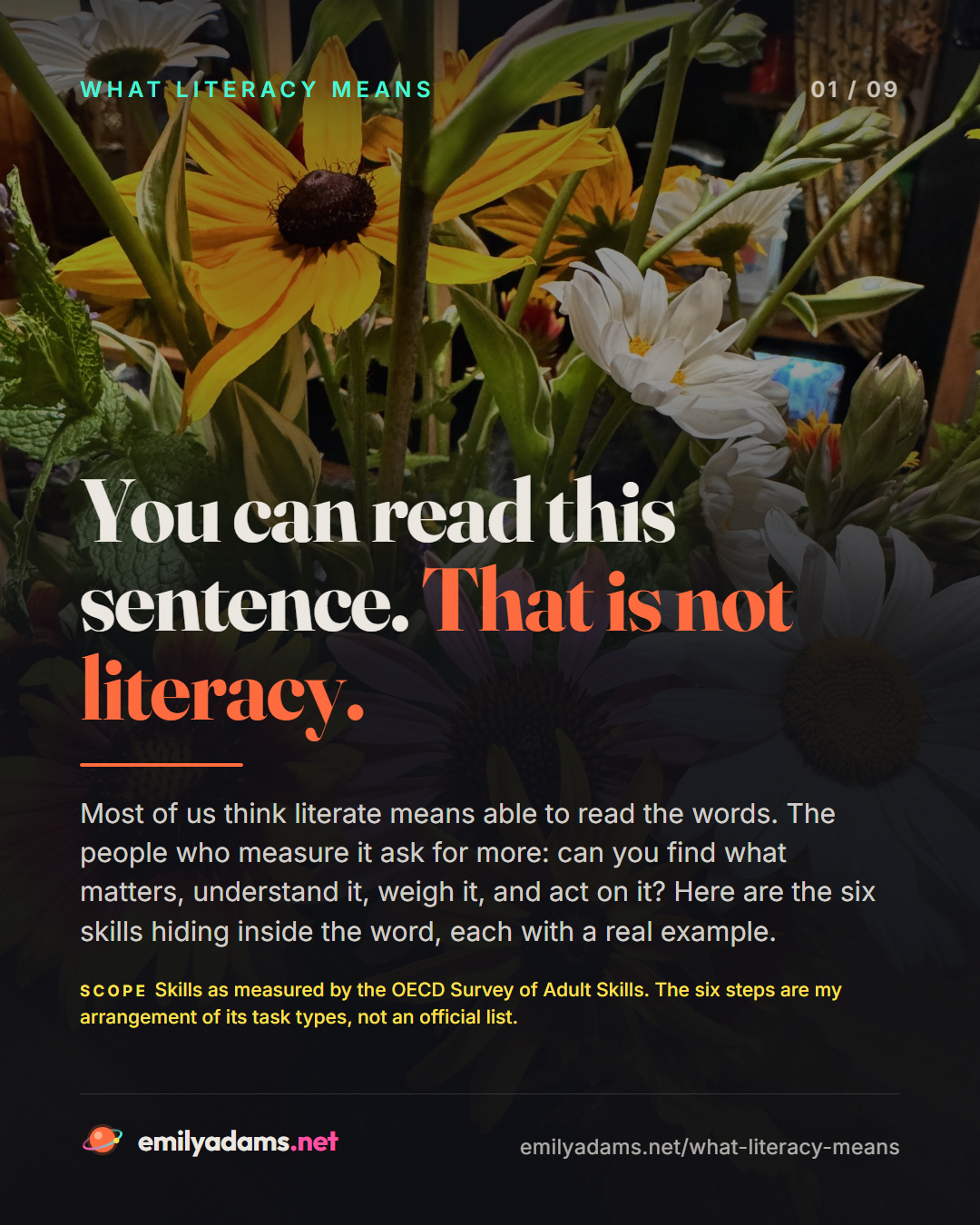
You can read this sentence. That is not literacy.
- Most of us think literate means able to read the words. The people who measure it ask for more: can you find what matters, understand it, weigh it, and act on it? Here are the six skills hiding inside the word, each with a real example.
SCOPE Skills as measured by the OECD Survey of Adult Skills. The six steps are my arrangement of its task types, not an official list.
All sources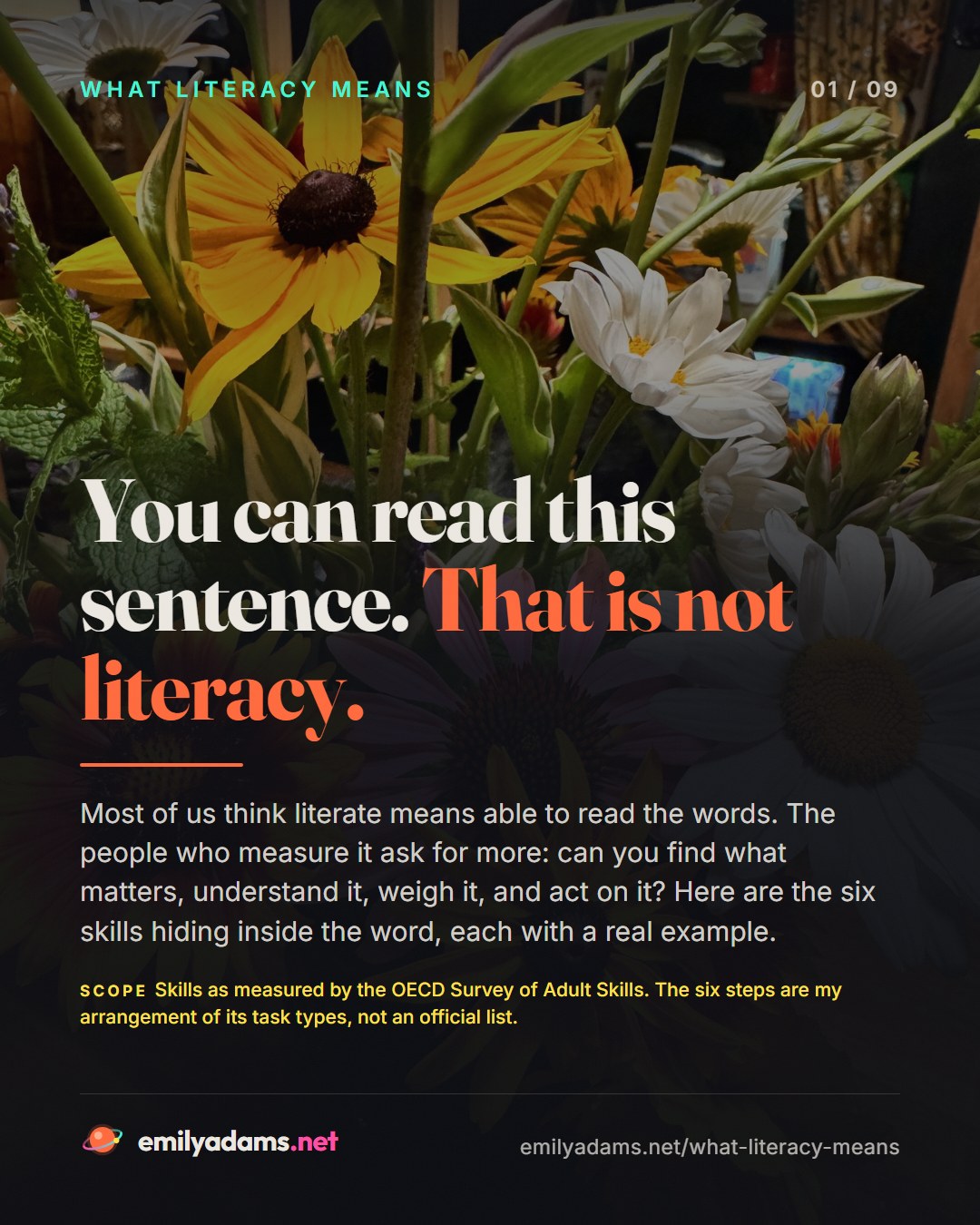
Card 02 of 09
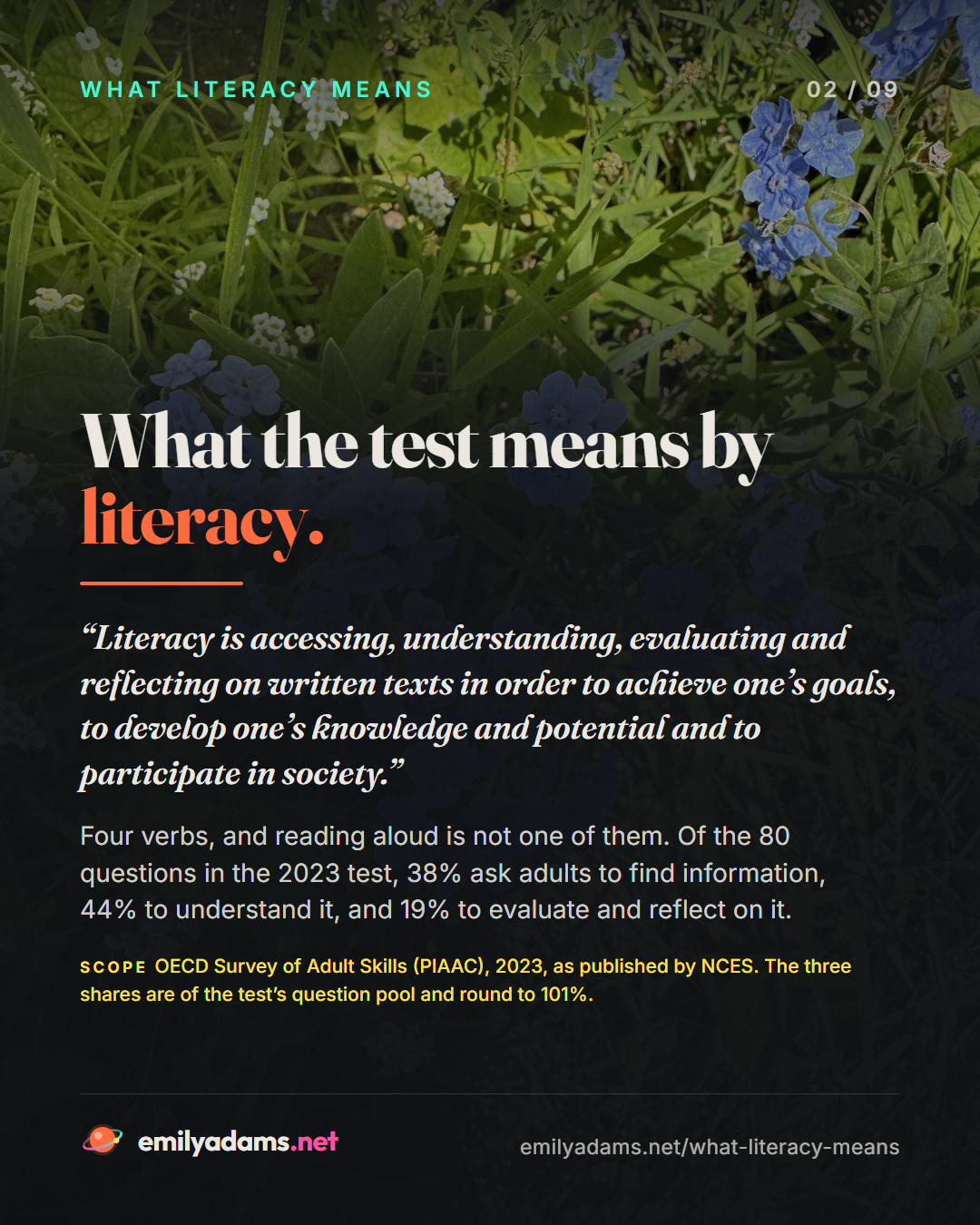
What the test means by literacy.
“Literacy is accessing, understanding, evaluating and reflecting on written texts in order to achieve one’s goals, to develop one’s knowledge and potential and to participate in society.”
- Four verbs, and reading aloud is not one of them. Of the 80 questions in the 2023 test, 38% ask adults to find information, 44% to understand it, and 19% to evaluate and reflect on it.
SCOPE OECD Survey of Adult Skills (PIAAC), 2023, as published by NCES. The three shares are of the test’s question pool and round to 101%.
Sources and links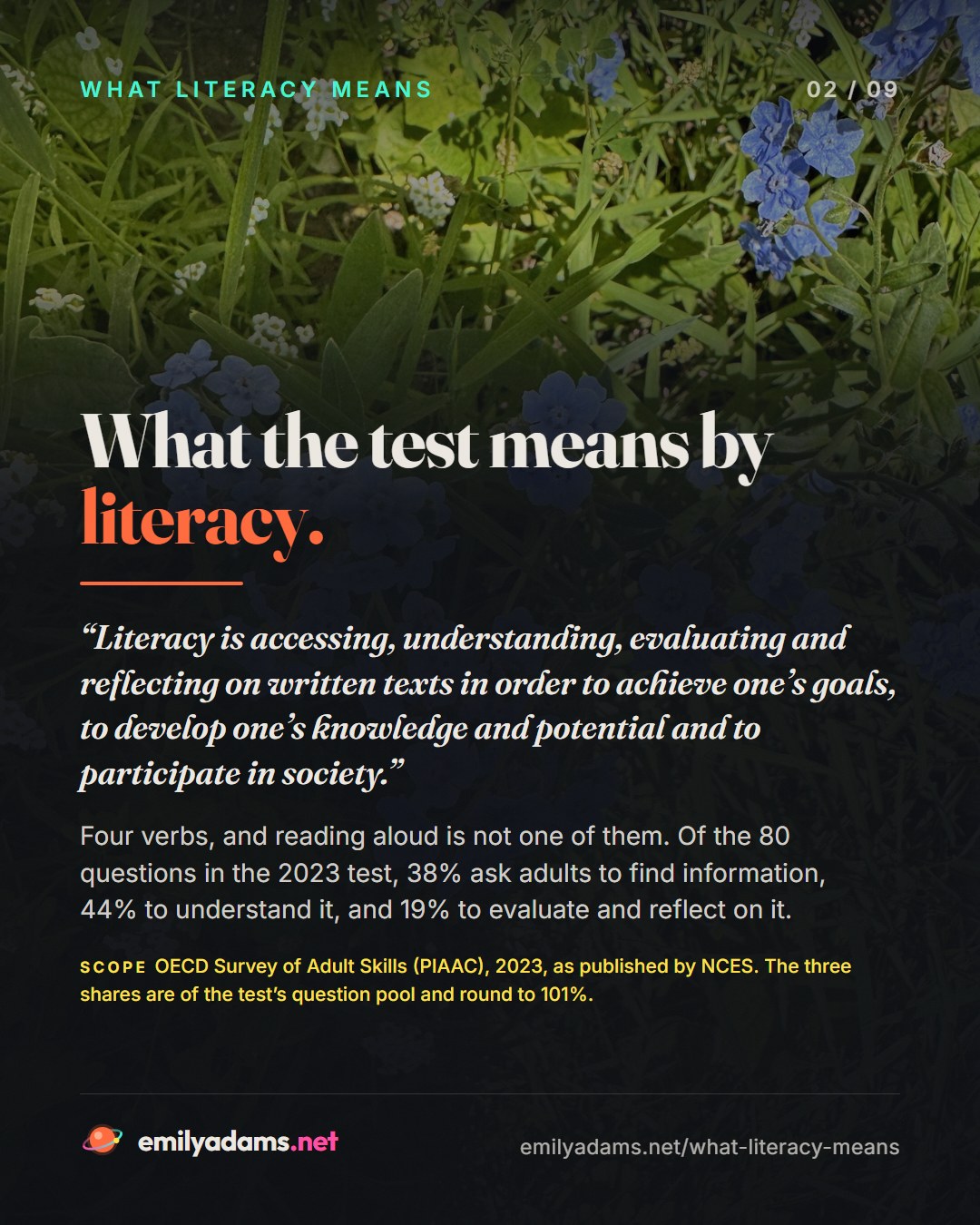
Card 03 of 09
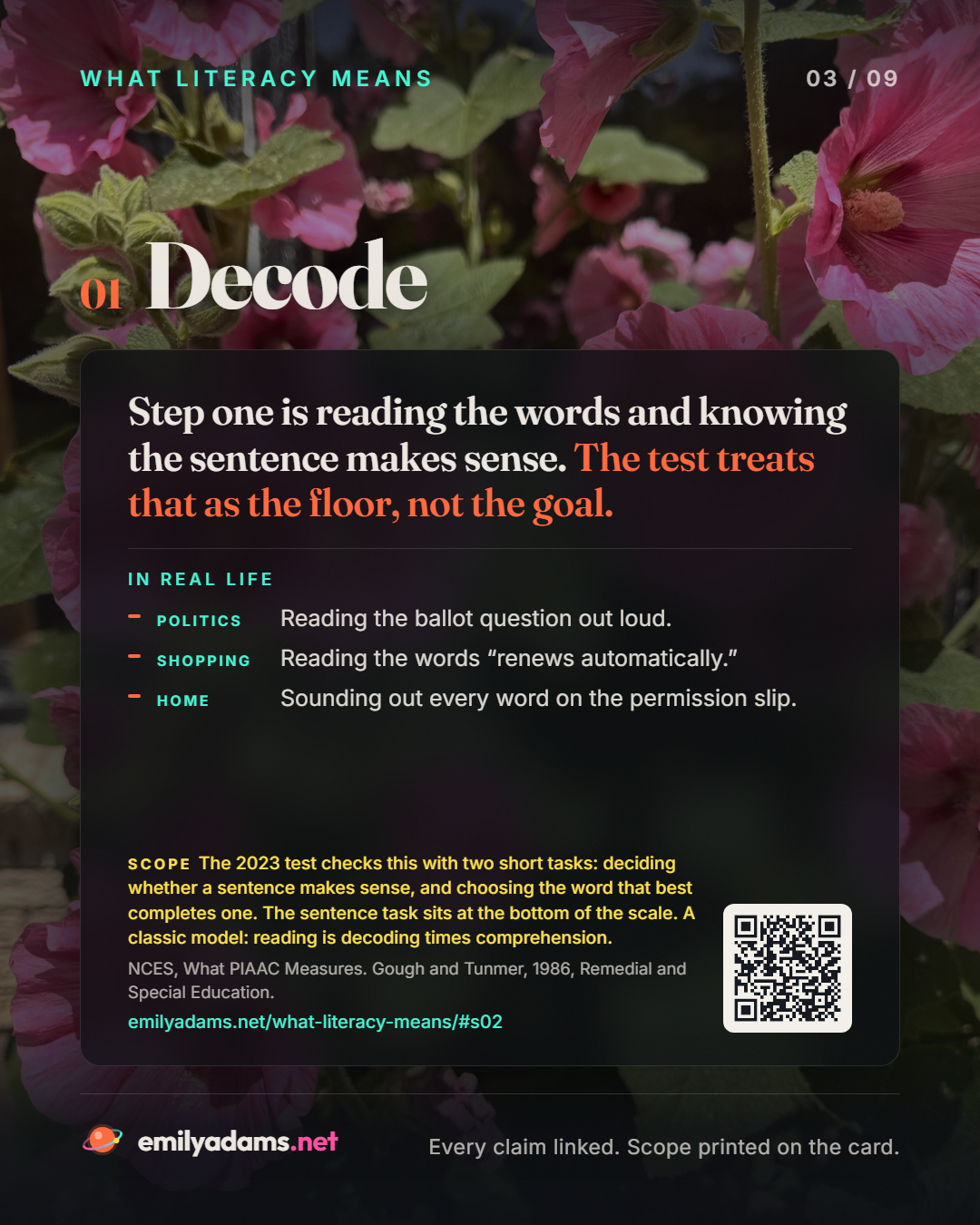
Decode. Step one is reading the words and knowing the sentence makes sense. The test treats that as the floor, not the goal.
- PoliticsReading the ballot question out loud.
- ShoppingReading the words “renews automatically.”
- HomeSounding out every word on the permission slip.
SCOPE The 2023 test checks this with two short tasks: deciding whether a sentence makes sense, and choosing the word that best completes one. The sentence task sits at the bottom of the scale. A classic model: reading is decoding times comprehension.
Sources and links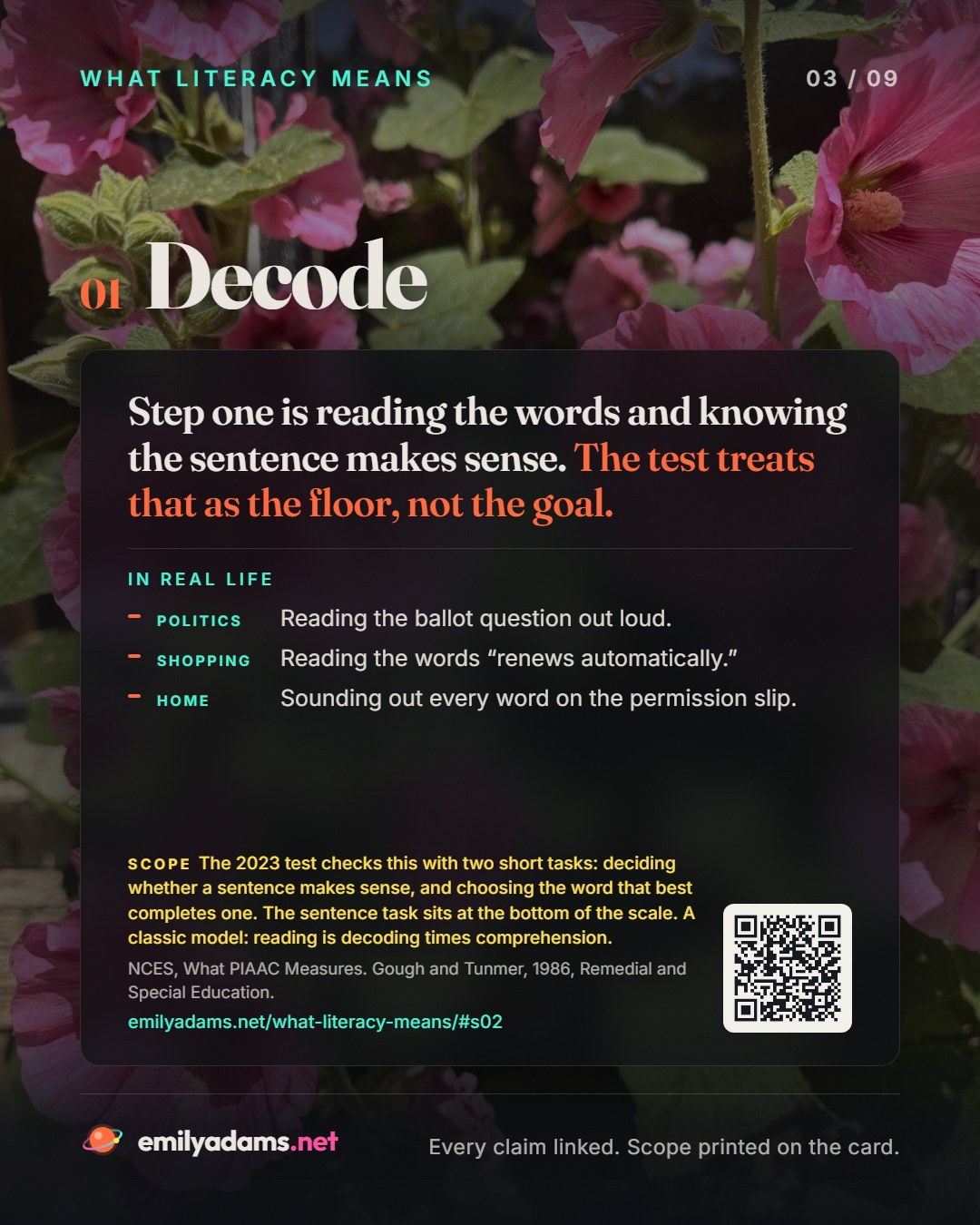
Card 04 of 09
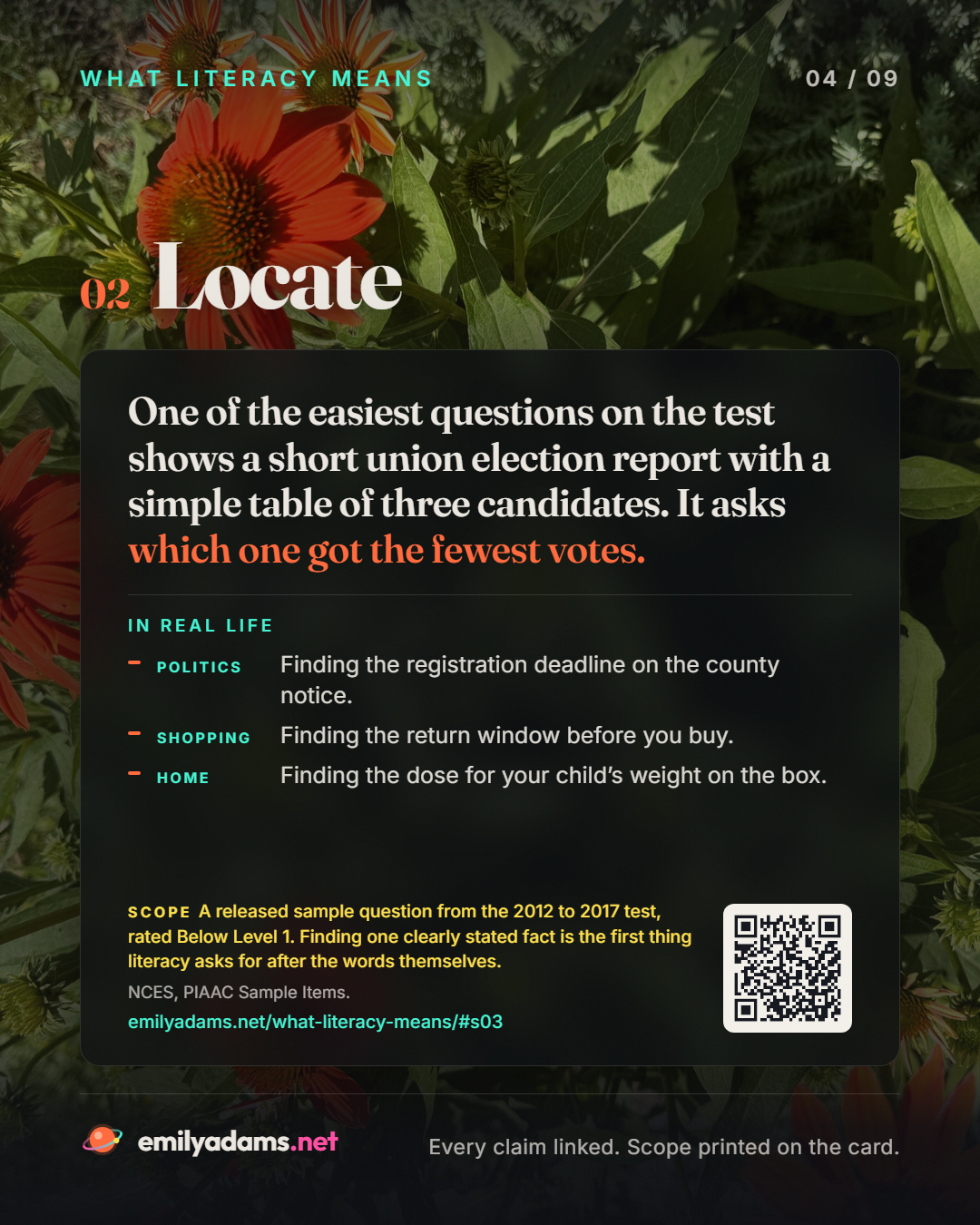
Locate. One of the easiest questions on the test shows a short union election report with a simple table of three candidates. It asks which one got the fewest votes.
- PoliticsFinding the registration deadline on the county notice.
- ShoppingFinding the return window before you buy.
- HomeFinding the dose for your child’s weight on the box.
SCOPE A released sample question from the 2012 to 2017 test, rated Below Level 1. Finding one clearly stated fact is the first thing literacy asks for after the words themselves.
Sources and links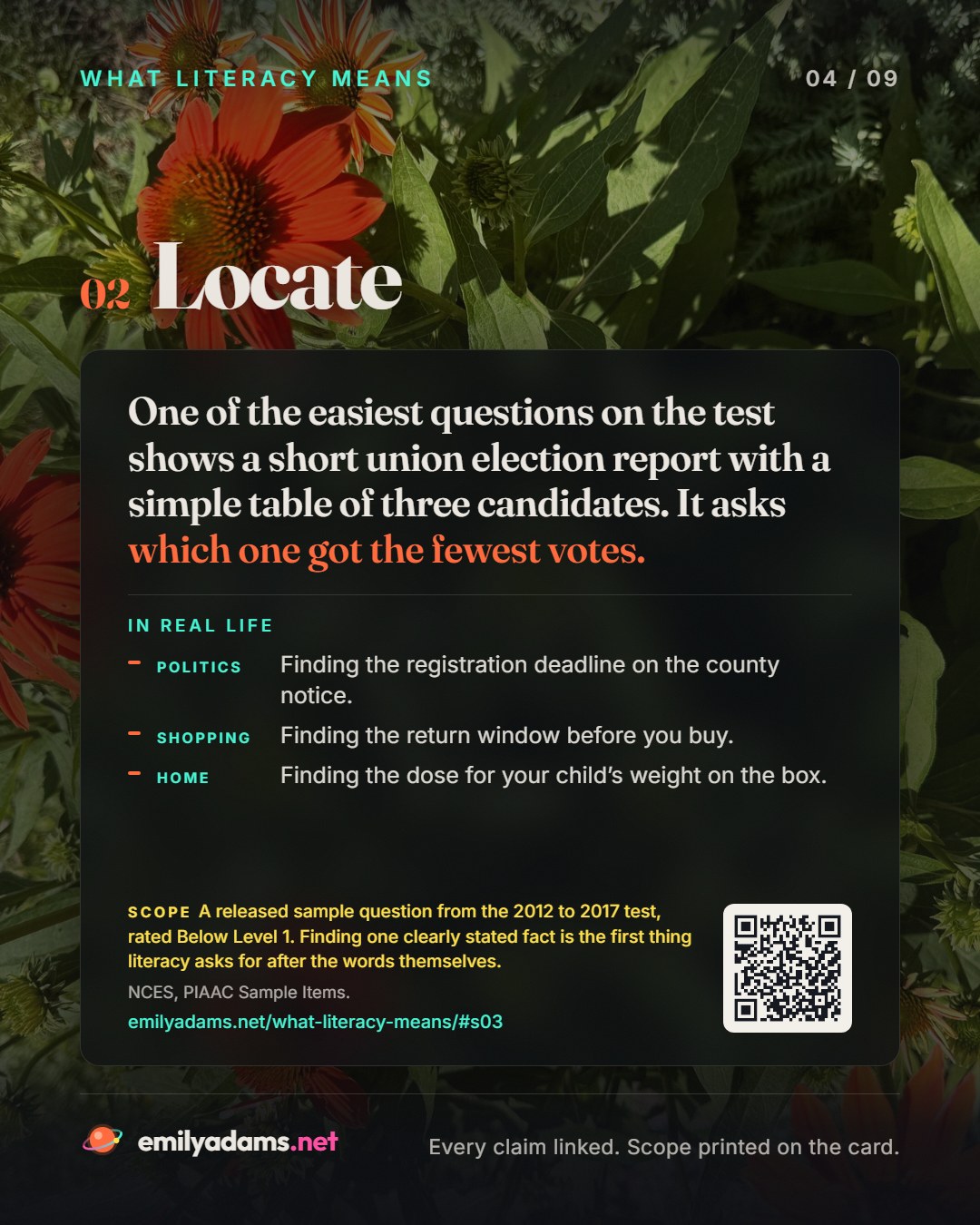
Card 05 of 09
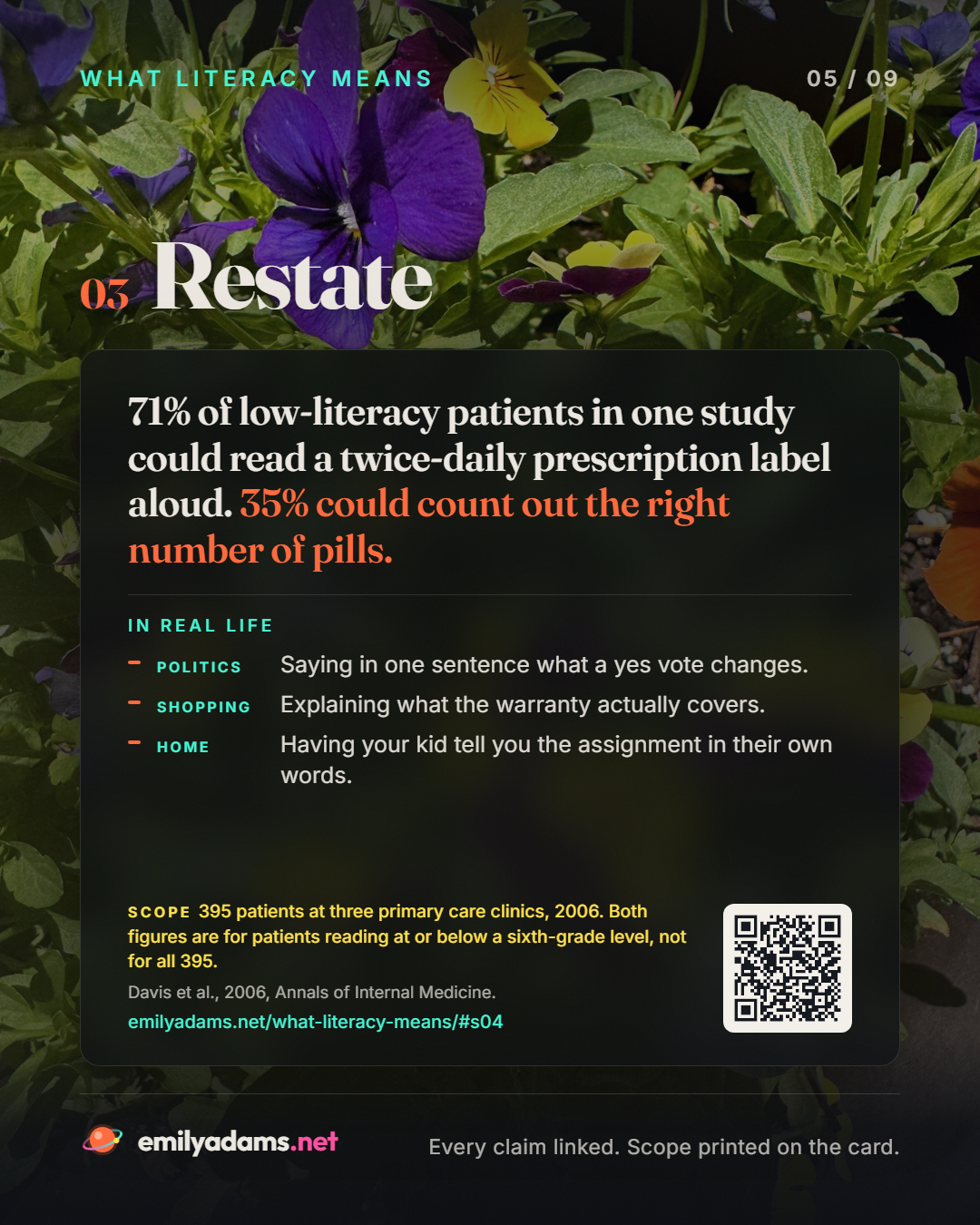
Restate. 71% of low-literacy patients in one study could read a twice-daily prescription label aloud. 35% could count out the right number of pills.
- PoliticsSaying in one sentence what a yes vote changes.
- ShoppingExplaining what the warranty actually covers.
- HomeHaving your kid tell you the assignment in their own words.
SCOPE 395 patients at three primary care clinics, 2006. Both figures are for patients reading at or below a sixth-grade level, not for all 395.
Sources and links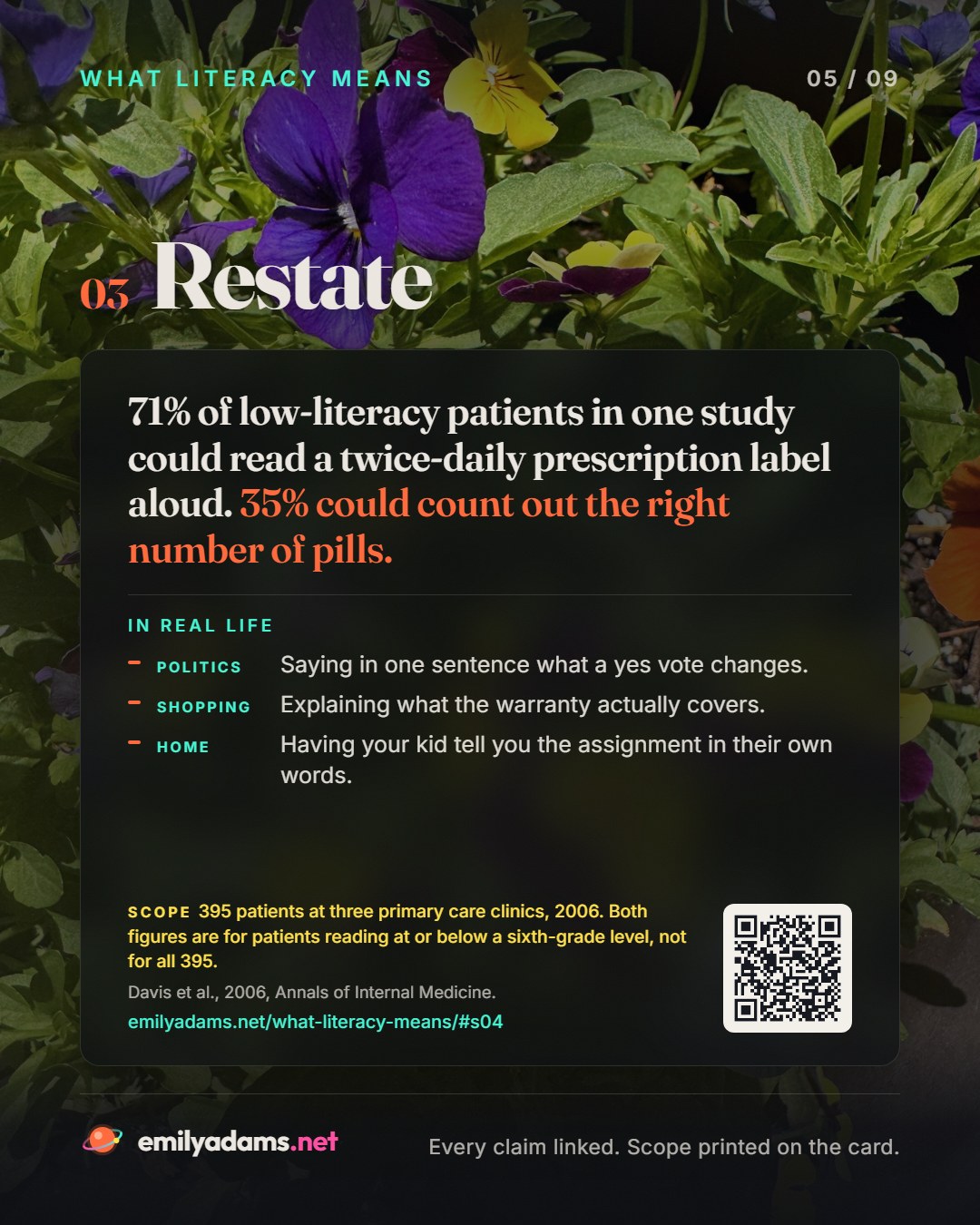
Card 06 of 09
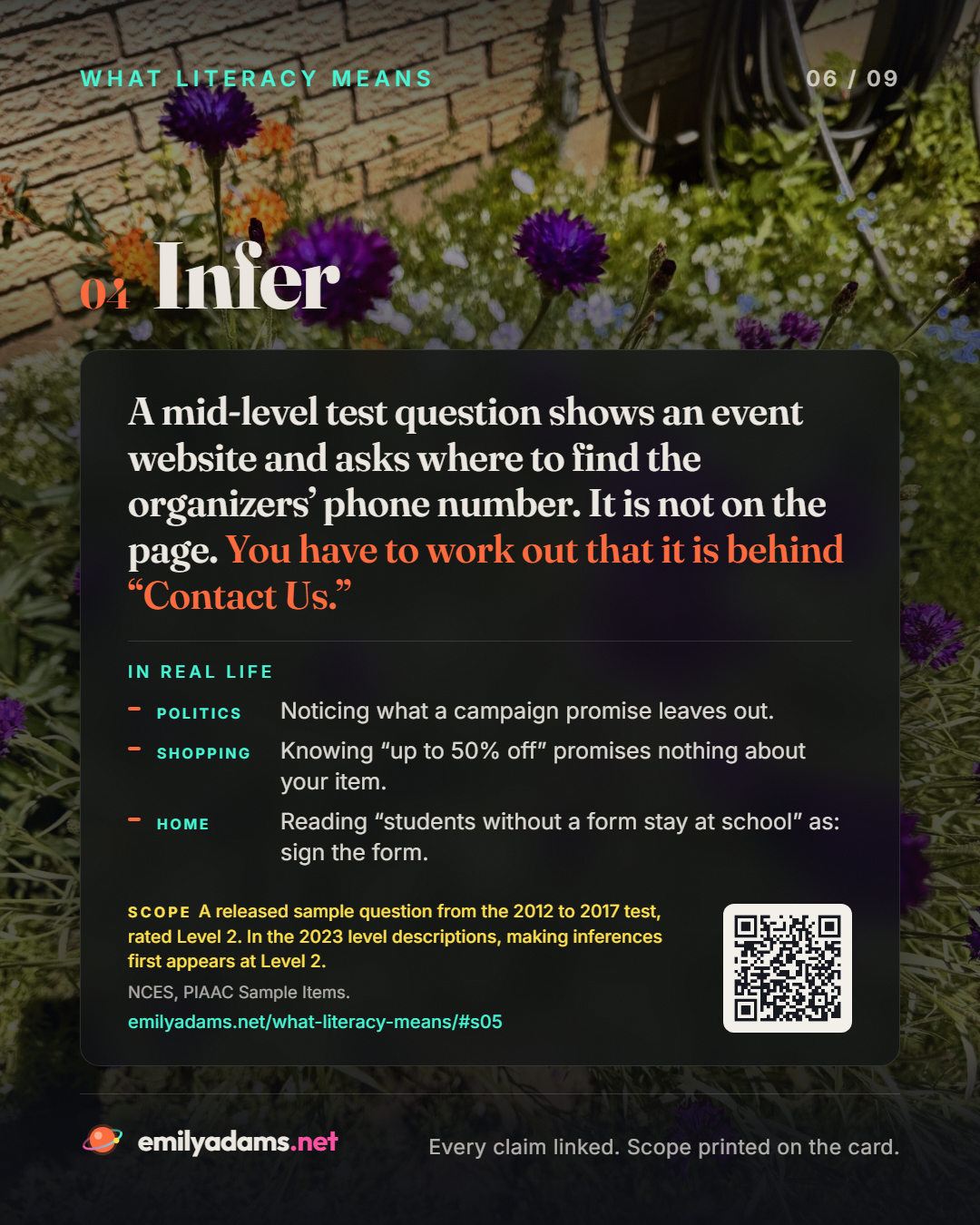
Infer. A mid-level test question shows an event website and asks where to find the organizers’ phone number. It is not on the page. You have to work out that it is behind “Contact Us.”
- PoliticsNoticing what a campaign promise leaves out.
- ShoppingKnowing “up to 50% off” promises nothing about your item.
- HomeReading “students without a form stay at school” as: sign the form.
SCOPE A released sample question from the 2012 to 2017 test, rated Level 2. In the 2023 level descriptions, making inferences first appears at Level 2.
Sources and links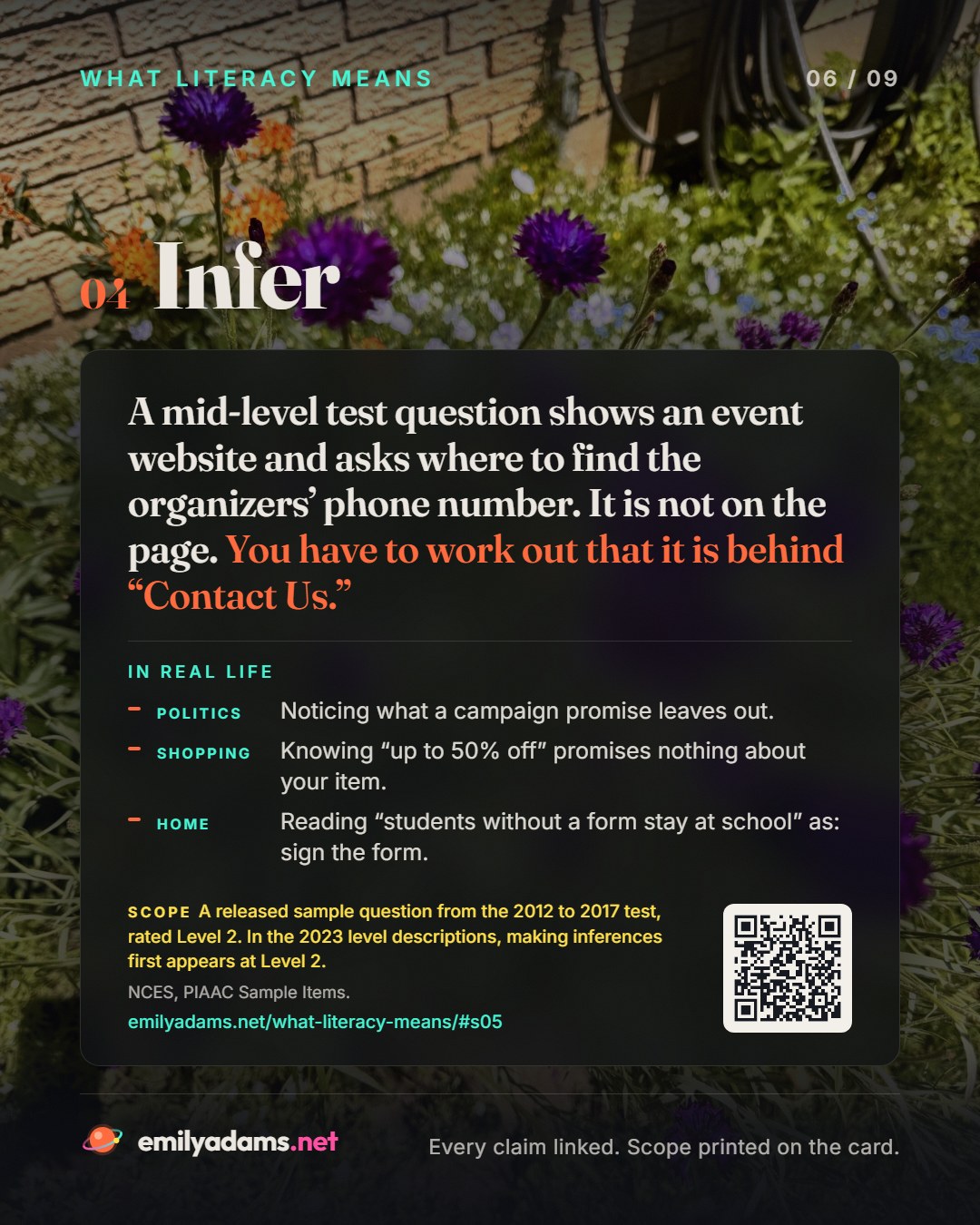
Card 07 of 09
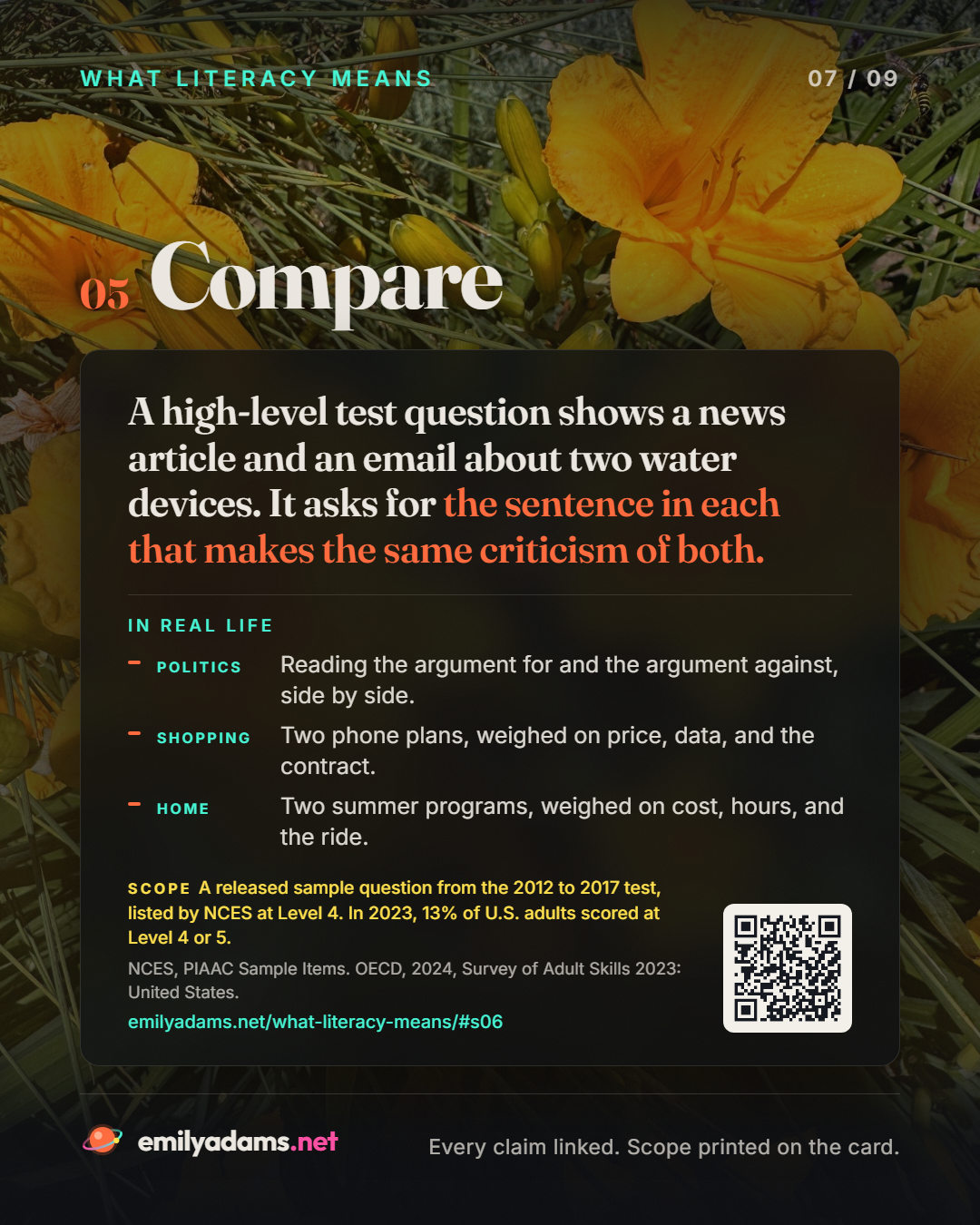
Compare. A high-level test question shows a news article and an email about two water devices. It asks for the sentence in each that makes the same criticism of both.
- PoliticsReading the argument for and the argument against, side by side.
- ShoppingTwo phone plans, weighed on price, data, and the contract.
- HomeTwo summer programs, weighed on cost, hours, and the ride.
SCOPE A released sample question from the 2012 to 2017 test, listed by NCES at Level 4. In 2023, 13% of U.S. adults scored at Level 4 or 5.
Sources and links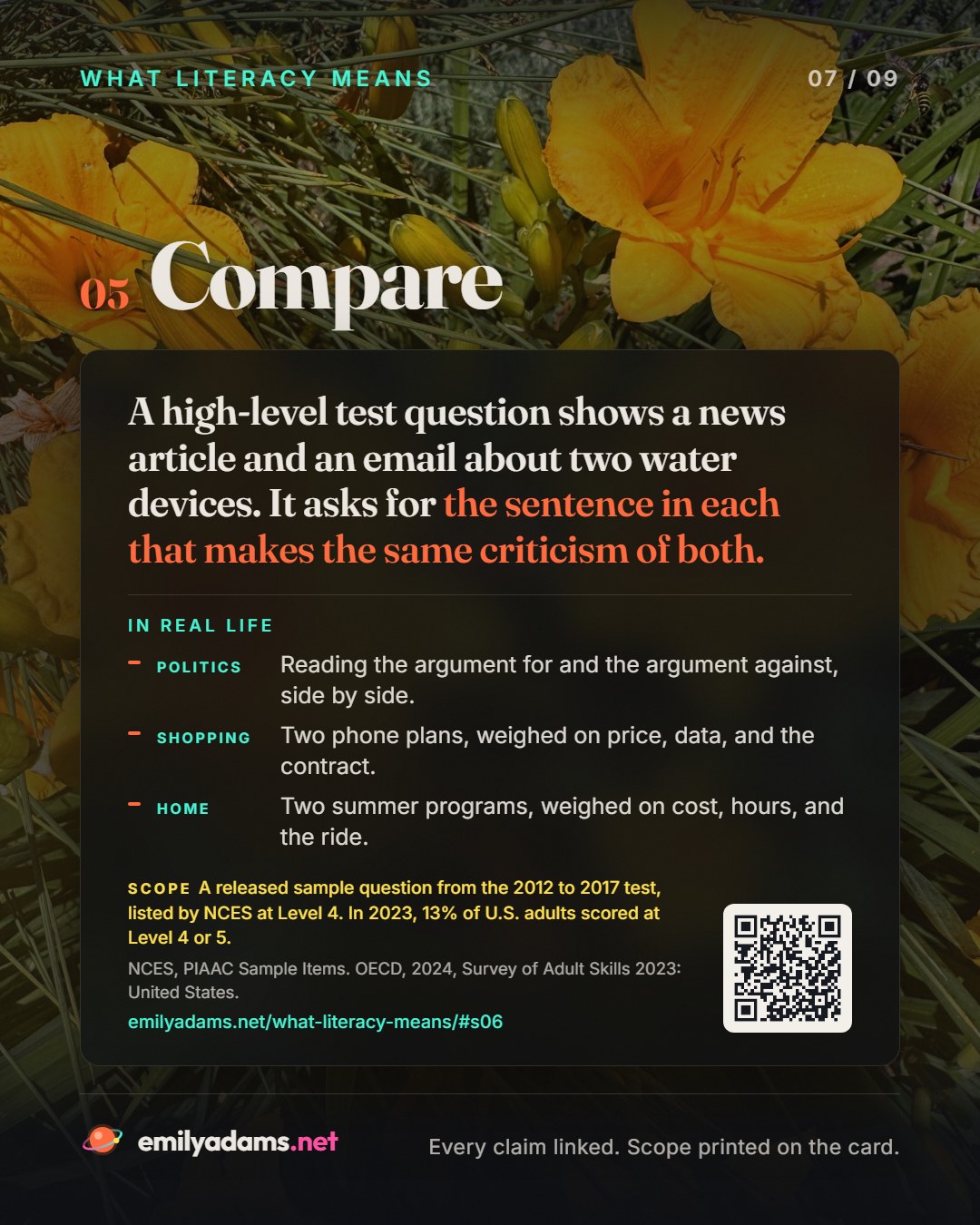
Card 08 of 09
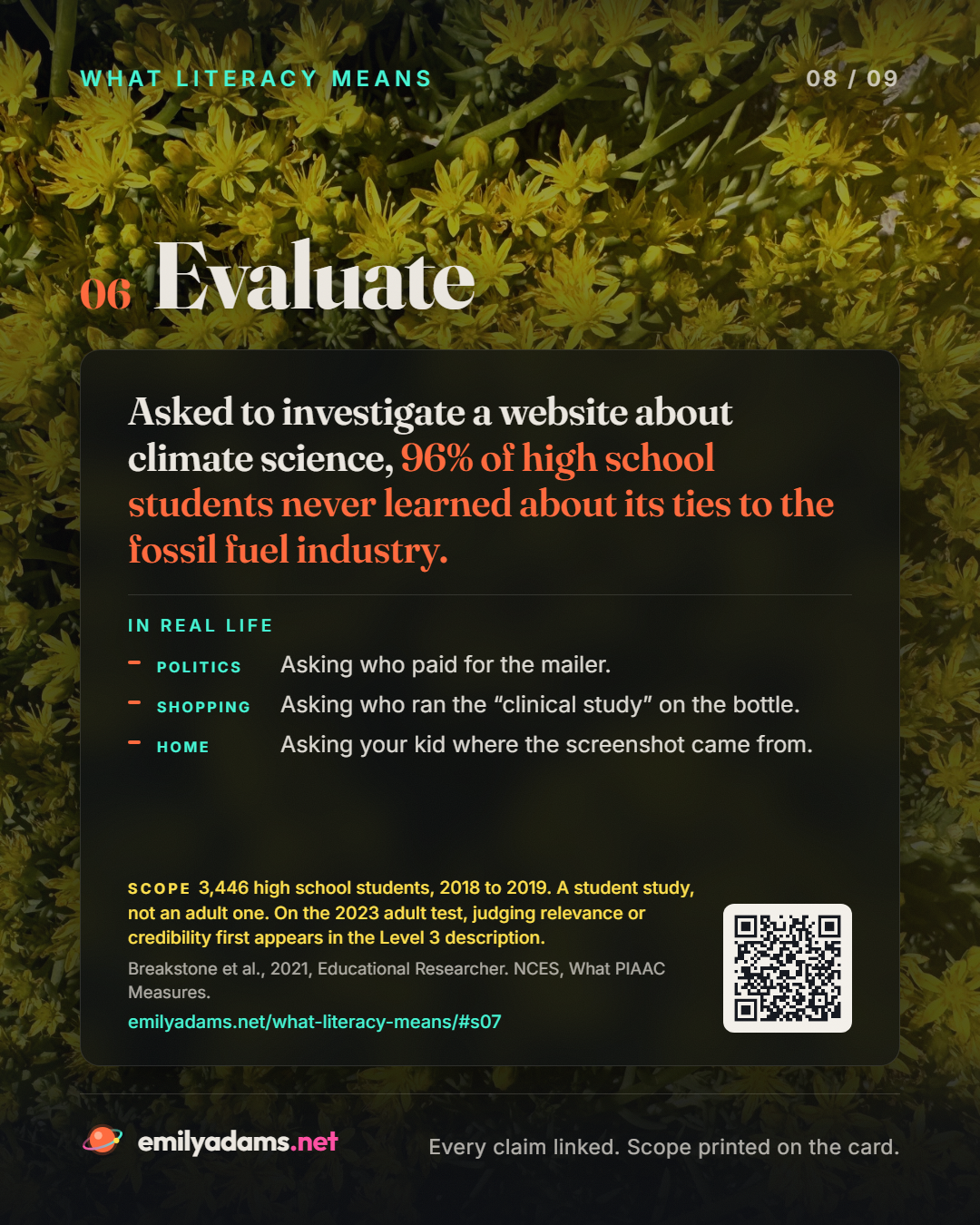
Evaluate. Asked to investigate a website about climate science, 96% of high school students never learned about its ties to the fossil fuel industry.
- PoliticsAsking who paid for the mailer.
- ShoppingAsking who ran the “clinical study” on the bottle.
- HomeAsking your kid where the screenshot came from.
SCOPE 3,446 high school students, 2018 to 2019. A student study, not an adult one. On the 2023 adult test, judging relevance or credibility first appears in the Level 3 description.
Sources and links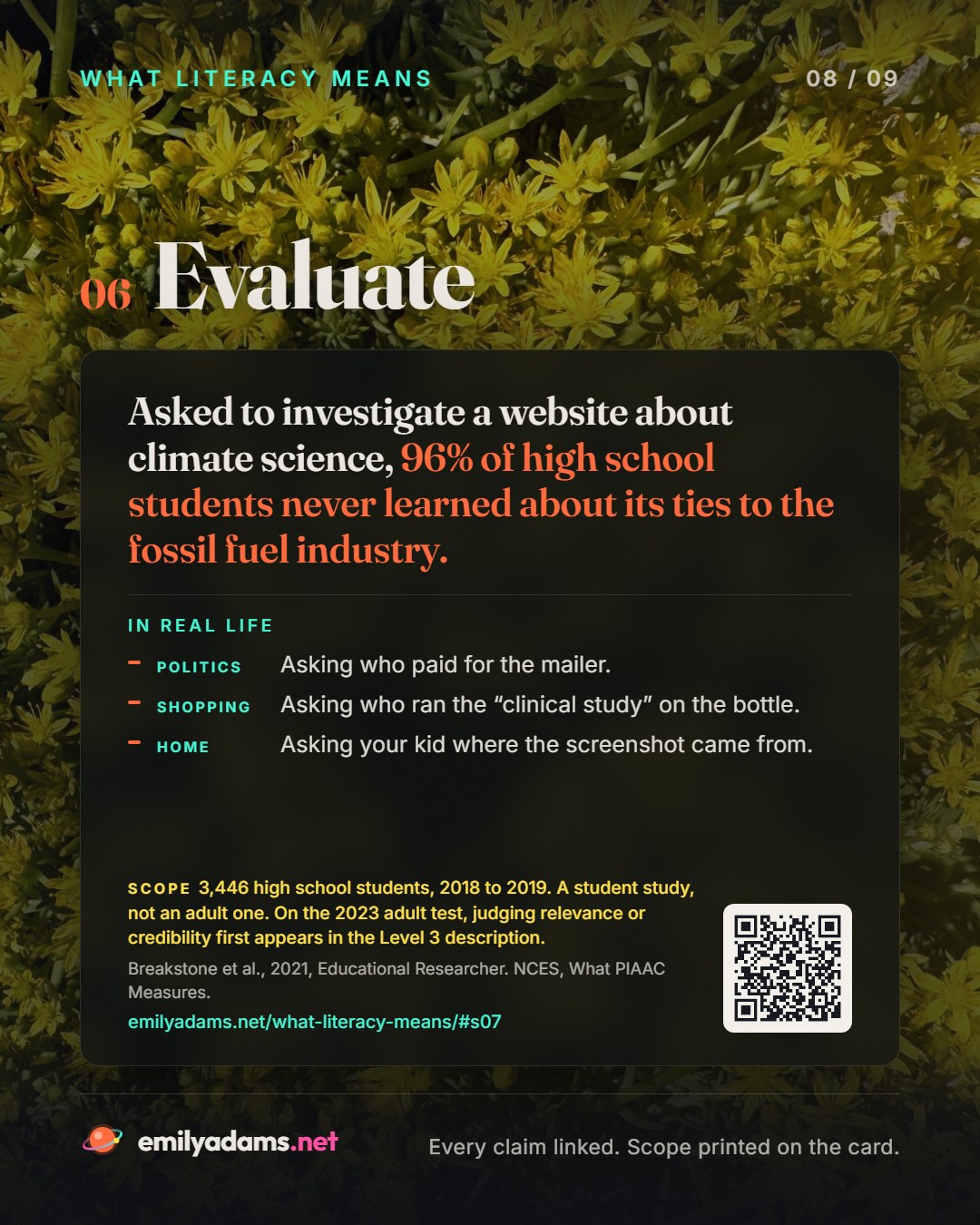
Card 09 of 09
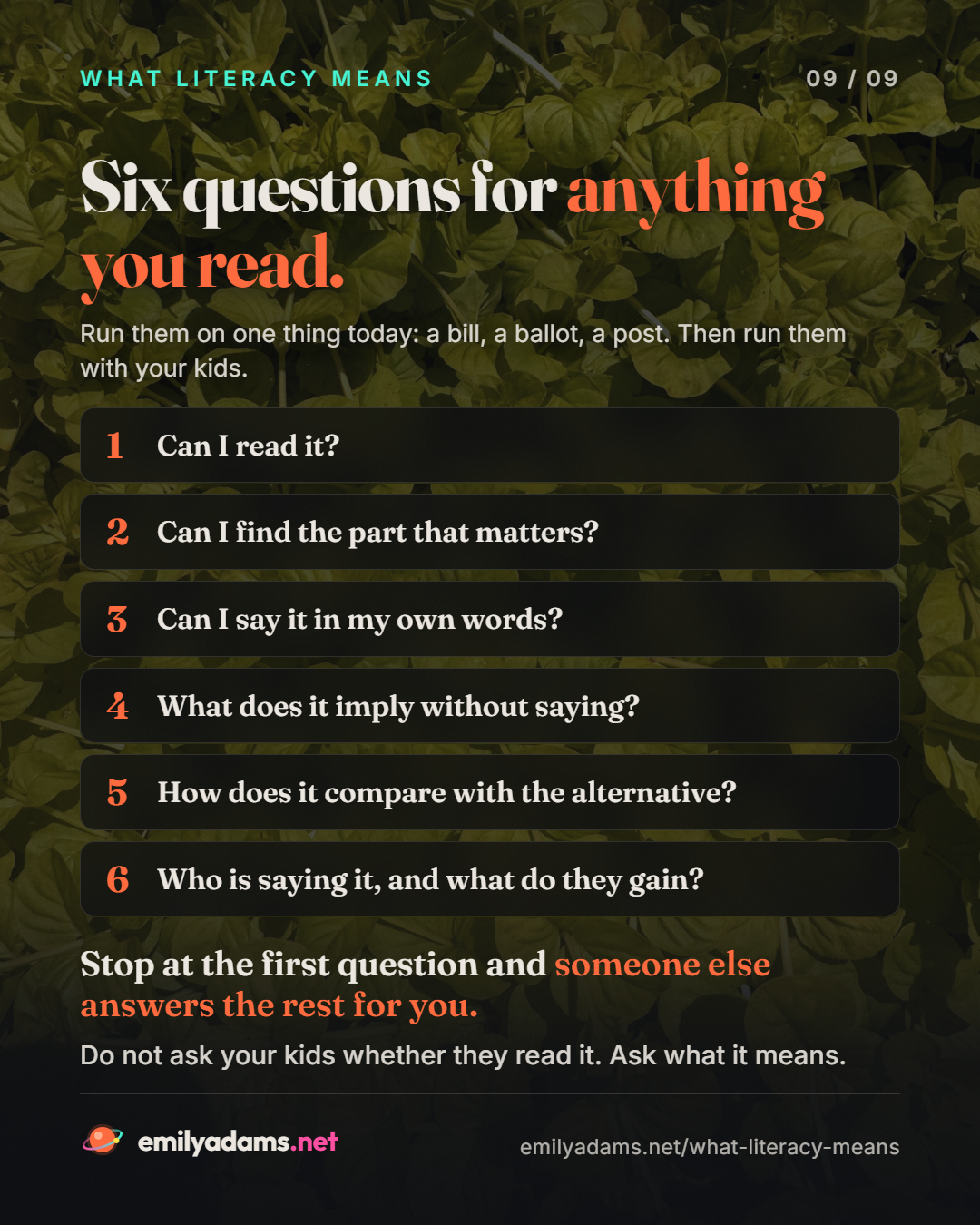
Six questions for anything you read.
- Run them on one thing today: a bill, a ballot, a post. Then run them with your kids.
- Can I read it?
- Can I find the part that matters?
- Can I say it in my own words?
- What does it imply without saying?
- How does it compare with the alternative?
- Who is saying it, and what do they gain?
Stop at the first question and someone else answers the rest for you. Do not ask your kids whether they read it. Ask what it means.
What these cards cannot tell you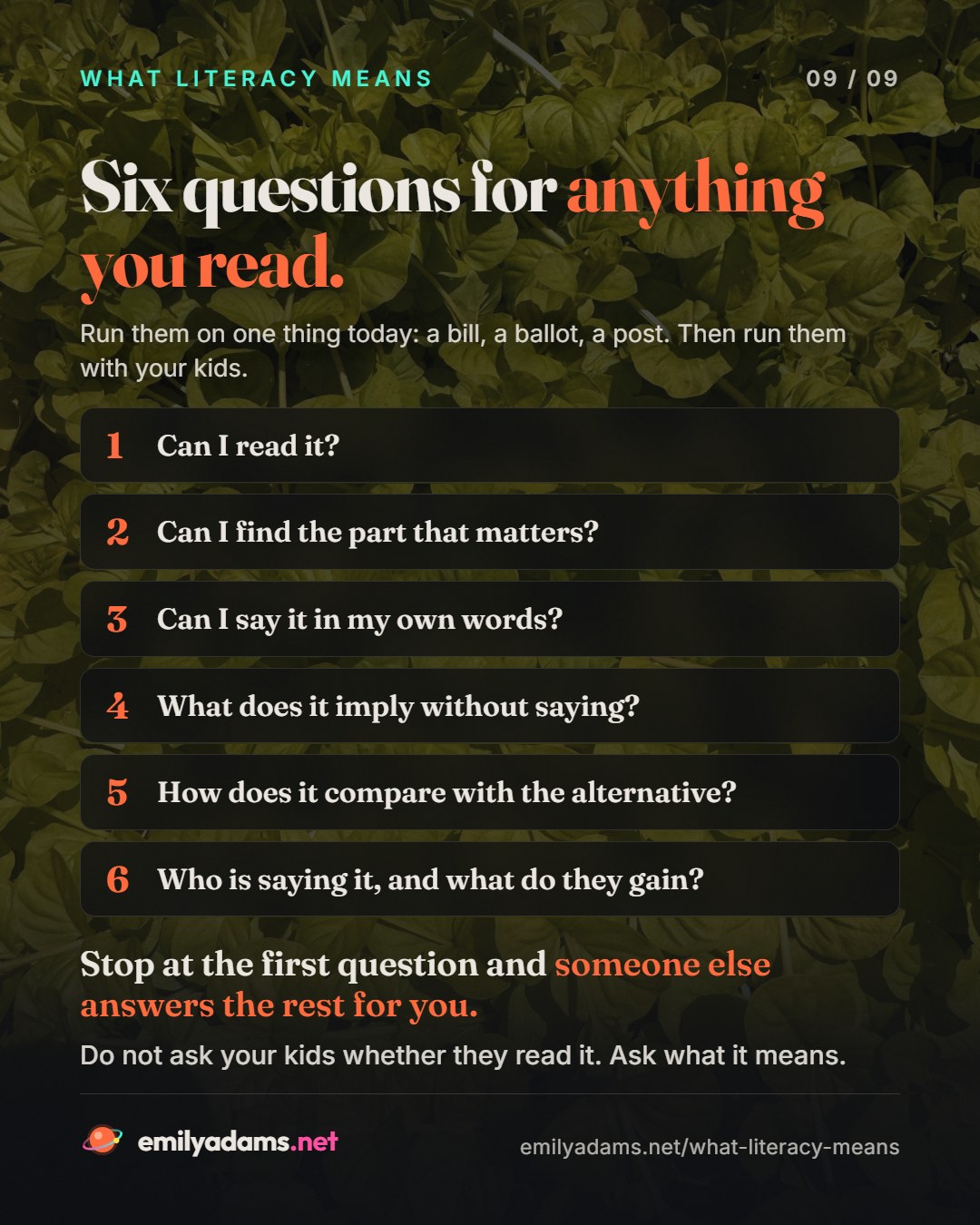
Closing card
Next: how literacy gets measured.
- Part three is the scoring: the levels behind the headlines about adult literacy, what each one means, and where the country lands. Every source on these cards is linked, with its limits.