What Men Reported, Anonymously

The study behind the cards.

A ten-slide series on one 2026 study: an anonymous survey in which 2,689 young men were asked whether they had used any of 36 strategies to get sex from a woman who did not want it. A graphic of its numbers went viral. The numbers are real. Some of the framing around them is not. This page has the study, every figure checked against the paper, the full table, and what the study cannot tell you. By a mother raising boys.

Published October 3, 2026 · Emily Adams · Figures verified against the open-access paper and the Crossref registry

The Cards

The full text of every card, in order, with the card itself under each one.

Card 01 of 9
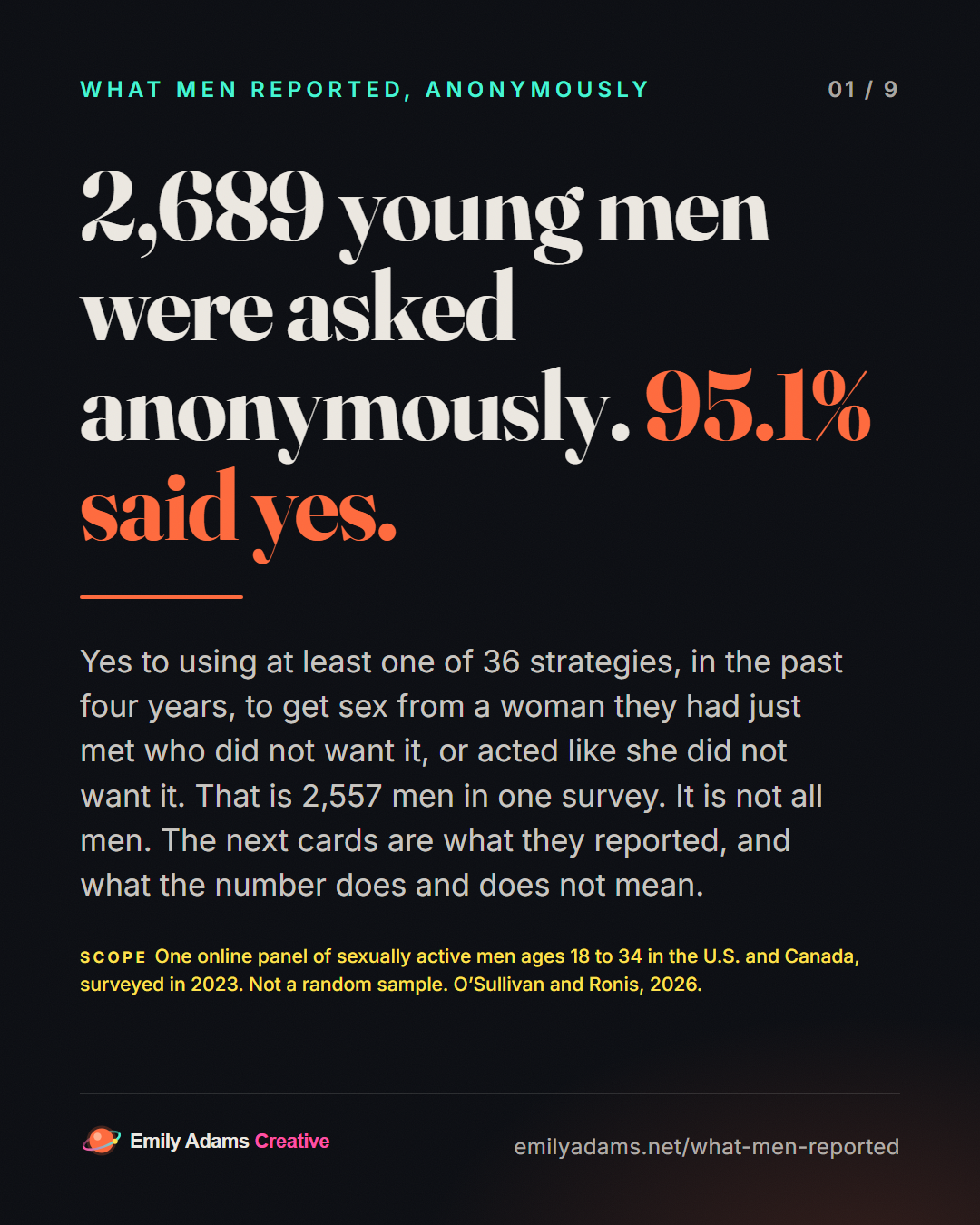
2,689 young men were asked anonymously. 95.1% said yes.
  • Yes to using at least one of 36 strategies, in the past four years, to get sex from a woman they had just met who did not want it, or acted like she did not want it. That is 2,557 men in one survey. It is not all men. The next cards are what they reported, and what the number does and does not mean.
SCOPE One online panel of sexually active men ages 18 to 34 in the U.S. and Canada, surveyed in 2023. Not a random sample. O’Sullivan and Ronis, 2026.
Study and linkCard 1
Card 02 of 9
The question they answered.
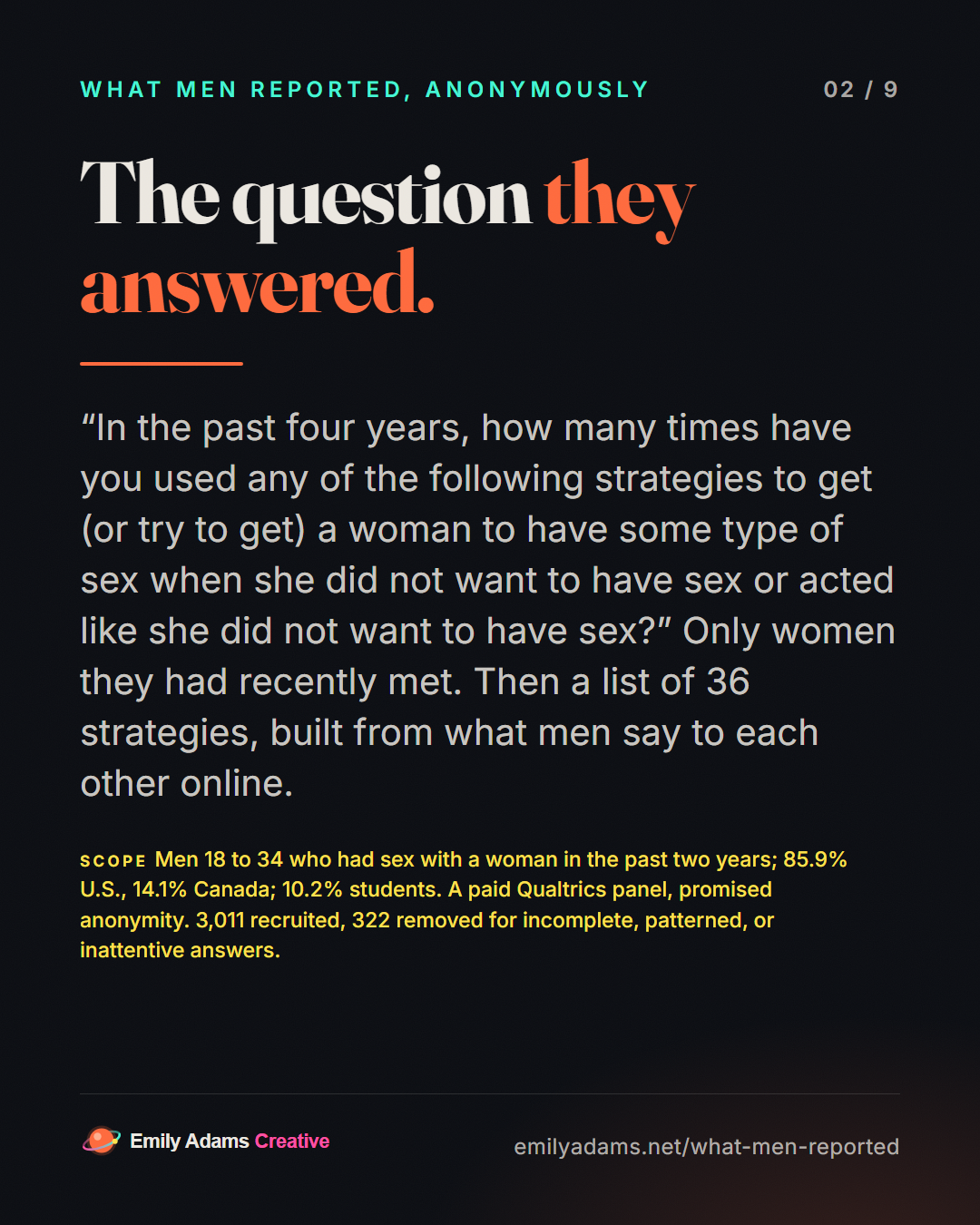
  • “In the past four years, how many times have you used any of the following strategies to get (or try to get) a woman to have some type of sex when she did not want to have sex or acted like she did not want to have sex?” Only women they had recently met. Then a list of 36 strategies, built from what men say to each other online.
SCOPE Men 18 to 34 who had sex with a woman in the past two years; 85.9% U.S., 14.1% Canada; 10.2% students. A paid Qualtrics panel, promised anonymity. 3,011 recruited, 322 removed for incomplete, patterned, or inattentive answers.
Study and linkCard 2
Card 03 of 9
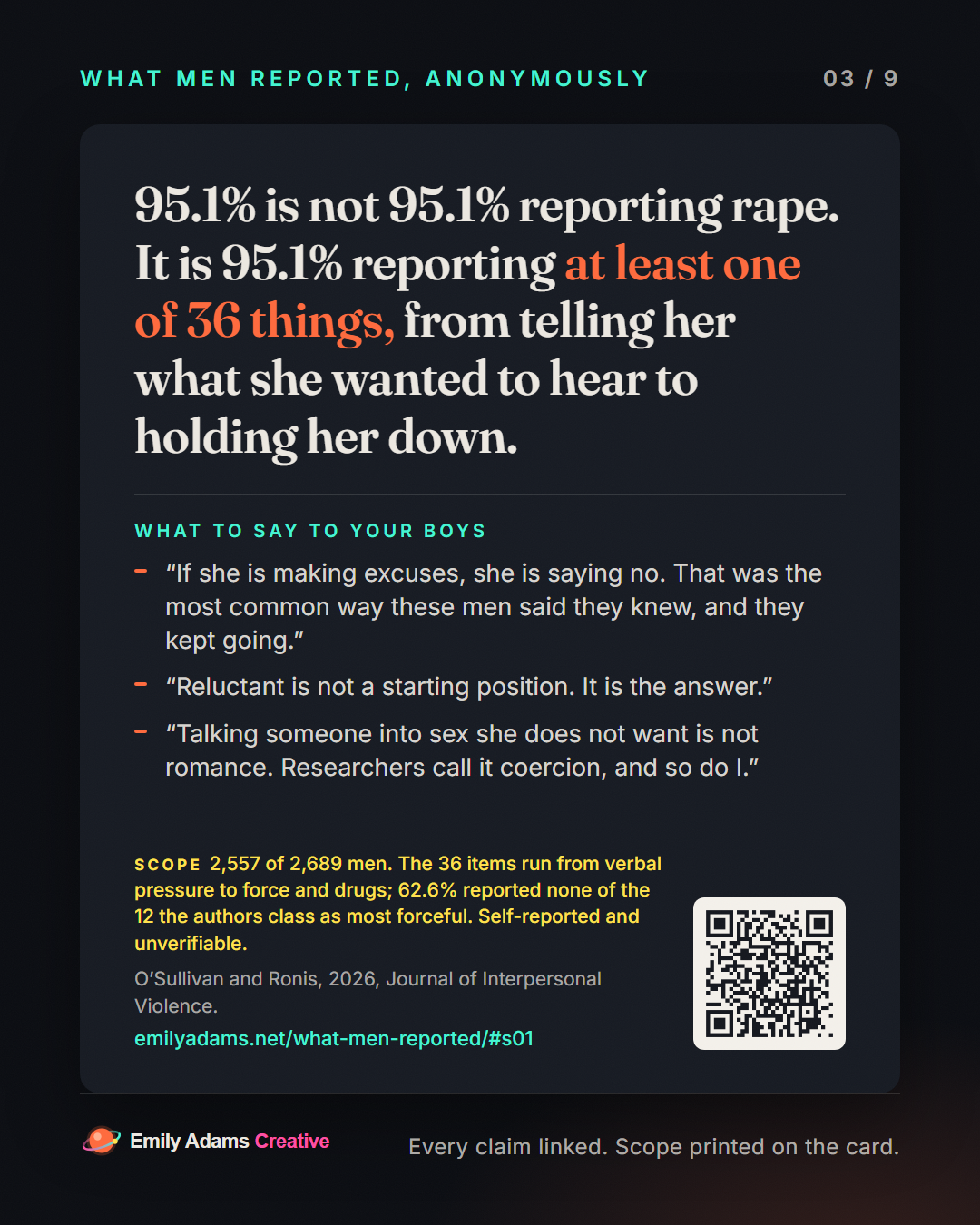
95.1% is not 95.1% reporting rape. It is 95.1% reporting at least one of 36 things, from telling her what she wanted to hear to holding her down.
  • “If she is making excuses, she is saying no. That was the most common way these men said they knew, and they kept going.”
  • “Reluctant is not a starting position. It is the answer.”
  • “Talking someone into sex she does not want is not romance. Researchers call it coercion, and so do I.”
SCOPE 2,557 of 2,689 men. The 36 items run from verbal pressure to force and drugs; 62.6% reported none of the 12 the authors class as most forceful. Self-reported and unverifiable.
Study and linkCard 3
Card 04 of 9
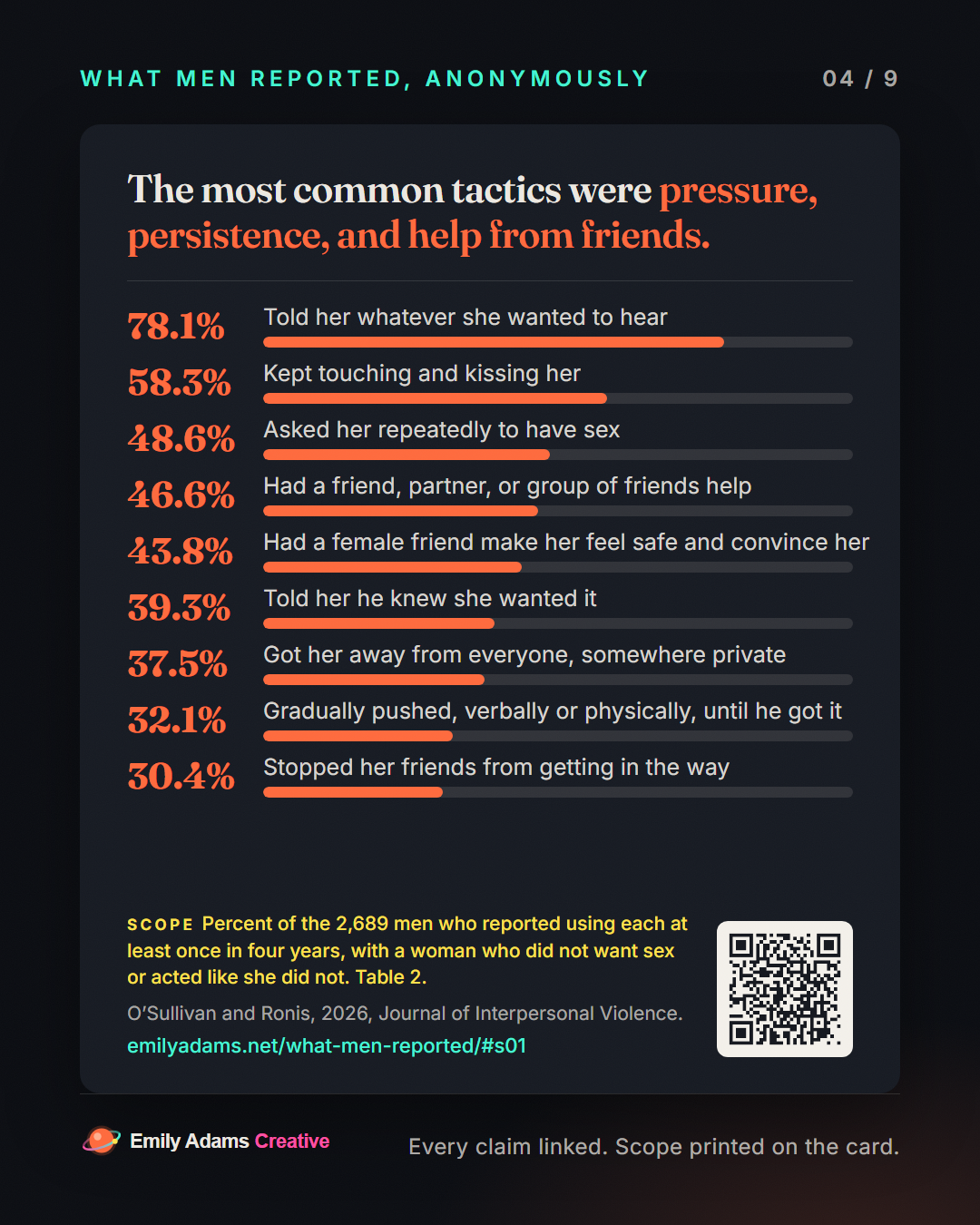
The most common tactics were pressure, persistence, and help from friends.
78.1%Told her whatever she wanted to hear
58.3%Kept touching and kissing her
48.6%Asked her repeatedly to have sex
46.6%Had a friend, partner, or group of friends help
43.8%Had a female friend make her feel safe and convince her
39.3%Told her he knew she wanted it
37.5%Got her away from everyone, somewhere private
32.1%Gradually pushed, verbally or physically, until he got it
30.4%Stopped her friends from getting in the way
SCOPE Percent of the 2,689 men who reported using each at least once in four years, with a woman who did not want sex or acted like she did not. Table 2.
Full tableCard 4
Card 05 of 9
Overt force was less common. The authors’ words: “but not uncommon.” 37.4% reported at least one of the 12 most forceful strategies.
20.7%Got her drunk or high when she was not
18.1%Stopped her, or tried to, when she tried to leave
11.2%Took advantage of her being asleep or sleepy
10.0%Overpowered her physically from the start
9.4%Used physical restraint, such as holding her down
9.3%Used physical force to create pain
8.6%Used drugs such as GHB or roofies
5.5%Used something, even a weapon, to frighten her
SCOPE Same scale as the last card. 62.6% reported none of the 12-item forceful subscale; not every item shown here is in it. 10.0% of this sample is 270 men.
Full tableCard 5
Card 06 of 9
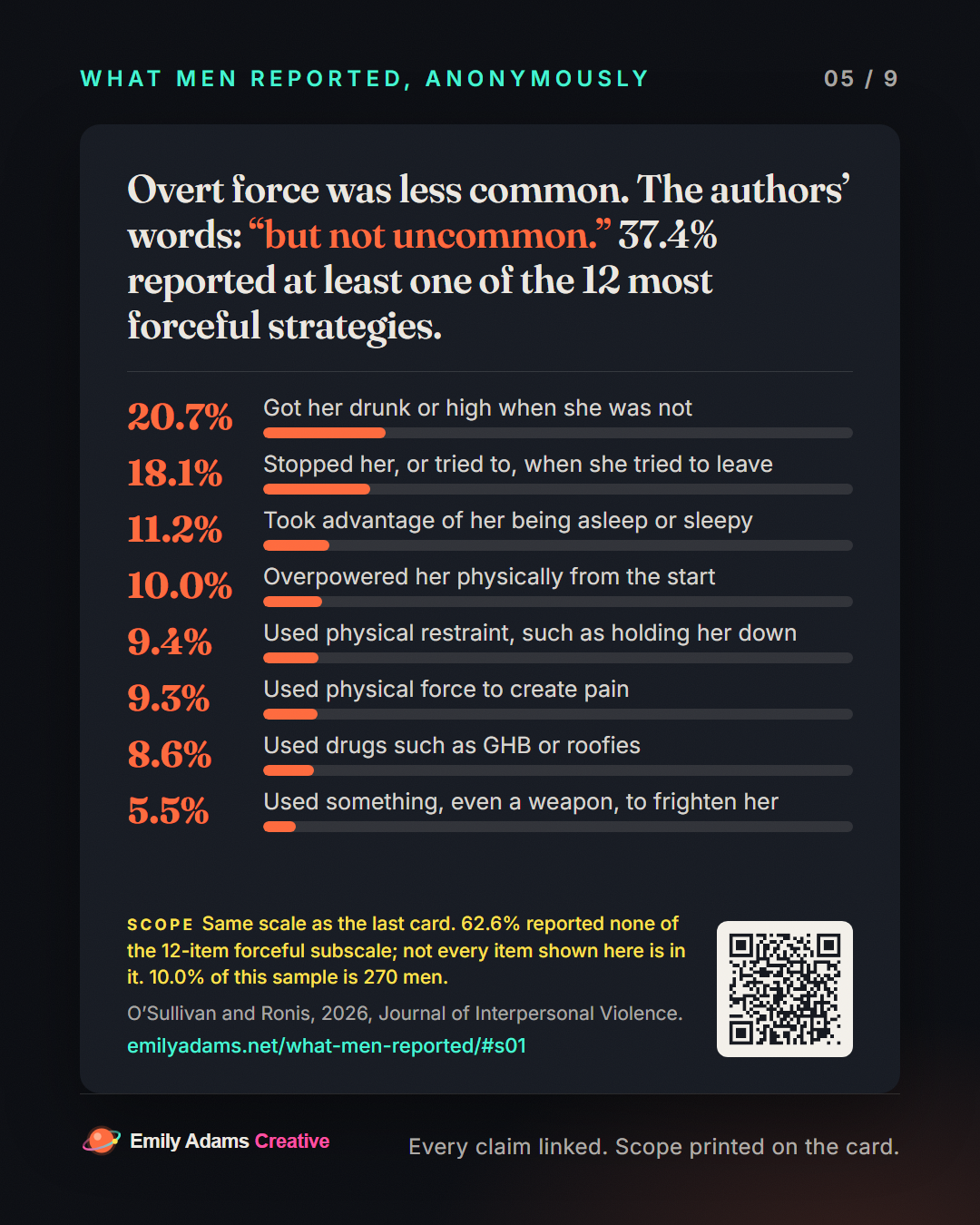
Men said it worked. They reported getting the sex they wanted on 64.6% of the occasions they used one of these strategies.
  • “If you had to wear her down, you did not get a yes. You got her to stop saying no.”
  • “Sex she did not want is not a win. It is harm, and you are the one who did it.”
  • “The only yes that counts is one she is still glad she gave the next morning.”
SCOPE Men’s own ratings, strategy by strategy. They were asked to recall a recent or vivid occasion, which the authors say may favor the ones that ended in sex. Women were not surveyed.
Study and linkCard 6
Card 07 of 9
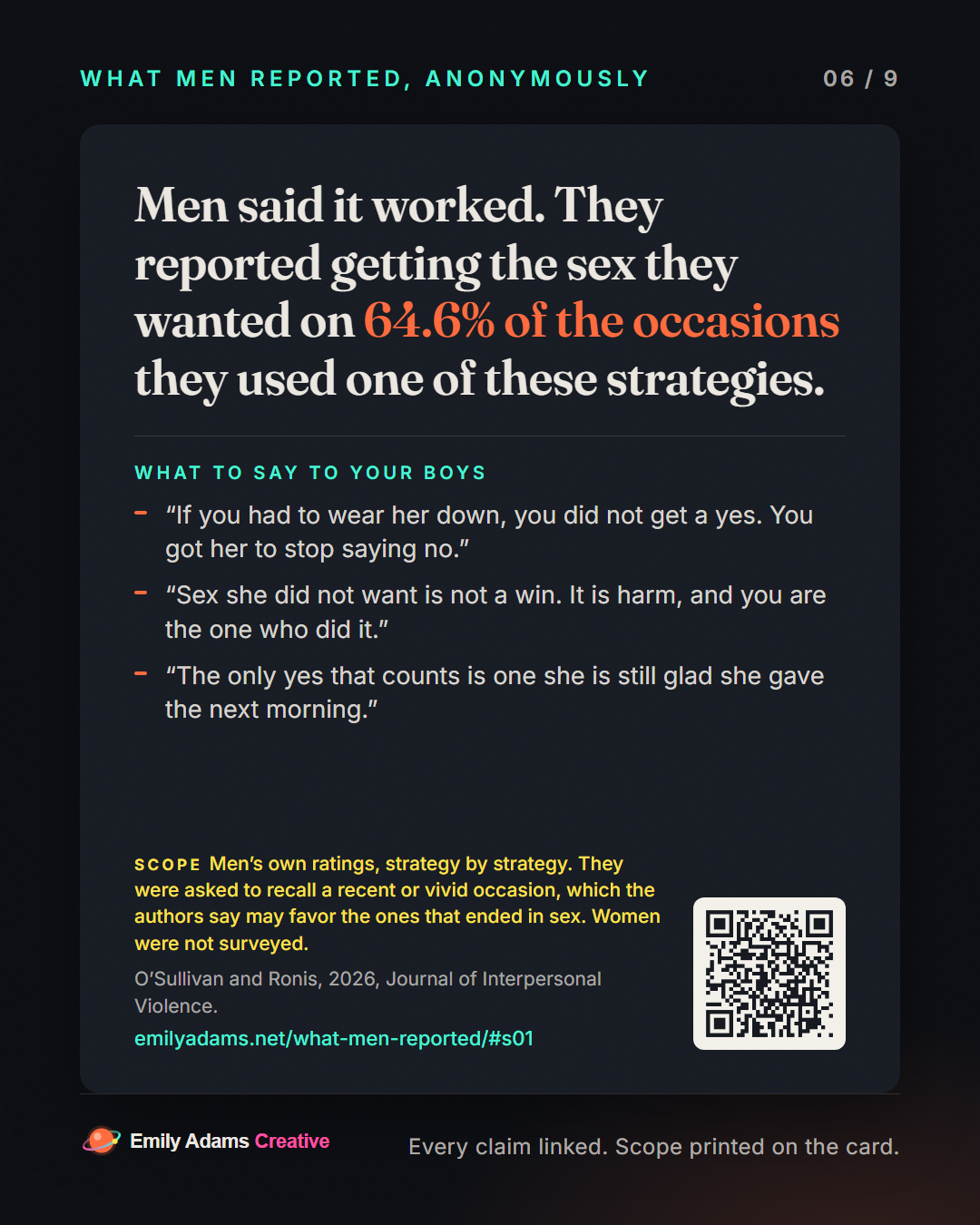
It was rarely one thing. The average number of different strategies reported was 8.94. The paper’s title is the pattern: isolate, inebriate, intimidate, repeat.
  • “Getting her alone, getting her drunk, and not letting it go is not flirting. It is a method, and people can see you doing it.”
  • “In this survey, the men who rated themselves best at getting sex also reported more force. Do not admire that guy.”
  • “If a friend asks you to help get a girl alone, the answer is no. Then you go find her friends.”
SCOPE Standard deviation 7.98, so the spread is wide. 76.2% called their efforts unplanned; 15.5% a deliberate plan. Self-rating and forceful strategies were correlated (r = .247), not shown as cause.
Study and linkCard 7
Card 08 of 9
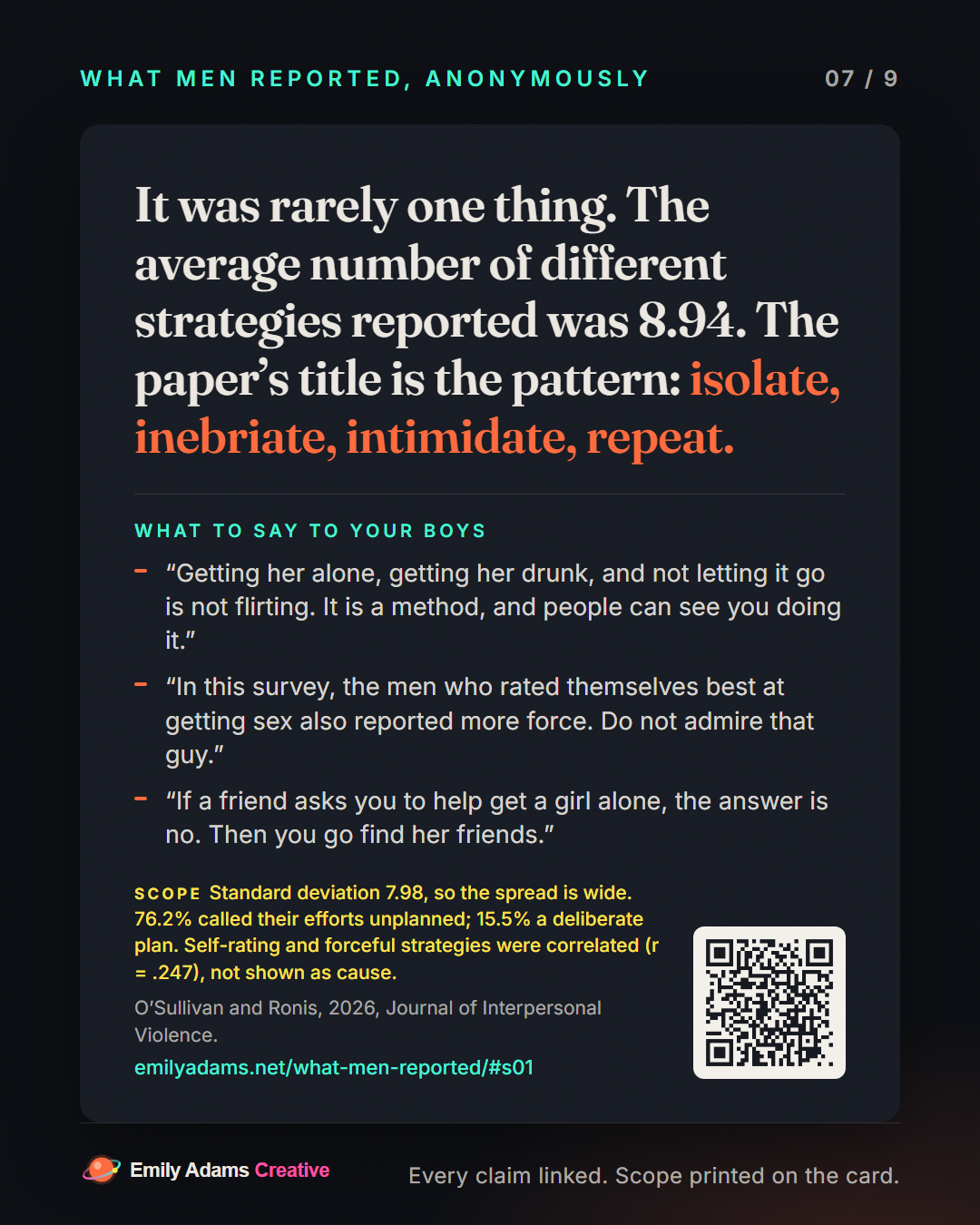
Other people were around 80.4% of the time. About 70% of the men said nothing bad came of it. One said someone stepped in.
  • “Someone is almost always there. Be the someone.”
  • “Nothing happening to him afterward does not mean nothing happened to her.”
  • “Seven men mentioned that she was traumatized. When a guy tells the story, notice who is missing from it.”
SCOPE Open-ended answers about a recent or vivid occasion: 1,903 men wrote only “no” when asked if anything bad resulted; 3 of 2,254 cited rape accusations or charges. Men were not asked directly whether anyone intervened.
Study and linkCard 8
Card 09 of 9
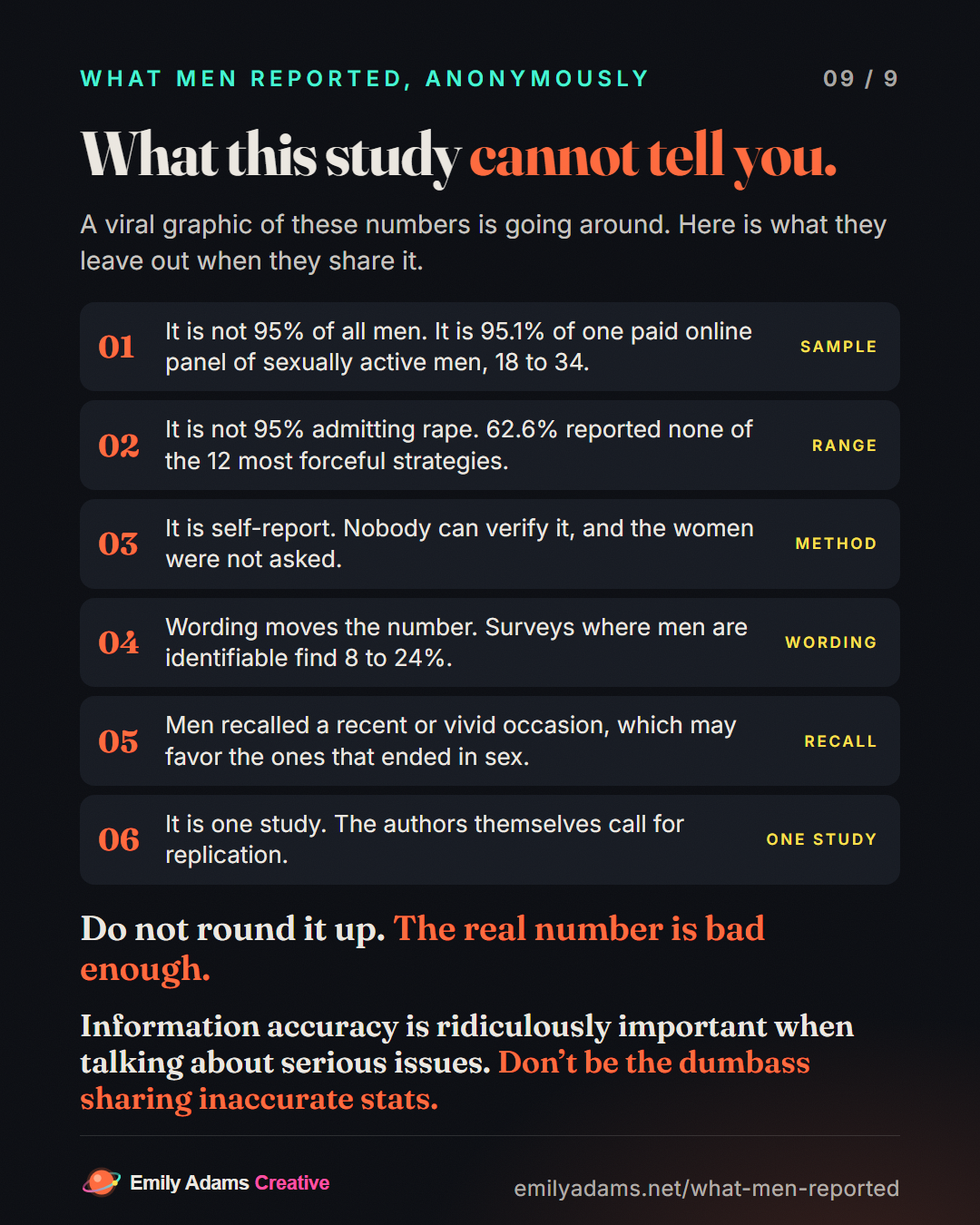
What this study cannot tell you.
  • It is not 95% of all men. It is 95.1% of one paid online panel of sexually active men, 18 to 34. Sample
  • It is not 95% admitting rape. 62.6% reported none of the 12 most forceful strategies. Range
  • It is self-report. Nobody can verify it, and the women were not asked. Method
  • Wording moves the number. Surveys where men are identifiable find 8 to 24%. Wording
  • Men recalled a recent or vivid occasion, which may favor the ones that ended in sex. Recall
  • It is one study. The authors themselves call for replication. One study
Do not round it up. The real number is bad enough. Information accuracy is ridiculously important when talking about serious issues. Don’t be the dumbass sharing inaccurate stats.
The limits in fullCard 9
Closing card
One study. Every number checked against the paper.
  • I read it as a mother raising boys. Most of what these men reported passes for normal, and somebody taught it to them. Read the study. Then talk to your sons before a friend does.
Closing card

The Study

One study carries the series. Three more are context, each cited by the 2026 authors themselves. A scope line follows every one.

On every card · Reference 1

Isolate, Inebriate, Intimidate, Repeat: High Rates of Sexual Force Against Women Are Reported When Young Men Given Anonymous Surveys

O'Sullivan and Ronis, 2026 · Journal of Interpersonal Violence, published online April 2, 2026

The researchers asked men how many times in the past four years they had used any of 36 strategies to get, or try to get, a woman to have sex when she did not want to or acted like she did not want to, counting only women they had recently met. 2,557 of the 2,689 men (95.1%) reported at least one. The average number of different strategies reported was 8.94 (standard deviation 7.98), and 36 men reported all 36. The most common were verbal and social: telling her whatever she wanted to hear (78.1%), continuing to touch and kiss her (58.3%), asking repeatedly (48.6%), and enlisting friends (46.6%). On the 12 items the authors class as most overtly forceful, 62.6% of men reported none, 15.7% reported one, and 21.7% reported two or more. Men rated the strategies as getting them the sex they wanted on 64.6% of the occasions they used them. Asked about a recent or vivid occasion, they said others were around 80.4% of the time; 1,903 wrote only “no” when asked whether anything bad came of it, 7 mentioned that the woman was traumatized, 1 mentioned that someone intervened, and 3 of 2,254 cited rape accusations or charges. The authors describe these as occasions of forced or coerced sex and argue that anonymity is why the rate is so much higher than in earlier work.

Scope  2,689 self-identified men ages 18 to 34 (85.9% United States, 14.1% Canada) who reported a sexual encounter with a woman in the past two years, recruited in spring 2023 through a paid Qualtrics online panel and promised anonymity. 3,011 were recruited; 322 were removed for incomplete answers, patterned responding, or failed attention checks. Not a random or nationally representative sample. Self-reported and unverifiable. One study, not yet replicated.
On card 9 · Reference 2

The Frequency of Sexual Perpetration in College Men: A Systematic Review of Reported Prevalence Rates From 2000 to 2017

Anderson, Silver, Ciampaglia, Vitale and Delahanty, 2019 · Trauma, Violence, and Abuse, 22(3), 481 to 495

The 2026 paper says that in identifiable convenience samples, self-reported perpetration since age 14 generally ranges from 8 to 24 percent depending on the kind of sexual aggression measured. That is the comparison behind card 9. The two figures are not apples to apples: the earlier studies used standard instruments, and the 2026 survey used a broader list of 36 behaviors with neutral wording.

Scope  A systematic review of studies of college men, who were identifiable to researchers. Cited by the 2026 paper, with two other sources, for the range it reports.
On card 9 · Reference 3

An Experimental Comparison of Three Phrases Used to Convey Lack of Consent: How Does Language Affect Men's Self-Reports of Sexual Aggression Against Women?

Abbey, McDaniel, VanParis and Helmers, 2025 · Psychology of Violence, 15(2), 235 to 246

The 2026 authors cite this study to make the point that different phrasings of the same question produce different rates of self-reported coercion. It is the reason card 9 says wording moves the number.

Scope  An experiment on survey wording. Cited by the 2026 authors in their own limitations section; summarized here as they describe it.
Background context · Reference 4

Meta-Analysis of Randomized Response Research: Thirty-Five Years of Validation

Lensvelt-Mulders, Hox, van der Heijden and Maas, 2005 · Sociological Methods and Research, 33(3), 319 to 348

The 2026 authors cite this meta-analysis for an estimate that 42 percent of sensitive behaviors go unreported in surveys that do not guarantee anonymity. It is the methodological case for running an anonymous survey at all.

Scope  A meta-analysis of validation studies on sensitive survey questions in general, not sexual aggression specifically. Summarized as the 2026 paper describes it.

What This Study Cannot Tell You

It is not “95% of men.” It is 95.1% of one paid online panel: men 18 to 34 in the United States and Canada who had sex with a woman in the past two years and chose to take a survey described as men’s chance to tell their side of the story. The authors say the panel is more representative than a convenience sample. It is still not a random sample of all men, and the percentages should not be applied to all men.
It is not 95% admitting rape. The 36 strategies run from telling a woman whatever she wanted to hear to restraint, drugs, and weapons. The most common were verbal pressure and help from friends. On the 12 items the authors class as most overtly forceful, 62.6% of the men reported none and 37.4% reported at least one. Both halves of that sentence belong in any honest summary.
The question was broad. Men were asked about a woman who “did not want to have sex or acted like she did not want to have sex.” The authors summarize this as women the men knew were unwilling and had not consented. The cards quote the question itself.
It is self-report, from one side. Nobody can verify the incidents. Women were not surveyed. The 64.6% figure is the men’s own rating of whether a strategy got them the sex they wanted, and they were asked to recall a recent or vivid occasion, which the authors say may favor occasions that ended in sex.
Wording moves the number, and this is one study. Earlier surveys of identifiable men, using standard instruments, found 8 to 24%. This survey used neutral wording, a longer list, and a promise of anonymity, so the two are not directly comparable. The authors call for replication with other samples and other measures.
About the viral graphic. Its percentages match Table 2 of the paper. It left out the most common strategy (78.1%, telling her whatever she wanted to hear), and its headline wording is easy to misread as a claim about all men. This series keeps the numbers and puts the limits back.

All 36 Strategies

From Table 2 of the paper: the percent of the 2,689 men who reported using each strategy at least once in the past four years, most common first. Wording is the survey’s own. The subscale labels are the authors’.

Ever usedStrategyAuthors’ subscale
78.1%Told her whatever she wanted to hear
58.3%Kept touching and kissing her
48.6%Asked her repeatedly to have sex
46.6%Had a friend, partner, or group of friends help you get what you wantSocially coercive subscale
43.8%Had a female friend around to make the woman feel safe and convince herSocially coercive subscale
39.3%Told her you knew she wanted it
37.9%Focused on a stranger to have sex with (or someone who did not know you)
37.6%Had a female friend bring her to youSocially coercive subscale
37.5%Got her away from everyone to somewhere private and under your control
32.9%Used your money, age, status to convince herSocially coercive subscale
32.1%Gradually pushed verbally or physically until you got what you wanted
30.4%Stopped her friends from getting in the way or interfering
24.5%Started undressing before she was ready
21.2%Kept her drunk/high if she already was drunk/high
20.9%Focused on a woman who you figured was unlikely to stop you
20.7%Got her drunk/high when she was not drunk/high
19.1%Demanded she stop conning you (faking a lack of interest in sex)
19.1%Corner her in some way so she could only focus on you
18.6%Started undressing her before she was ready
18.1%Stopped her (or tried to) if she tried to leave
15.2%Focused on a woman who you figured was unlikely to tell anyone if you kept going
14.5%Showed her that she was making you angryForceful subscale
14.5%Had her come to your house or apartment when she did not want toForceful subscale
14.0%Questioned her sexualityForceful subscale
12.7%Yelled at her or gave her hell for leading you onForceful subscale
11.9%Let her know she would regret it in some wayForceful subscale
11.2%Take advantage of her being asleep or sleepyForceful subscale
10.0%Just overpowered her physically from the startForceful subscale
9.4%Used physical restraint (such as holding her down, or tying her hands)Forceful subscale
9.3%Used some physical force to create some painForceful subscale
9.2%Forced her to enjoy it
8.6%Used drugs to help (e.g., GHB or roofies)Forceful subscale
8.1%Let her know you would embarrass or shame her in some way if she did notForceful subscale
6.8%Threatened to hurt yourself
5.5%Used something (even a weapon) to frighten her
5.2%Threatened to hurt herForceful subscale

Why I made cards out of one study.

I saw the graphic the way most people did, in a feed, with a number on it that is hard to look at. Before sharing it I wanted to know whether it was true. So I read the paper.

The numbers are real. What the graphic could not hold is everything around them: who was asked, what the question was, how wide the list is, and what the authors themselves say the study cannot show. Leave those out and the number becomes “95% of men,” which the study never claims and which is easy to wave away. Put them back and you are left with something harder to dismiss: in one large anonymous survey, most young men said yes to pressuring a woman they knew was reluctant, more than a third said yes to something the researchers class as forceful, and almost none of them reported that anything happened to them afterward.

I am raising boys. The part I cannot stop reading is the top of the table. Telling her what she wants to hear. Asking again. Having a friend help. None of that looks like violence to a seventeen-year-old. It looks like what he has been told works. That is where the conversation at home has to start, long before the bottom of the table.

Do not round it up. The real number is bad enough.