What Social Democracy Is
A political and economic approach that keeps a market economy and private ownership, and uses democratic government, taxes and unions to fund a large welfare state and limit inequality. Britannica says it began as an advocate of a peaceful evolutionary transition from capitalism to socialism, and came to mean “state regulation, rather than state ownership, of the means of production and extensive social welfare programs.” It was first known as revisionism.
The line it draws is with democratic socialism, which keeps the goal of ending private ownership of the major firms. Social democrats regulate capitalism rather than replace it. The two terms were reversed in use for decades, so the label depends on the country and the year. The dispute over the label is as old as the movement.
Who Owns It: Mostly Private, with Public Services and Strong Rules
Firms are privately owned and compete in markets. The state owns or funds a large share of services: health care, pensions, schooling and unemployment insurance. Denmark’s prime minister said at Harvard in 2015: “Denmark is far from a socialist planned economy. Denmark is a market economy.” That is the ownership question in one sentence.
Some social democrats tried to go further. Sweden’s Social Democrats legislated wage-earner investment funds in 1983, which business feared would move the country too far toward socialism, and which Britannica says appeared not to affect the economic system in any appreciable way. Britain’s Labour government nationalized coal, gas, electricity and the railways under Clement Attlee after 1945, an earlier, more ambitious experiment.
Who Rules: Voters, Coalitions and the Social Partners
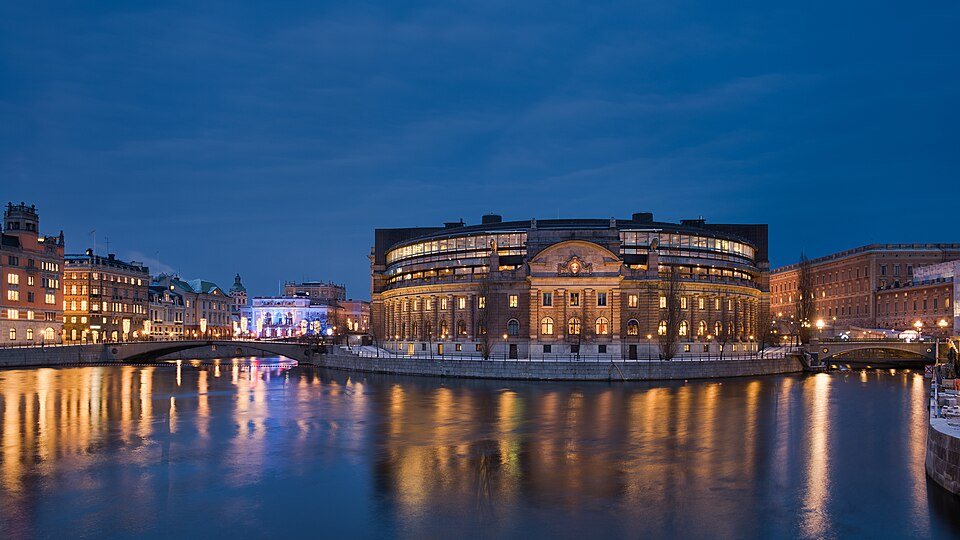
Social democracy is built on elections, competing parties, courts and a free press, and its parties usually govern in coalitions. Sweden’s 2026 election is a recent example: the Social Democrats led a bloc with the Left Party, Greens and Centre Party that won a three-seat majority in the 349-seat Riksdag, and the partners disagreed on whether the Left could hold cabinet posts (the 2026 result).
A second source of rule is the labor market. In Sweden, the Saltsjöbaden Agreement of 1938 between the employers’ federation and the trade union confederation set the rules of bargaining with little government intervention, and Denmark reached a similar agreement in 1899 and Norway in 1935. Unions and employers, called the social partners, make many decisions that other countries leave to legislatures. Finland and Iceland took a different path, with the basic labor market rules set by government, something Sweden’s partners tried to avoid.
What Social Democrats Believe
The diagnosis is that markets produce wealth but also insecurity. The 1942 Beveridge report said want was “one only of five giants on the road of reconstruction,” with disease, ignorance, squalor and idleness the others (the Beveridge report). Its remedy was social insurance by “co-operation between the State and the individual.”
On human nature, the Beveridge report assumed people respond to incentive and responsibility, which is why it warned the state “should not stifle incentive, opportunity, responsibility.” In practice that means universal insurance, a steady commitment to work, and a mix of flexibility and income security, as Denmark’s labor ministry calls it.
What Social Democrats Value
In rank order: social justice and solidarity first; freedom and democracy as the framework; security from the cradle to old age; and fairness in the sharing of the rewards of growth. The Socialist International’s 1989 Stockholm declaration states the family of values: “Democratic socialism is an international movement for freedom, social justice and solidarity.”
What it will trade away is some market outcomes. The Bad Godesberg program of 1959 made that explicit in Germany by embracing the market economy.
A Short History of Social Democracy
Social insurance began under a conservative. Chancellor Otto von Bismarck passed Germany’s sickness insurance law in 1883, accident insurance in 1884 and old-age pensions in 1889, aiming to check the growth of socialism (Bismarck’s insurance laws). Meanwhile Bebel and Liebknecht founded the German party in 1869, which became the country’s largest by 1912 (the German party).
Eduard Bernstein argued in 1899 that socialism would come by gradual reform (Bernstein). The movement then made its deals: Sweden’s labor agreement in 1938, Beveridge’s plan in 1942 and Labour’s postwar government. After 1945, Britannica says, West Germany, Sweden and Britain built welfare programs and moderated plans for wholesale nationalization. In the 1990s the Third Way moved parties further toward markets.
The older arrangements were thinner. England’s Elizabethan Poor Laws of 1598 made parishes tax for relief of the poor, and the harsh Poor Law of 1834 required relief inside the workhouse. By 1870 British friendly societies, run by skilled workers, had 1,250,000 members and by the early 20th century 7,000,000, and Britain’s only 19th-century social security law widened employers’ liability for injury at work. Germany’s insurance, and then the labor movement’s demand for more, changed that.
The Branches of Social Democracy
The family has several lines. The Nordic model joins high taxes and public services with flexible labor markets. The Beveridge or British line centers on universal national insurance and a national health service. The German line, set by the SPD’s postwar turn, joins the market economy to codetermination and social insurance. Revisionism, Bernstein’s school, was the original.
The Third Way of the 1990s is a later branch. Britannica says the term has been used for many things, from Nordic social democracy to fascism, and that Anthony Giddens gave it its late-20th-century meaning. Austrian social democrats built Red Vienna in the 1920s, treated on the democratic socialism page.
Where It Has Been Tried
Sweden is the model case: Social Democrats ruled for most of the 20th century, as Euronews notes. Denmark pairs a market economy with flexicurity. Britain’s postwar reforms under Attlee and Aneurin Bevan created the NHS. In Germany the SPD’s vote rose from 36 to nearly 46 percent between 1961 and 1972 after Bad Godesberg (West Germany).
The Swedish arrangements have not been fixed. Nordics.info records breakdowns of the 1938 system since the late 1960s, a new agreement in 1988 and abandoned talks on changes in 2007 to 2009 (the Swedish model’s trouble). Palme’s government of 1982 to 1986 pursued the funds, and he was assassinated on February 28, 1986 (Olof Palme).
The Case for It and the Case Against It
“Social democracy is socialism by another name.”
Britannica says social democracy began as a path to socialism but came to mean state regulation, not state ownership. Germany’s SPD embraced the market economy in 1959, and Denmark’s prime minister said in 2015 that Denmark is a market economy. Democratic socialists say that is why they exist as a separate camp.
Defenders say it combines the productivity of markets with security for everyone. They point to Denmark, where unemployment benefit can reach up to 90 percent of previous earnings for lower-paid workers and the state spends heavily on retraining. They say the postwar boom under welfare states shows the combination works.
Critics from the right, such as Heritage Foundation analysts, argue Nordic prosperity rests on free markets, with “compassionate capitalists” generating the wealth (the right’s critique). Both camps point to 2026. Defenders note that the parties of Sweden and Denmark remain the largest; critics note that both posted their worst results in more than a century or in the party’s history. Critics from the left argue it gave up the goal: Britannica says the SPD at Bad Godesberg “formally cast off nearly a century of commitment to socialism,” and Rosa Luxemburg said reformers choose “a different goal” (the left’s critique).
What Social Democracy Is Not
“Sweden and Denmark are socialist countries.”
Denmark’s prime minister told Harvard in 2015: “Denmark is a market economy.” Heritage Foundation analysts wrote in 2018 that the Nordic countries “are not technically socialist.” The White House Council of Economic Advisers said the same year that Nordic policies differ significantly from what economists mean by socialism.
It is not democratic socialism, which aims to replace private ownership of the major firms. It is not communism, which rejects the multiparty state. It is not simply a big welfare state: a welfare state is the instrument, and social democracy is the political program behind it, though other parties have built welfare programs too, as Bismarck’s insurance shows.
The word “socialist” in a party’s name does not settle the question. The Socialist International lists 132 member parties, many of them social democratic, and the Party of European Socialists is an umbrella for both socialist and social democratic parties.
Social Democracy Today
In 2026 the parties of Sweden and Denmark were still the largest but weaker. Sweden’s Social Democrats won 28 percent in September, their worst result in more than a century, and led a bloc to a narrow majority. In Denmark, Mette Frederiksen’s party won 21.9 percent in March, its worst result ever, in an early election after tensions with the United States over Greenland (Denmark).
In Germany, a June 2026 poll put the SPD at 11 percent, its lowest ever in a national survey (the SPD slump). The Socialist International counts 34 member parties in government, and Spain’s prime minister, Pedro Sánchez, hailed the Swedish result as a victory for social democracy and the welfare state (the International).
Forming governments is hard. After Sweden’s 2022 election it took more than five weeks, and after 2018 almost 20 weeks, Euronews notes, and in 2026 Andersson faced a partner that would not back cabinet seats for the Left.