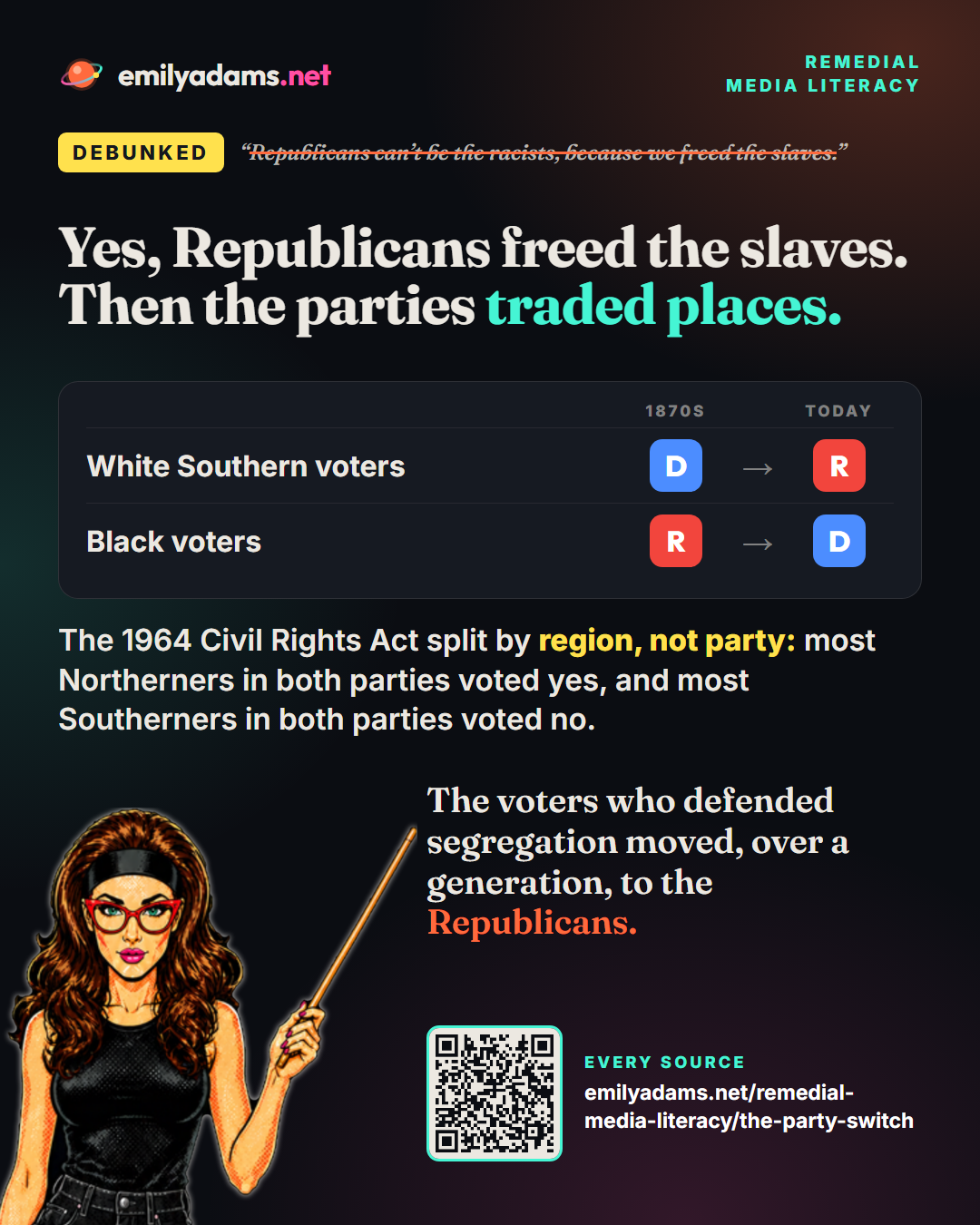
The Claim
It turns up under almost every argument about race and politics: “Well, they don’t tell you that the Republicans are the ones that freed the slaves, so we can’t be the racist ones.” The reasoning behind it goes like this: Democrats defended slavery and Jim Crow, so they must still be the racist party.
The history is real, and at a quick glance it sounds like it makes sense. What it skips is how the parties traded places. Neither party kept the same voters for a century and a half. White Southern voters moved from the Democrats to the Republicans, and Black voters moved from the Republicans to the Democrats. Here is how, when, and why it happened.
Lincoln’s Republicans End Slavery
In the 1860s, Abraham Lincoln’s Republicans ended slavery and made Black Americans citizens and voters, through three amendments to the Constitution: the 13th ended slavery, the 14th made citizenship and equal protection national guarantees, and the 15th barred any state from denying the vote on account of race.
Democrats, then the party of the white South, fought all of it. They used constitutional arguments, economic warnings, racial fear campaigns, restrictive state laws, and, in parts of the South, intimidation and violence.
What is revealing is how they framed it. They called federal protection of Black civil rights an attack on white Americans’ freedoms, on states’ rights, and on constitutional government. In 1868 the Democratic ticket of Horatio Seymour and Francis Blair campaigned under a badge that said it plainly: “This is a white man’s country; let white men rule.”
The Black Codes and the Klan
Right after the war, all-white Southern legislatures, led by former Confederates, passed Black Codes to restrict freedom: required labor contracts, vagrancy laws that punished unemployment, and limits on Black Americans’ economic independence. Some let Black people who were arrested be forced into labor. The effect was to preserve much of the plantation labor system without formally restoring slavery.
White supremacist groups, including the Ku Klux Klan, attacked Black citizens and the white Republicans who supported them, to scare them out of politics. In 1874 the cartoonist Thomas Nast drew a Klansman and a White League member shaking hands over a terrorized Black family, and titled it “Worse than slavery.”
Reconstruction, and How It Ended
From 1865 to 1877, Republicans in Washington worked to rebuild the South and protect the rights of the formerly enslaved, with federal troops when needed. This is called Reconstruction. For a few years it changed who held power: Southern states sent the first Black members of Congress to Washington, and every one of them was a Republican.
It came apart over a decade, not in a day. By 1877, Northern voters had grown tired of Reconstruction, the Supreme Court had narrowed the new amendments in the Slaughterhouse Cases of 1873 and United States v. Cruikshank in 1876, and Democrats had retaken most Southern states. That year the new Republican president, Rutherford B. Hayes, withdrew the federal troops that were propping up the last Reconstruction governments, in Louisiana and South Carolina.
Ninety Years of Jim Crow
Southern Democrats took back control and built Jim Crow: segregation, and laws designed to keep Black citizens from voting, such as poll taxes, literacy tests and white-only primaries. With Washington no longer enforcing the 14th and 15th Amendments in the South, Jim Crow lasted for nearly ninety years, until the civil rights laws of the 1960s.
For about sixty of those years, political loyalty rested mostly on what the two parties had done during the Civil War and Reconstruction. White Southerners voted Democratic, so reliably that the region was called the Solid South. Black Americans, where they could still vote, mostly in the North, voted Republican.
The New Deal Changes the Math
The Great Depression changed political priorities. Black Americans were especially vulnerable to unemployment, discrimination and poverty, but in 1932 most still stuck with the Republicans, out of loyalty to Lincoln and emancipation.
Democratic President Franklin D. Roosevelt took office in 1933 and introduced the New Deal, a series of federal programs to provide relief, create jobs, and reform the banks so the country could recover. Black families got an unequal, often segregated share, and Social Security at first left out farm and household work, jobs many Black workers held. But it was real help, and allies like Eleanor Roosevelt and Mary McLeod Bethune pushed for more. Republicans offered little.
In 1936, most Black voters chose the Democrat.
One Party, Both Sides
That left the Democratic Party holding both sides of the fight over civil rights: Black voters and Northern liberals on one side, and the segregationist white South on the other. Those two groups were never a match. Something had to give.
The Dixiecrat Walkout
In 1948, Democratic President Harry Truman pushed civil rights. When the party’s convention adopted a civil rights plank, Southern segregationists walked out and formed the Dixiecrats, whose platform said: “We stand for the segregation of the races.”
But the Dixiecrats did not simply leave the Democrats and become Republicans. They ran as the “States’ Rights Democratic Party,” and in the four states they carried they were the official Democratic ticket. Most of them came crawling back, then fought civil rights legislation from inside their own party, using filibusters, and the threat of them, against civil rights bills in 1957, 1960 and 1964, and resisted the growing influence of Northern Democrats who supported racial equality.
Meanwhile, Republicans were increasingly divided between their traditional civil rights supporters, such as President Eisenhower and Senate leader Everett Dirksen, and a growing conservative movement that emphasized limited federal government and pushed “states’ rights.” Remember that phrase.
1964: The Vote by Party, and by Region
In 1964, Democrat Lyndon Johnson signed the Civil Rights Act. Republicans in Congress backed it at a higher rate than Democrats did. That number is real, and it is the one the comment section quotes.
Now sort the same vote by region. Most Northerners in both parties voted yes. Most Southerners in both parties voted no. The real dividing line was region. Southern lawmakers, elected by white voters while most Black Southerners were kept from voting, defended segregation. Northern lawmakers in both parties backed civil rights. Democrats held most of the Southern seats, so most of the no votes were theirs, and that is why their party total was lower.
Thurmond, Goldwater and the Southern Strategy
That year, Strom Thurmond, the 1948 Dixiecrat candidate and by then a Democratic senator, switched to the Republicans. Their nominee for president, Barry Goldwater, had voted against the Civil Rights Act. He lost badly, but he won five states in the Deep South, along with his home state of Arizona.
Republican strategists took note. From Nixon to Reagan, they courted white Southern voters with coded language like “law and order,” “states’ rights,” “forced busing,” “soft on crime,” and more. One Republican strategist, Lee Atwater, admitted it on tape in 1981: openly racist language had started to backfire and cost votes, so campaigns switched to abstract words that sent the same signal without saying it outright.
A Slow Switch
It happened slowly: first in races for president, then for Congress, then in state capitols, as older voters gave way to their children and grandchildren. By 1994, Republicans held most of the South’s seats in the U.S. House for the first time since Reconstruction.
Economists who went back to decades of survey data found that race drove it. A 2018 study in the American Economic Review found that the defection of white Southerners with conservative views on race explains the entire decline in white Southern Democratic identification from 1958 to 1980.
So Yes, Republicans Freed the Slaves
So yes, Republicans freed the slaves. But over the next century, the parties traded places. The Democrats who fought for civil rights stayed Democrats. The voters who defended segregation moved, over a generation, to the Republicans.
You may find some super interesting parallels between then and now. As always, please fact check me. You’ll be surprised what you find when you go looking. For the full story of how the coded language works, read The Code Word.