Raiders, Traders, Settlers
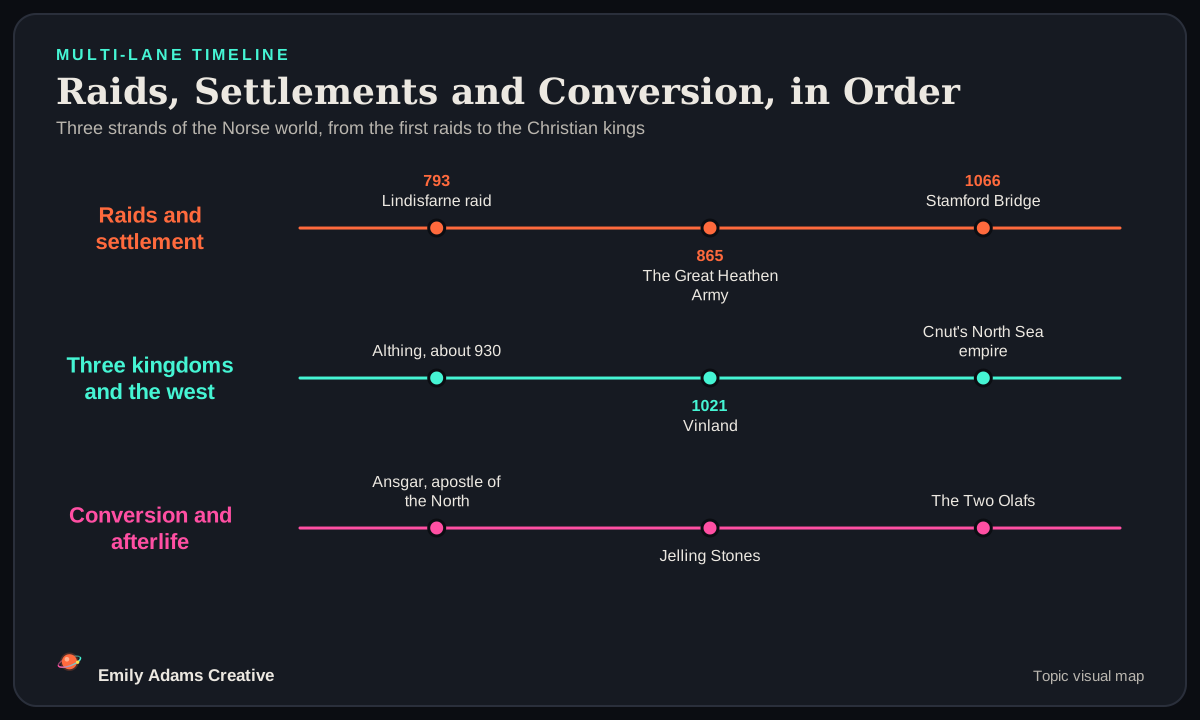
In 793, seaborne raiders struck the monastery of Lindisfarne on the coast of Northumbria. The Anglo-Saxon Chronicle remembered them as heathen men who destroyed God’s church by robbery and slaughter. Historians date the start of the Viking Age from that raid, and its end from September 1066, when the Norwegian king Harald Hardrada was killed at Stamford Bridge near York. The National Museum of Denmark gives the Danish span as roughly 800 to 1050.

“Viking” was a job before it was a people. In the early Scandinavian languages, vikingr meant a pirate, and going “a-viking” meant going raiding. The men and women of Denmark, Norway, and Sweden were mostly farmers. Some of them, some of the time, went abroad as raiders, traders, mercenaries, diplomats, explorers, and settlers.
Their advantage was the ship: a narrow keel and a shallow draft let even large warships land on beaches and row up rivers. The same technology carried cargo. Trading towns such as Hedeby and Ribe grew under royal protection, and silver flowed north, much of it as Arab coins struck in Central Asia. A bronze Buddha made in the Swat Valley ended up on an island in a Swedish lake.
Most of what was written about Vikings in their own time was written by their victims. The Vikings carved runes but wrote no books, and the chronicles that survive came largely from monks whose churches had been robbed. Archaeology fills in the rest, and it shows a world where trade, fishing, and farming mattered as much as the raid.
The Danes in England
For two generations the raids on England were hit and run. In 865 that changed. A large army, remembered by its victims as the Great Heathen Army, landed in East Anglia to conquer rather than plunder. It took York, killed the kings of Northumbria and East Anglia, and broke Mercia.
Only Wessex held. Its king, Alfred, was driven into the Somerset marshes in 878, then rallied and beat the Danish leader Guthrum at Edington. Guthrum was baptized with Alfred as his godfather, and a later treaty between the two kings drew a border up the Thames and the Lea to Watling Street. It also valued a slain Englishman and a slain Dane at the same price.
North and east of that line lay what later centuries called the Danelaw, the region of “Danes’ law.” Its heart in the Midlands was a network of fortified towns that the Anglo-Saxon Chronicle calls the Five Boroughs: Leicester, Lincoln, Nottingham, Stamford, and Derby. Alfred’s son Edward and daughter Aethelflaed won much of it back by the 920s, and the last Viking king of York, Eric Bloodaxe, was driven out in 954.
The settlers stayed. They left thousands of place names ending in -by and -thorpe, everyday English words such as sky, egg, and window, and a distinct body of local law. Britannica notes that DNA evidence has confirmed the link between Denmark and the modern people of Derbyshire.
A second wave came in the 990s. English kings paid Danegeld to buy the raiders off, and in 1013 the Danish king Sweyn Forkbeard took the whole kingdom. His son Cnut ruled England, Denmark, and Norway as one North Sea empire. The story closed in 1066 with two northern invasions in one autumn: a Norwegian king at Stamford Bridge, and William of Normandy, whose duchy had been founded by a Viking.
Three Kingdoms, Three Directions
Denmark, Norway, and Sweden did not yet exist as nations when the raids began. The Swedish History Museum stresses that eastern Scandinavia was a patchwork of smaller “lands” ruled by local aristocrats, and that power over wide regions was personal and temporary. Still, the travelers from each region tended to head one way. The National Museum of Denmark sums it up: Danes settled mainly in England and Normandy, Norwegians in Scotland, Ireland, and the North Atlantic islands, and Swedes in northwestern Russia.
The Swedish route ran east. From Birka, an island town in Lake Malaren, traders crossed the Baltic and followed the Russian rivers toward the Black and Caspian Seas. The people the Byzantines and Arabs called the Rus gave their name to Russia, and Scandinavians reached Constantinople, which they called Miklagard, the great city. Some served its emperors as soldiers.
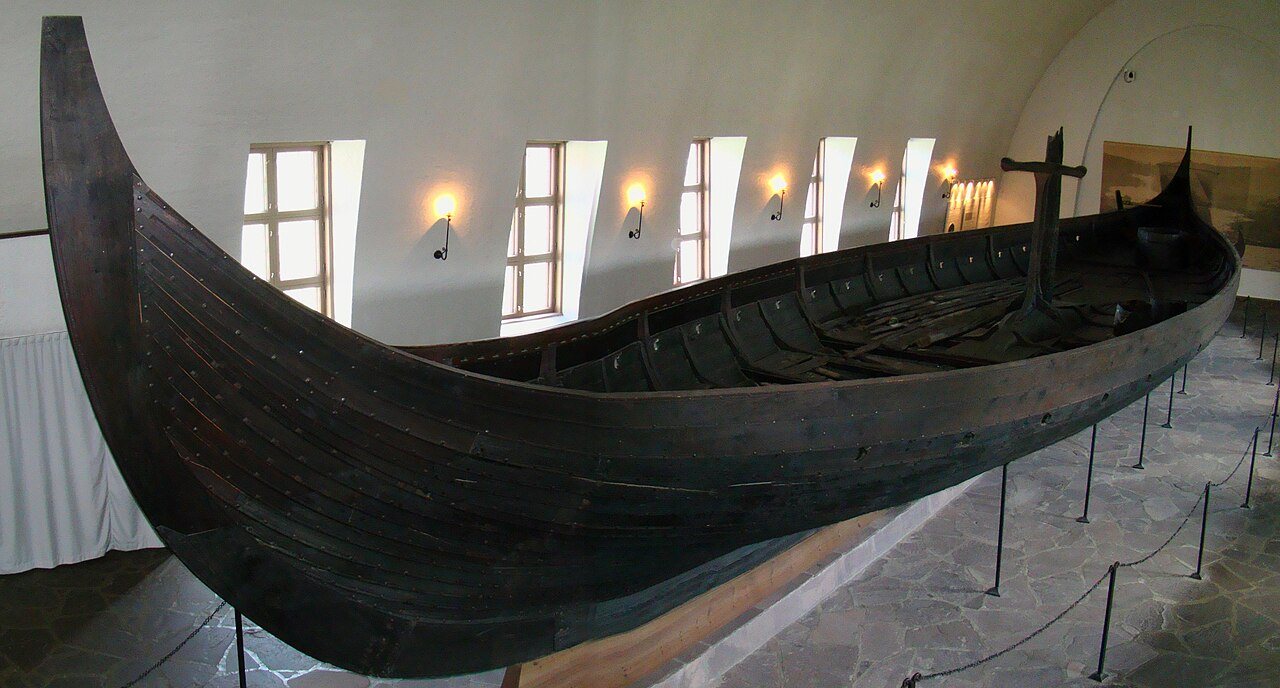
The Norwegian route ran west, over open ocean, in ships like the ones buried at Oseberg and Gokstad. Settlers poured into Iceland from about 900, where they founded an assembly that still exists; Greenland around 985; and the coast of North America, where tree rings at L’Anse aux Meadows in Newfoundland prove that Norse travelers were felling trees in 1021.
The Danish route ran south and west, to England and to the Seine, where a Viking chief named Rollo founded Normandy. At home, the Danish kings built a state. Around 965 King Harald raised a great rune stone at Jelling that names Denmark and claims he made the Danes Christian. His nickname, Bluetooth, now names a wireless technology whose logo joins his runic initials.
Jarls, Farmers, Thralls, and Women
Viking society had three ranks, and a poem says so. In the Eddic poem Rigsthula, a god fathers three sons in three houses: Thrall, ancestor of slaves; Karl, ancestor of free farmers; and Jarl, ancestor of the great men. The National Museum of Denmark summarizes the real divisions the same way: free and unfree, rich and poor, men and women.
Slavery was not a side business. The museum calls slaves among the most important goods the Vikings traded, taken mostly in raids on Eastern Europe and the British Isles and sold at markets such as Hedeby and Bolghar on the Volga. Christianity slowly reduced slavery, but Danish law still regulated slaves in 1241.
Free men settled disputes and made law at open-air assemblies called things, which live on in the names of Norway’s Storting and Iceland’s Althing. Kings were, in the museum’s phrase, first among equals, and had to buy and fight for the support of the magnates.
Women could not speak in court or inherit equally, but they had more freedom than most women in Europe at the time. A wife could divorce her husband, ran the farm when he was away, and could raise a rune stone in her own name. The richest burial of the age, at Oseberg, belonged to women. In 2017 a genomic study showed that the occupant of a famous warrior grave at Birka was female, setting off one of archaeology’s loudest arguments: the Birka warrior.
The Gods and the People Who Wrote Them Down
The Norse gods were many, quarrelsome, and humanlike. Odin, one-eyed god of war, wisdom, and the dead, was the god of kings and warriors. Thor, with his hammer, was the god of ordinary farmers and the most popular. Freyja ruled love, fertility, and a kind of magic called seid. Four of them still name English weekdays: Tuesday for Tyr, Wednesday for Woden, Thursday for Thor, Friday for Frigg or Freyja.
Their universe hung on a world tree, Yggdrasil, linking nine worlds, and it was headed for Ragnarok, the doom of the gods. Slain warriors went to Odin’s hall, Valhalla, or to Freyja’s field, Folkvang.
Almost everything known about these myths was written down after the Vikings had become Christian. The two main sources are the Poetic Edda and Snorri Sturluson’s Prose Edda, both from thirteenth-century Iceland. The Swedish History Museum warns readers to remember that the recording took place after the old faith had largely been replaced. The Icelandic sagas carry the same caution: they were written two or three centuries after the events they describe.
Worship was practical. Communities held blot sacrifices at the solstices and equinoxes, feasting on the meat and toasting the gods, and seeresses were consulted about the future. The ethics of everyday life survive in the Havamal, a poem of advice on hospitality, friendship, and reputation.
The Slow Turn to Christ
Christianity arrived over three centuries, not in a day. Danish traders accepted a preliminary sign of the cross to do business in Christian towns. The Danish king Harald Klak was baptized at the Frankish court in 826, and the missionary Ansgar preached at Hedeby and Birka with little to show for it.
For a long time the two faiths lived side by side. A smith’s mold found at Trend in Jutland could cast two crosses and a Thor’s hammer at once, and families hedged their bets at burials. Kings tipped the balance: Harald Bluetooth claimed on the Jelling stone around 965 that he had made the Danes Christian.
Norway’s conversion was more violent. Olaf Tryggvason forced the faith on the coast in the late 990s, and Olaf Haraldsson, one of the two Olafs, pressed it inland until he died in battle at Stiklestad in 1030 and became Norway’s patron saint. Sweden came last: the Swedish History Museum notes that the church organization was fully established in southern and central Sweden only by the twelfth century, and that conversion there was “not a single conversion, but many.”
Myths That Stuck
“The Vikings were blond, horned-helmeted warriors who did nothing but raid.”
No horned Viking helmet has ever been found; the Museum of the Viking Age in Oslo traces the image to an 1876 opera costume. Most Vikings were farmers, and the National Museum of Denmark lists them as traders, settlers, mercenaries, and diplomats as well as raiders. A 2020 study of 442 genomes found many had dark hair.
The most famous Viking accessory never existed. Only one reasonably complete Viking helmet has been found, at Gjermundbu in Norway, and it has no horns. The Museum of the Viking Age in Oslo calls the horned helmet purely a myth; it entered the costume box at the 1876 premiere of Wagner’s Ring cycle.
Other myths came from translation and from enemies. The idea that Vikings drank from their victims’ skulls came from a seventeenth-century mistranslated poem. The image of filthy savages runs against the evidence of combs, tweezers, and ear scoops found in men’s and women’s graves alike. The gruesome blood eagle is still argued over. Berserkers, at least, were real enough to give English a word.
Much of the popular Viking was invented in the nineteenth century. Scholar Andrew Wawn argues that Victorian Britain really invented the Vikings as they are now known, believing Viking blood flowed in Victorian veins, and dressing its heroes in long blond hair and horned helmets.
What the Genomes Show
“The Vikings were a pure Nordic race.”
A 2020 study in Nature of 442 Viking Age genomes found substantial ancestry from southern and eastern Europe flowing into Scandinavia, distinct Danish, Swedish, and Norwegian populations, and people buried as Vikings with no Scandinavian ancestry at all. The University of Copenhagen researchers said Vikings tended to be dark-haired rather than blond.
In 2020 the journal Nature published the largest genetic study of the Viking world: 442 ancient genomes from sites across Europe and Greenland, led by Ashot Margaryan and Eske Willerslev. It found gene flow into Scandinavia from the south and east during the Viking Age, sharp genetic differences within Scandinavia, and a clear map of who went where.
That map matched the museums’ account. The study found a major influx of Danish ancestry into England, Swedish ancestry into the Baltic, and Norwegian ancestry into Ireland, Iceland, and Greenland. In the university’s own summary, the three groups rarely mixed. It also found that being a Viking was a matter of culture as much as ancestry: a man in a Viking-style grave in Scotland had, genetically, nothing in common with Scandinavians.
Hair color is a smaller myth that genes also corrected. The University of Copenhagen release quoted Willerslev saying Vikings tended to be dark-haired rather than blond. Earlier work summarized by the National Museum of Denmark found red hair common in the west and blond hair dominant around Stockholm. The Vikings were a mobile, mixed population, which is exactly the opposite of the story told about them by people who later borrowed their symbols.
Stolen Symbols
In the twentieth century the Nazis took the runes. The Anti-Defamation League’s hate symbols database records that they adopted the othala rune, among many similar symbols, to build a mythic “Aryan” past, and put it on the insignia of two Waffen SS divisions. Since 1945 white supremacists in Europe and North America have kept using it, along with the valknot, a knot associated with Odin.
The theory behind the theft is older than the Nazis. American race writers of the early 1900s ranked a “Nordic” race at the top of humanity, an idea traced on the site’s history of the word invasion, and the Nazis idealized their “Aryans” as blond and tall. The genome study above describes a population that was neither pure nor uniform.
Modern believers in the old gods have pushed back. In 2016, after what its authors called escalating rhetoric and action from the Asatru Folk Assembly, a “folkish” group, other heathens issued Declaration 127, named for a Havamal stanza that tells the listener to call evil by its name. In Denmark, the officially recognized heathen society Forn Sidr practices a faith the National Museum of Denmark calls a revival, not a survival. The ADL itself warns that non-racist pagans use the same runes, and that context decides.
What Still Lives: Denmark, Sweden, Norway
The Viking gods lost, but the old calendar did not. The National Museum of Denmark notes that Vikings feasted at midwinter and midsummer, and the three countries still build their year around light and dark. Christianity renamed the feasts and Lutheranism shaped the churches: denmark.dk reports that 72 percent of Danes belong to the Evangelical Lutheran state church, though few attend except at Christmas.
Denmark’s word for its way of life is hygge, an untranslatable coziness the Oxford English Dictionary adopted in 2017. Danes light Sankt Hans bonfires on June 23, dress children up for Fastelavn before Lent, and on Christmas Eve hold hands and dance around the tree. They tell children that their flag, the Dannebrog, fell from heaven in 1219. In the nineteenth century the pastor N.F.S. Grundtvig, who also studied the Eddas, inspired the folk high schools. And in October 1943 Danes ferried nearly all of the country’s Jews across the water to Sweden, the rescue of the Danish Jews.
Sweden’s year runs from Walpurgis bonfires on April 30 to Midsummer and Lucia: a maypole and herring in June, and on December 13 a girl in white with a crown of candles. Its outdoors belongs, by custom and law, to everyone: the right of public access lets anyone walk, pick berries, or camp on most land, and Norway’s 1957 Outdoor Recreation Act guarantees the same.
Norway’s great day is May 17, Constitution Day, celebrated with children’s parades and the embroidered national costume, the bunad. Its medieval stave churches and the folk tales gathered by Asbjornsen and Moe helped build a national identity in a country that, Britannica notes, was long dominated by Denmark and Sweden and became fully independent only in 1905.
Two things run across all three. One is a novelist’s joke that became a national self-diagnosis: the Law of Jante, whose first rule is that you shall not believe you are special. The other is a people who were there before any of the kingdoms: the Sami of the far north, whose homeland, Sapmi, crosses four borders.
The Nordic Model Is Not Socialism
“Scandinavia proves socialism works, or proves it fails.”
Denmark’s own prime minister said in 2015 that Denmark is far from a socialist planned economy and is a market economy. Nordic countries combine private enterprise and free trade with high taxes, strong unions, and broad welfare. Norway’s state fund invests in private companies worldwide rather than owning the economy.
Modern Denmark, Sweden, and Norway are often held up, by admirers and critics alike, as socialist. Historians at nordics.info, a research platform at Aarhus University, describe what the Nordic model usually means: comprehensive welfare states financed by high taxes, combined with strong collective bargaining between unions and employers, inside market economies. Even its fans have argued over whether it was a “middle way” between capitalism and communism or simply capitalism with a large safety net.
Danish leaders have answered the question themselves. In 2015 Prime Minister Lars Lokke Rasmussen told an audience at Harvard that Denmark is far from a socialist planned economy: “Denmark is a market economy.” Norway’s oil wealth sits in a sovereign wealth fund that owns about 1.5 percent of the world’s listed shares, which is the opposite of state ownership of the means of production.
Whatever the label, the results draw attention. In the World Happiness Report 2026, Finland ranked first, Iceland and Denmark second and third, and Sweden and Norway fifth and sixth, while the United States ranked 23rd. The same model, and the same talking point, are tested on the sibling page of conservative talking points.
Across the Atlantic Again
Eight centuries after Vinland, Scandinavians crossed the Atlantic in far greater numbers. Norwegian emigration in the modern era began in 1825, and the great emigration from Sweden peaked in 1887. The Swenson Swedish Immigration Research Center counts some 1.3 million Swedes who came to the United States. Norway sent fewer people in total but a larger share of its population: the Encyclopedia of the Great Plains notes that only Ireland lost a bigger proportion of its people to emigration.
They went mostly to the Upper Midwest. By 1910 the census counted 665,207 Swedish-born, 403,877 Norwegian-born, and 181,649 Danish-born residents of the United States. Minnesota became the most Swedish state, and Chicago, for a time, had more Swedes than any city but Stockholm. Wisconsin was the first center of Norwegian settlement, and its traditions endure: Stoughton, Wisconsin, still draws thousands to its Syttende Mai festival every May, and Lutheran church basements still serve lutefisk and lefse.