A Wound to Conscience
Most trauma is organized around fear. Moral injury is organized around conscience. The psychiatrist Jonathan Shay gave it a name while treating Vietnam veterans, and later defined it as “a betrayal of what’s right, by someone who holds legitimate authority, in a high stakes situation.” His patients had the nightmares and the startle that the diagnosis of post-traumatic stress describes. What consumed many of them was something else: guilt, shame, rage, and a collapse of trust that the fear-based model did not explain.
In 2009 a team led by the psychologist Brett Litz widened the definition in a paper that launched most of the modern research. They described harm that follows “perpetrating, failing to prevent, or bearing witness to acts that transgress deeply held moral beliefs and expectations.” The field now calls those experiences potentially morally injurious events. The word “potentially” matters: most people who go through one do not carry a lasting injury.
There are three doors in. The first is what you did, or failed to do: acts of commission and omission. The second is what you saw others do. The third is what was done to you by people who were supposed to protect you, which is Shay’s original idea of betrayal by those in charge. The first door leads mostly to guilt and shame. The third leads mostly to anger and distrust. Many people walk through more than one.
The VA National Center for PTSD describes moral injury as the psychological, behavioral, social, and sometimes spiritual aftermath of such events, and lists its hallmark reactions: guilt, shame, betrayal, disgust, and anger, along with an inability to forgive oneself that can show up as quiet self-sabotage.
Guilt and Shame, Not Fear
The diagnosis of post-traumatic stress disorder begins with danger. Its entry criterion requires exposure to actual or threatened death, serious injury, or sexual violence. Moral injury can follow events that threatened no one’s body: a nurse who watches patients die alone under a no-visitors rule, an official who signs an order he believes is cruel, a reporter who files the story and leaves the people in it behind.
The two conditions overlap heavily, and many people carry both. The VA’s clinical guidance notes that hyperarousal, the jumpy, on-guard state at the center of PTSD, is not central to moral injury, and that a person can have either one without the other. A 2018 study of 930 National Guard members found that the two formed statistically distinct clusters, and that people who carried both were at markedly higher risk of suicide attempts.
The emotional engine is different too. Researchers draw a sharp line between guilt and shame. Guilt says “I did something bad” and can motivate repair. Shame says “I am bad because of what I did” and tends to drive hiding, isolation, and self-punishment. Fear fades when the danger is gone. Shame does not, because the thing it is afraid of is the self.
One of the clearest demonstrations came from newsrooms. When psychiatrists surveyed journalists covering the 2015 refugee crisis in Europe, PTSD symptoms were low. Moral injury and guilt were high, especially among reporters who had stepped outside their role to help.
Measuring an Invisible Wound
A wound that cannot be measured cannot be studied, and for most of its history moral injury has been hard to pin down. The first widely used tool, the Moral Injury Events Scale, counted exposure to troubling events rather than the damage they caused. Later instruments tried to measure the injury itself: the Moral Injury Outcome Scale, built by an international consortium, and the Moral Injury and Distress Scale, tested on veterans, health care workers, and first responders.
The MIDS research produced the field’s first threshold for clinically meaningful moral injury, a score that separates ordinary moral pain from the impairing kind. That distinction is important. Feeling terrible after a terrible event is not a disorder; it is evidence of a working conscience.
The researchers who built the field are candid about its limits. A 2019 review of 116 studies found no consensus definition, no gold-standard measure, and little research outside the military, and the same year Litz and Patricia Kerig opened a special journal issue by laying out the concept’s unresolved problems. The science is young. The experience it describes is not.
Not Burnout, Not Just Distress
“Doctors and nurses are just burned out. They need better self-care.”
Burnout, as the World Health Organization defines it, is unmanaged workplace stress. Many clinicians describe something different: being blocked from doing right by patients. In a survey of 2,099 U.S. health care workers during COVID-19, about half reported distress over wrongs committed by others. A meditation app does not change a staffing policy.
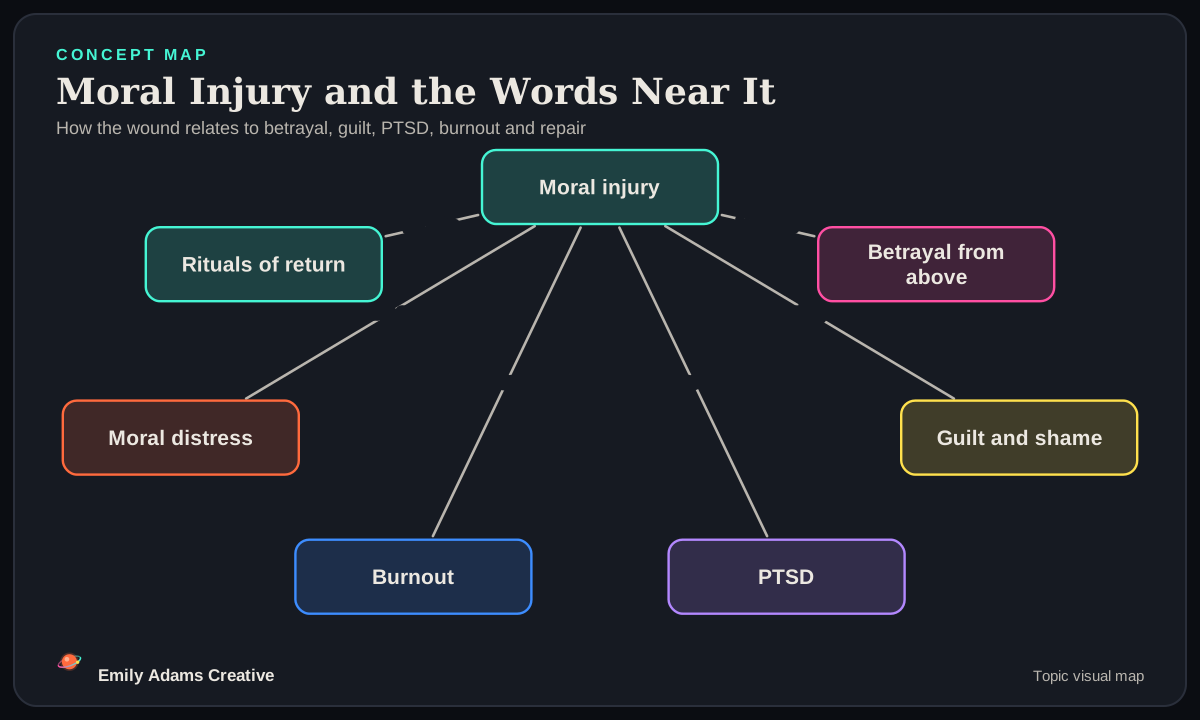
Moral injury is often confused with two neighbors. Moral distress, a term the nursing ethicist Andrew Jameton introduced in 1984, describes knowing the right thing to do while institutional constraints make it impossible to do it. Burnout, as the World Health Organization defines it, is chronic workplace stress that has not been successfully managed, marked by exhaustion, cynicism, and reduced effectiveness.
In 2018 the psychiatrist Wendy Dean and the surgeon Simon Talbot argued in a widely shared essay that physicians were not burning out; they were being morally injured. Burnout, they wrote, implies a failure of resilience in people who have spent decades proving theirs. The real problem was a system that keeps clinicians from giving patients the care they know those patients need.
The distinction is about where the problem lives. The burnout frame locates it in the worker and prescribes self-care. The moral injury frame locates it in the conditions and asks what the institution is making people do. Distress and injury sit on a continuum: the VA notes that the newest clinical scale includes a cutoff designed to separate moral distress from moral injury that is highly distressing and impairing.
Who Carries It
Soldiers came first because war asks for the most. When the Army screened 2,797 soldiers returning from Iraq, 40 percent reported killing or being responsible for a death, and killing predicted PTSD symptoms, alcohol abuse, anger, and relationship problems even after accounting for overall combat exposure. Nationally, roughly one in three U.S. combat veterans reports at least one potentially morally injurious event. Distance does not erase it: remote aircraft crews who watch strikes on a screen face their own version.
Health care is the second great reservoir. During the pandemic, health care workers reported distress over others’ wrongful acts at rates matching post-9/11 combat veterans. When researchers compared nationally representative samples, health care workers were as likely as combat veterans to screen positive for clinically meaningful moral injury, and both groups were about twice as likely as first responders.
The list keeps growing: firefighters and paramedics, police officers, reporters, and refugees who were forced into impossible choices. It also includes people injured from the third door, survivors of abuse by people they trusted, whose wound is betrayal rather than guilt.
A pattern runs through the research. Risk concentrates where people hold responsibility without control: the reporter without the resources to tell the story, the nurse without the staff to give the care, the soldier carrying out a decision made far above him. Studies of health care workers and of the MIDS cutoff both found higher rates among groups with less social power.
What It Does
Moral injury is not just painful; it is associated with measurable harm. A 2018 meta-analysis of 13 studies covering 6,373 workers found that morally injurious experiences accounted for a modest but real share of the variation in PTSD, depression, and suicidality. Most veterans with PTSD or depression report such events, which suggests that moral injury is woven through the conditions clinicians already treat.
The most serious link is with suicide. In a survey of 14,057 post-9/11 veterans, men who reported perpetration were twice as likely to attempt suicide after leaving the service, while for women the strongest predictor was betrayal. A national study of combat veterans found the link held above and beyond combat severity, PTSD, and depression.
The rest of the damage is quieter. The VA lists substance use disorders among the associated problems. Many people lose faith in God, in institutions, or in themselves, and the trust-violation side of the injury can make every authority look like the one that failed them. A person who has decided he is unforgivable often arranges his life to prove it.
Betrayal From Above
Shay’s betrayal door opens far beyond the military. The psychologist Jennifer Freyd calls the civilian version institutional betrayal: harm done by an institution to the people who depend on it, by failing to prevent abuse or by responding badly when it is reported. In a 2013 study of college women, those whose schools had betrayed them after unwanted sexual experiences reported more anxiety, dissociation, and trauma symptoms than those whose schools had not. Among veterans who experienced military sexual trauma, perceived institutional betrayal was linked to higher odds of a suicide attempt.
Institutions under pressure follow a script that Freyd’s group calls DARVO: deny, attack, and reverse victim and offender. The pattern is familiar from church abuse scandals, campus assault cases, and workplace harassment, and every step of it deepens the wound. Freyd’s proposed remedy is institutional courage, an organization’s commitment to seek the truth and act on it despite the cost.
The people who try to force that truth into the open often pay most. A study of 35 Australian whistleblowers found that every one had suffered for it, most starting with the first internal complaint. Inside large systems, social workers describe feeling like a part in a broken machine, carrying out decisions they believe are wrong. The same logic scales up to whole countries: when citizens believe their government lies to them or abandons them, the result looks less like disagreement and more like grief. Trust in the federal government has fallen from about three in four Americans in the early 1960s to fewer than one in five in 2025.
How Conscience Gets Switched Off
“I was just following orders. It wasn’t my call.”
International law answered that after the Second World War. The Nuremberg Principles, adopted by the United Nations International Law Commission in 1950, say acting on orders does not relieve a person of responsibility when a moral choice was possible. Psychologists call the excuse displacement of responsibility, one of the ways people switch conscience off.
If moral injury is what happens when conscience registers a wrong, moral disengagement is how people keep it from registering in the first place. The psychologist Albert Bandura described the maneuvers: justify the act as serving a worthy cause, rename it in sanitized language, compare it to something worse, hand responsibility up the chain or spread it across many hands, ignore the consequences, and blame or dehumanize the victims. He noted that great cruelties usually run through ordinary organizations, split into small tasks, staffed by people who are considerate at home.
The two ideas fit together. Disengagement protects people in the moment; injury often arrives later, when the euphemism wears off, the uniform comes off, and the person sees the act plainly. Rachel MacNair’s research on perpetration-induced traumatic stress described the trauma that follows taking part in killing, a burden the moral injury literature now counts as its most dangerous form.
The law closed one escape route after the Second World War. The fourth Nuremberg Principle holds that acting under orders does not relieve a person of responsibility, provided a moral choice was in fact possible. That clause is the hinge of moral injury. The people most at risk are the ones who knew they had a choice, or later decided they did.
The Man Who Landed
On March 16, 1968, an Army helicopter pilot named Hugh Thompson Jr. flew over the village of My Lai and saw bodies of women and children. When he realized American soldiers were killing civilians, he landed his helicopter in the line of fire, ordered his two crewmen to train their guns on the Americans, and helped evacuate survivors. The massacre killed hundreds of people; Vietnam remembers 504.
Thompson’s reward at home was suspicion. He said he was treated like a traitor and received death threats. The Army awarded him and his crew the Soldier’s Medal only in 1998, thirty years later. His story is the clearest available picture of the alternative to moral injury: the person who refuses, at the moment it counts, and then has to live with the cost of having been right.
Most people do not land the helicopter. Research on moral courage in health care finds that the people who stay silent are usually not indifferent; they are constrained by fear of conflict, of retaliation, of losing their place. That is the bystander problem in its institutional form, and it is why a silent witness can carry a wound too.
What Repair Looks Like
For years the default was to treat moral injury with the standard PTSD therapies, and they help some people. But fear fades with exposure; guilt does not, if the guilt is about something real. Shame tells the person they do not deserve to get better, and the worst event is often the last one disclosed. A new generation of treatments was built around those problems.
Adaptive Disclosure, developed by Litz and colleagues, has the person speak to an imagined compassionate moral authority about what happened, then sort out who was actually responsible and plan amends. Impact of Killing, developed by Shira Maguen, addresses killing directly and builds toward self-forgiveness and an amends plan; in a 2026 randomized trial it improved functioning, PTSD, and moral injury more than a comparison therapy. Acceptance and Commitment Therapy for moral injury treats moral pain as evidence of values worth living by rather than a symptom to erase, and Trauma Informed Guilt Reduction targets hindsight bias and inflated responsibility.
Two threads run through all of them. The first is forgiveness, especially of oneself, which the Impact of Killing team calls the cornerstone of healing, without pretending the wrong did not happen. The second is that repair is not purely clinical. Chaplains co-lead several of the new programs, and a chaplain-led group, Building Spiritual Strength, addresses anger at God and the problem of forgiveness head on.
Rituals of Return
Societies have known about this wound for a long time, and many built ways to carry warriors back across the line between war and home. The Hebrew Bible orders soldiers who had killed to stay outside the camp for seven days and be purified before rejoining the community. The Diné, or Navajo, perform the Enemy Way ceremony for returning warriors, a practice the VA now supports for Native veterans.

Medieval Christianity did something similar. After the Norman Conquest, the bishops of Normandy issued a penitential ordinance, confirmed by the papal legate Ermenfrid, that assigned penance to the men who had fought for William at Hastings and in the campaigns that followed. The victory was lawful in their eyes. The killing still required repair.
What these rituals share is that the community takes part. The returning soldier is not alone with what he did; others witness it, name it, and receive him back. Jonathan Shay made this the center of his work, starting with the Iliad, and called it the communalization of trauma: the person heals by telling the story to people who listen, take it seriously, and then let him come home. Modern clinics are slowly rebuilding that piece. The VA’s Moral Injury Group, co-led by a chaplain and a psychologist, ends with participants sharing testimony with members of the public.
Beyond the Battlefield
Moral injury has spread far past its military origins, sometimes into places researchers are only beginning to map. People who leave high-control religious communities often describe both doors at once: betrayal by leaders who taught them, and guilt for what they did or believed while inside. A study of survivors of religious conversion practices in Australia documented that combination, along with the loss of a community that had once been home.
It also helps to separate moral injury from moral outrage. Outrage is directed outward, is often public, and on social media is rewarded with attention. Moral injury is directed inward or at a betrayer, and is usually private and slow. Outrage can be the healthy response that prevents injury, when it leads someone to refuse or speak up. It can also be a substitute for action, a feeling discharged in public while the wrong continues.
The concept’s most important lesson may be about silence. Everyone who saw a wrong and said nothing has stood at the first door, and the research suggests some of them will carry it. The answer is not to stop feeling the weight. It is to build families, workplaces, congregations, and governments where the person who lands the helicopter is honored in time, and where people who did wrong under pressure can tell the truth and still be received home.