Four Words That Mean Different Things
Most arguments about matriarchy go wrong in the first sentence, because four different words get used as one. Matriarchy, strictly, means women holding political authority over a society the way men have held it in patriarchies. Matrilineal means descent, names, and inheritance run through the mother’s line. Matrilocal means a husband moves in with or near his wife’s family. Matrifocal means the household is organized around the mother, whatever the formal rules say.
The second, third, and fourth are common and well documented. In the largest cross-cultural database anthropologists use, 160 of 1,291 societies are coded as matrilineal, against 590 patrilineal. Where couples live after marriage follows the same lean: daughters staying home is a real and recurring rule, but sons staying home is more common.
The first word is the hard one. Even in societies where land and lineage pass through women, men often hold formal office, frequently as a mother’s brother rather than a husband. Anthropologists call the tension built into that arrangement the matrilineal puzzle, and it is the reason careful scholars rarely call any documented society a matriarchy in the strict sense.
The Victorian Theory of Mother Right
The idea that humanity began under female rule did not come from feminists. It came from nineteenth-century men building grand theories of progress. In 1861 the Swiss jurist Johann Jakob Bachofen argued from Greek myth and classical texts that an age of mother right had preceded the rule of fathers. Lewis Henry Morgan, who had studied the Haudenosaunee in New York, placed descent through the female line at the start of his ladder of social evolution in 1877.
Friedrich Engels turned the theory into a political argument in 1884: private property, he wrote, overturned mother right and subordinated women. For most of these men, the matriarchal stage was a primitive rung that patriarchy had rightly climbed past. Anthropologists dropped the whole ladder in the twentieth century, once fieldwork showed that societies do not march through fixed stages and that no documented society matched the theory’s picture of women ruling men.
The Goddess Debate
The idea came back in the 1970s with a new meaning. The Lithuanian American archaeologist Marija Gimbutas described a Neolithic Old Europe that was woman-centered, peaceful, and devoted to a great goddess, until horse-riding herders from the steppe overran it. The women’s spirituality movement took her picture and gave patriarchy a birthday: about five thousand years ago.
The strongest critique came from a feminist. In 2000 the religion scholar Cynthia Eller argued that the evidence for a matriarchal prehistory was a highly ideological reading of a few artifacts, and that the story did women no favors, because it rested on old ideas of women as nature and men as history. The figurines at the center of the argument, from the Paleolithic Venus carvings to the seated women of Catalhoyuk, have many plausible readings, and none of them comes with an inscription saying who held power.
Some scholars answered by changing the definition rather than the evidence. The anthropologist Peggy Reeves Sanday reserved the old meaning, female rule, for a different word and used matriarchy for societies whose founding principles are maternal. Heide Goettner-Abendroth, founder of what she calls modern matriarchal studies, defines matriarchies as egalitarian, consensus-run societies built on matrilineal kinship. Both redefinitions describe real societies. Neither describes women ruling men.
What Bones and Ancient DNA Show
Ancient DNA has done what figurines could not: it shows who lived with whom, and whose line was honored. In Iron Age Dorset, a 2025 study in Nature found a community built around a single maternal lineage, with the unrelated adults buried there mostly men who had married in. The same pattern recurred at sites across Britain. Roman writers had already noticed that British women could rule, inherit, and lead armies.

In the American Southwest, the most elaborate crypt at Chaco Canyon held nine people who shared identical mitochondrial genomes, a ruling family traced through mothers for roughly 330 years. In the Andes, a 9,000-year-old young woman was buried with a hunting kit, and a survey of early American burials suggested women made up a substantial share of big-game hunters. How far that finding generalizes is an open argument among specialists.
None of this shows a lost matriarchy. It shows something more useful: female-centered kinship and women with real authority appear again and again in the human record, in different places and centuries, without anyone needing to invent them.
Societies Where Descent Runs Through Mothers
Several living societies are routinely called matriarchies in travel writing. Up close, each is something more specific. Among the Mosuo of southwest China, households are led by a senior woman, children belong to their mother’s house, and partners traditionally do not marry or share a home. Mothers’ brothers, not fathers, are the men who raise the children.

The Minangkabau of West Sumatra, about four million people, pass land and houses from mothers to daughters and are also devoutly Muslim, a combination they have reconciled for centuries. Among the Khasi of Meghalaya in northeast India, the youngest daughter inherits the family house, and a small men’s movement has campaigned against the system. Yet the Khasi state’s government ministers have been men.
In Ghana, Asante kingship passes through the female line, and the queen mother nominates the king. Each of these societies gives women property, standing, and a protected place in the family that most patrilineal societies do not. None of them is run by women in the way patriarchies are run by men, and the people who live in them usually describe their systems as balance.
The Clan Mothers and the Suffragists
The clearest case of women holding formal political power over men’s offices is in New York State. In the Haudenosaunee Confederacy, the six nations once called the Iroquois, clan mothers choose the chiefs, advise them, and can remove a chief who fails his people. The chiefs sit in council; the women decide who sits there.
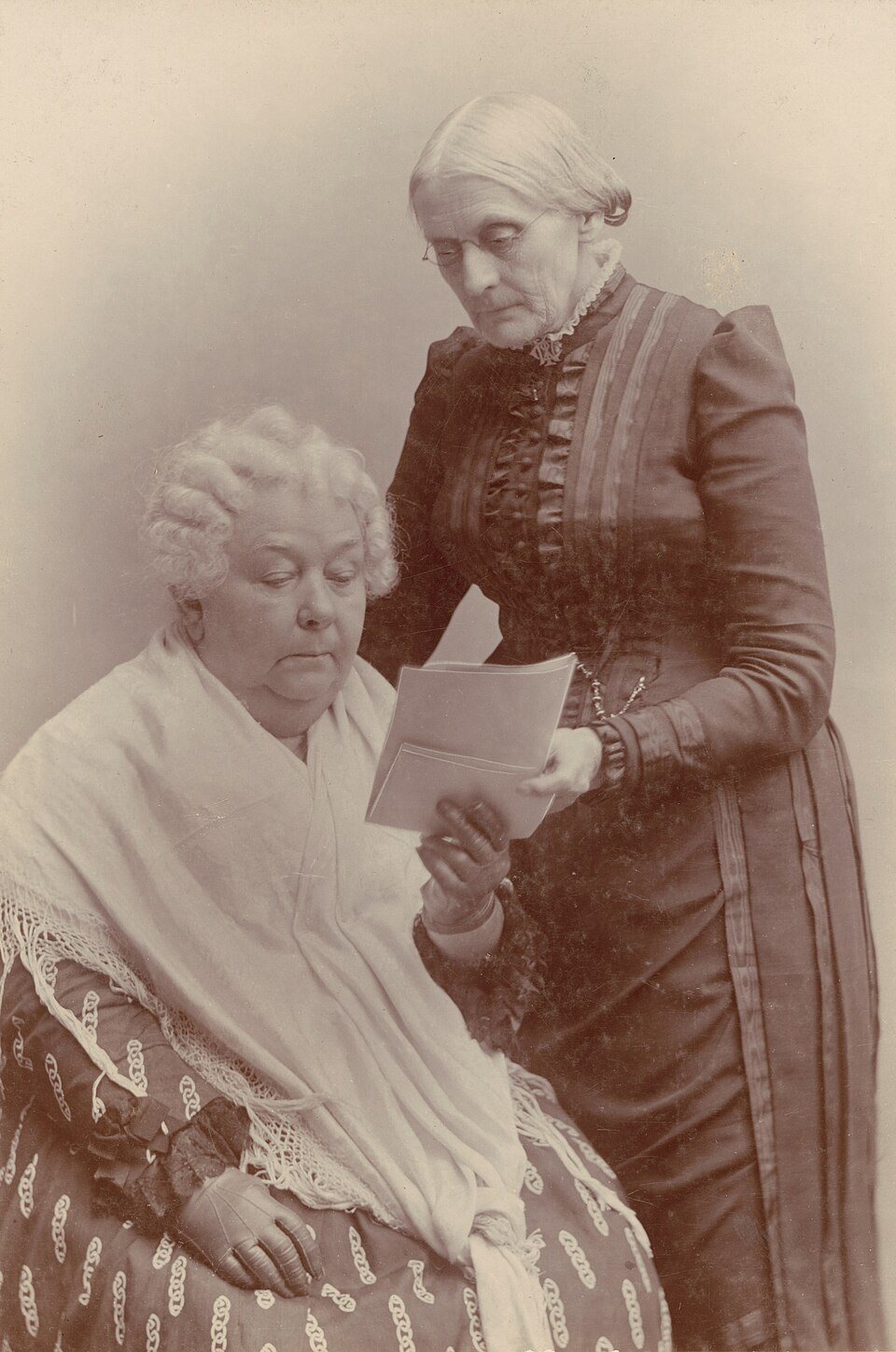
American suffragists lived beside this system and wrote about it. Matilda Joslyn Gage, who led the National Woman Suffrage Association with Elizabeth Cady Stanton and Susan B. Anthony, praised Haudenosaunee justice and was adopted into the Mohawk Wolf Clan in 1893. In 1891 Stanton told the National Council of Women that among the Haudenosaunee the nomination of chiefs had always rested with the women. The historian Sally Roesch Wagner has spent decades documenting that influence, which most histories of the suffrage movement left out.
Elsewhere, women built power from the ground up. In northern Kenya, Umoja began in 1990 as a refuge for Samburu women who had survived rape and violence, and grew into a village where men do not live. It is the closest thing to a women-run community on record, and it exists because the society around it gave women nowhere safe to be.
What Changes When Descent Runs Through Women
Matrilineal societies offer something rare in social science: neighbors who share a landscape, a diet, and often their genes, but differ in whose line counts. Researchers have used that contrast to ask which gender differences are built in and which are taught.
The results point the same way. In a 2009 experiment, Khasi women chose to compete more often than Khasi men, the reverse of the pattern among the patriarchal Maasai and in Western labs. In a second experiment, a gender gap in solving a spatial puzzle disappeared between a patrilineal society and its matrilineal neighbor. Across sub-Saharan Africa, the economist Sara Lowes compared communities on either side of the matrilineal belt and found matrilineal women experienced less domestic violence, had more say in their own lives, and had healthier children whose education gap between sons and daughters closed. Among the Mosuo, women’s health advantages flipped with the kinship system.
The same studies carry a cost the brochures leave out. Lowes also found that matrilineal spouses cooperated less within marriage when income was easy to hide. Kinship through women gives a wife a safety net outside her husband. That protects her, and it also loosens the household.
How Patriarchy Spread and Matriliny Shrank
“Patriarchy is natural. Every society has always been run by men.”
About one society in eight in the Ethnographic Atlas traces descent through mothers, and a 2003 study of Bantu-speaking societies found matrilineal cultures turned patrilineal after acquiring cattle. Male-run systems are common, but they track property and history, not a law of nature.
If matrilineal kinship works this well for women, the obvious next question is why it is the minority. The best evidence points to property, and to the animals and tools that made property worth fighting over. A phylogenetic study of Bantu-speaking societies found that acquiring cattle led matrilineal cultures to become patrilineal. Economists tracing the plough found that the descendants of plough-farming societies hold more unequal views of women’s roles today, even after emigrating. Geneticists modeling a sharp drop in Y-chromosome diversity about five to seven thousand years ago proposed that competing patrilineal clans could explain it.
Ancient DNA confirms that patrilocal communities have been the more common finding: a 2026 review notes that most genetic studies of past societies have found sons staying home, and that matrilocal cases are only now being documented. Engels was wrong about the stages and right that property mattered.
Modern states finished what herds and ploughs began. Kerala’s matrilineal Nair households were abolished by statute in 1976 after decades of regulation under colonial and princely-state laws. Ghana’s 1985 inheritance law set out to replace lineage obligations with the nuclear family. In each case the law presented the change as modernization.
Women in Power Now
The best modern evidence on what happens when women hold office comes from India. Since the 1990s, one third of village council leadership posts have been reserved for women by lottery, which turns politics into an experiment. Esther Duflo and Raghabendra Chattopadhyay found that women leaders invested in what women in their villages needed: water, fuel, and roads. A follow-up found that exposure to a woman leader weakened villagers’ stereotypes, even when it did not change their stated preference for men. At the state level, more women legislators meant fewer newborn deaths.
Other findings are more modest. Women’s participation in peace talks is associated with more durable agreements, though women remain a small share of negotiators. Norway’s 40 percent board quota raised the qualifications of women directors and narrowed the pay gap on boards, but did little for women further down. The pandemic claim that countries led by women had fewer deaths did not hold up in a global analysis.
Today Rwanda leads the world in women legislators, at 63.8 percent of its lower house in October 2026, and the Nordic countries sit near the top. The United States ranks 87th. The ranking also contains a caution: two of the top three are one-party states, where a seat in parliament is not the same as power.
Grandmothers, Elephants, and Orcas
Humans are one of very few animals in which females live for decades after they stop reproducing. The leading explanation, the grandmother hypothesis, holds that older women’s help feeding their grandchildren shaped human life history itself: our long lives, late maturity, and high fertility. Church records from preindustrial Finland and Canada showed that grandmothers’ longevity paid off in grandchildren, up to a point.

The other mammals that come closest show what female leadership looks like when it is about knowledge rather than force. In resident killer whales, post-reproductive mothers lead their families to salmon, especially in lean years. In African elephants, the oldest female’s judgment about threats keeps her family alive. In spotted hyenas, females dominate because they have more allies, not because they are bigger. Across primates, female-dominated societies are more common than once assumed. The bonobos, whose female coalitions are the subject of the Argument for Matriarchy series, are one case among several.
Matriarchy as a Fear Word
For as long as there have been stories about women in charge, they have been told as warnings. The Greeks made the Amazons the enemy their heroes defeated. Archaeology has since found that many steppe women really were fighters, buried with their weapons.

In the United States, the word was used against Black families. The 1965 Moynihan Report described the Black community as forced into a matriarchal structure that held back Black men. Scholars answered that the extended, mother-centered family was an adaptation to discrimination, not its cause. The pattern is consistent: when women’s authority shows up in someone else’s household, it gets called a pathology; when it shows up in myth, it gets called a threat. Neither label is a finding.
What a Society Built on Care Would Take
“Countries with generous family policy have already solved the gender gap.”
Danish administrative data show the arrival of children still creates a gender earnings gap of about 20 percent in the long run, and a study of sixty years of Austrian reforms found parental leave and child care expansions had virtually no effect on closing the gap. Policy helps families; it has not equalized power.
The appeal of matriarchy, for most people who invoke it, is not women ruling men. It is a society organized around care, where raising children and tending elders count as central work. The nearest modern test is the Nordic welfare state, and its results are instructive.
Even in Denmark, the arrival of a first child cuts women’s long-run earnings by about 20 percent relative to men’s, and that gap now accounts for most of the remaining gender inequality in pay. A study of sixty years of Austrian reforms found that expanding parental leave and child care did virtually nothing to close the gap. Policy alone has not built a care society. What the matrilineal evidence suggests is the missing piece: women surrounded by their own kin, holding their own property, with authority that does not depend on a husband.