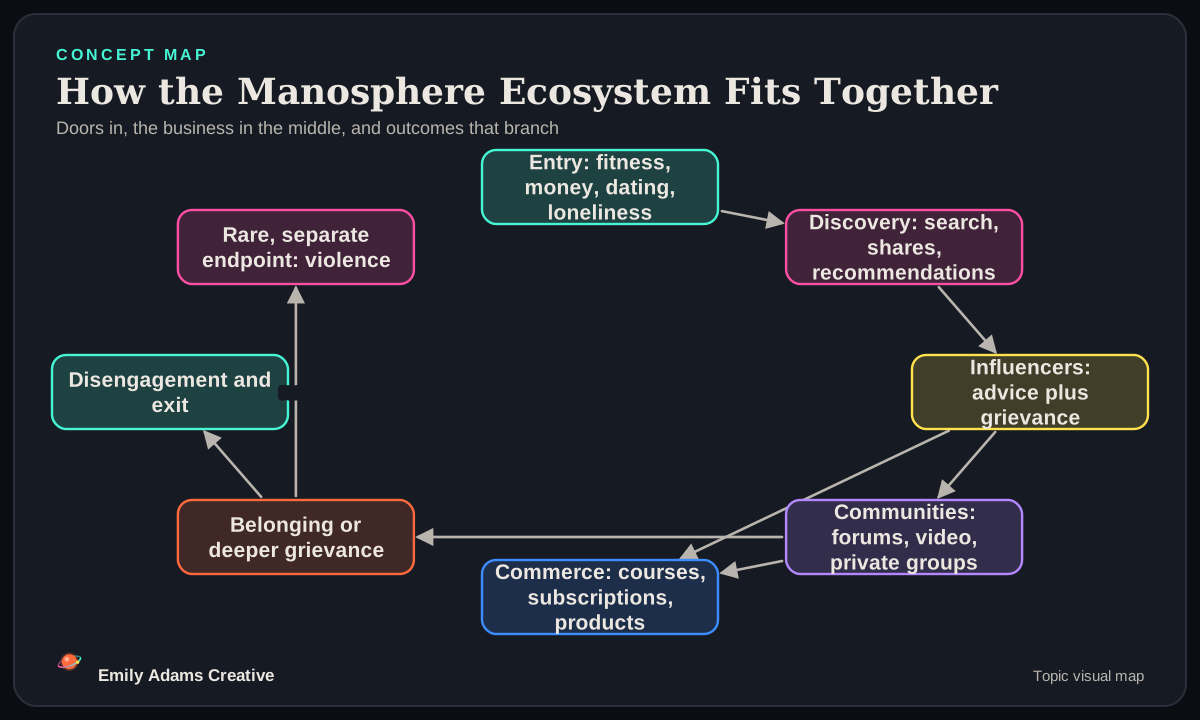
Singlehood, Ideology, Misogyny, and Violence Are Different Things
Incel is short for involuntary celibate. The word began in 1997 as the name of a support project started by a woman, open to anyone of any gender who wanted a relationship and could not find one. Almost three decades later it names something narrower: an online identity, mostly male, with its own vocabulary, its own explanation for why some people stay alone, and in some corners open contempt for women. Around it sits a larger and looser network usually called the manosphere, where men’s rights advocates, pickup coaches, separatists, appearance optimizers and paid influencers compete for the same audience.
Six things are routinely collapsed into one: being involuntarily single, advocating for men’s welfare, buying masculine self-help, posting in an incel forum, endorsing misogyny, and supporting violence. Each describes a different number of people and a different kind of problem. Most single men are not incels. Most men who watch a fitness or dating influencer have not joined anything. Most people who post hostile things in a forum never hurt anyone.
The direct research supports keeping those lines. In the largest survey of self-identified incels in the United States and the United Kingdom, nearly half gave the highest loneliness answer on every loneliness item, and about one in twenty said violence against perceived enemies was often justified. Those two numbers describe the field. Distress is common. Endorsement of violence is a minority position. Violent acts are rarer still, and they are a separate endpoint, not the last stop on a line every member rides.
The men in these studies are often in real pain, and much of the commercial manosphere works by selling that pain back to them. Taking the distress seriously and taking the misogyny seriously are not competing positions. The evidence requires both.
A Support Project That Lost Its Name
The label came first and the ideology much later. In 1997 a university student known publicly only as Alana built a website about her own dating struggles and found she was not alone. Alana’s Involuntary Celibacy Project became a mutual-support space for people of any gender who wanted romance or sex and were not finding it.

The 2000s produced several successors with very different temperaments. Some early forums for the shy and the romantically excluded stayed supportive. Others turned hostile, and a forum built to complain about pickup coaching, PUAHate, became one of the best known. At the same time, pickup-artist books and forums taught that dating was a set of learnable tactics and a competition for status. In 2012 a Reddit community gave red-pill thinking an organized home. Between 2014 and 2018, harassment campaigns and publicized attacks brought the whole cluster to public and policy attention.
None of this was a single movement, and it was not inevitable. A 2026 historical study of the years 1997 to 2014 argues that the turn toward misogyny was one path among several the communities could have taken. A computational study of 28.8 million posts across six forums and 51 subreddits traced how manosphere communities shifted over time, and found rising toxicity in some newer communities. The longer lineage reaches back to the men’s liberation and men’s rights politics of the 1970s and 1980s, which answered changing gender roles in sharply different ways.
In the 2020s the center of gravity moved again, from dedicated forums to short-form video, podcasts and paid communities, where the ideas reach people who would never search for an incel forum.
Not One Movement: The Subgroup Map
Researchers describe the manosphere as overlapping communities rather than an organization, and a 2025 synthesis argues the newer version is best studied as several manospheres, each with its own center. The groups disagree with each other, sometimes bitterly. What they share is a focus on male identity, men’s grievances, dating and status.

The main tribes make distinct claims. Men’s rights activism advocates on legal and family issues where men may face disadvantage. Pickup artistry sells systems for dating success. Men Going Their Own Way counsels withdrawal from relationships with women. Looksmaxxing promises status through appearance. The manfluencer packages a version of masculinity, wealth or discipline as a product. Incels, in the modern subcultural sense, are an identity built around romantic exclusion.
Two metaphors run through all of them. The red pill, borrowed from The Matrix, is the belief that mainstream society hides the real rules of sex and gender. The black pill is the darker conclusion that looks, genes and status settle romantic outcomes in advance, so effort is pointless. The red pill sells a course. The black pill sells despair, and despair is harder to leave.
Each label covers a range. Some pickup advice is ordinary confidence coaching; some is manipulative. Some men who skip marriage are simply independent; some are separatists who speak of women with contempt. Grooming, lifting and skin care are not ideology. The useful question is never which label a man uses, but which claims he has come to believe and what they ask him to do.
What Direct Studies of Incels Found
“Incels are just autistic guys who can’t read women.”
The largest survey of self-identified incels, done for the UK government in 2024, found 30.7 percent scored above the cutoff on a brief autism screen. A screen is not a diagnosis, most did not score above it, and the study offers no evidence that autism causes misogyny. Loneliness, depression and anxiety were far more widespread.
Most writing about incels analyzes their posts. A smaller body of research asks the men themselves. The largest is a 2024 study led by Swansea University for the UK Commission for Countering Extremism, which surveyed 561 self-identified incels in the United States and the United Kingdom.
The distress was severe. Forty-eight percent gave the highest response on all three loneliness items. On standard screening questionnaires, 43.0 percent met the threshold for anxiety and 38.9 percent for elevated depression, screening results rather than diagnoses. And 21.6 percent reported suicidal thoughts nearly every day in the previous two weeks.
Two other numbers draw more attention than they can bear. On the AQ-10, a brief autism screen, 30.7 percent scored above the cutoff, which is not a rate of diagnosed autism and offers no evidence that autism causes misogyny. About 5 percent said violence against perceived enemies was often justified: an attitude, not a record of anything anyone did.
The sample did not fit the stereotype. It included men of color and men across the political spectrum, so left and right alone cannot explain who identifies as an incel. In the report’s models, mental health and ideological belief each predicted its composite measure of harmful attitudes more strongly than the social-network measure did. The data were collected at one point in time, so they show association, not which came first.
How Private Rejection Becomes a Group Grievance
“Women only care about looks. The data proves it.”
A 2024 study compared self-identified incels with single men who were not incels and found both groups misjudged what women look for in a partner. The error was shared, not proof of a hidden rule. Looks matter to everyone somewhat, but the belief that they settle everything comes from the forums, not from the data.
The surveys describe a state. Experiments and repeated studies get closer to a mechanism. The strongest direct evidence concerns belonging. Three studies published as Behind the Blackpill found that incels active in online communities reported strong identity fusion, a sense that the self and the group are one. Being understood and confirmed by other members, a process called self-verification, went with stronger fusion, and fusion went with approval of violence toward women or online harassment, depending on the study.
A second line of evidence concerns status. A 2026 Swedish project combined a survey of 2,751 people with three experiments and found that perceived threats to masculine status were linked to engagement with misogynist grievance groups. When the researchers presented messages that framed male status as under attack, anger rose, and in some conditions so did stated willingness to engage.
Around those findings sit mechanisms with weaker but real support. Aggrieved entitlement frames a relationship or status as something owed and unjustly withheld. Overgeneralization turns a handful of rejections into a law about all women. Hostile attribution reads an ambiguous no as contempt. Group polarization rewards the most extreme version of a belief with the most approval. Some research also links certain personality traits to harmful attitudes, which is a correlation, not a diagnosis.
The beliefs being reinforced are often simply wrong. A 2024 study of the mating psychology of incels compared self-identified incels with single men who were not incels and found that both groups misjudged what women want in a partner. The distortion was not confined to incels, and it did not support the claim that looks are all that count.
Cult, Conspiracy, or Neither
When parents watch a son vanish into a feed, the word that comes to mind is cult. Parts of the comparison fit. Researchers of extremism often use the 3N model: a need for significance or recognition, a narrative that names who is to blame and what will fix it, and a network that rewards the person for adopting it. Incel spaces offer all three. So do many high-control groups, which also trade in insider knowledge, shame, us-versus-them divisions, membership payments and the discrediting of outsiders.
Other parts do not fit. The manosphere has no single leader, no compound, no enforced isolation and no coercive membership structure. A man can leave a forum with a click, and many do. Calling it a cult is an analogy, not a diagnosis, and the analogy breaks precisely where the remedy would differ: there is no leader to expose and no group to extract someone from.
The comparison with conspiracy belief is closer. Red-pill and black-pill claims work as a closed explanatory system that simplifies a painful uncertainty by blaming a powerful outside force and treating counterevidence as proof of the cover-up. A 2025 meta-analysis of 279 independent studies links frustrated psychological needs to conspiracy belief. That is general research on conspiracy belief, not a direct study of incels, but it describes the same trade: certainty and blame in exchange for the loss of a hopeful explanation.
None of these frameworks describes a conveyor belt. Researchers sketch a hypothesized sequence, from rejection to seeking an explanation to repeated exposure to peer validation, with an exit at every step. A 2026 longitudinal study of forum language found that users followed different patterns of persisting, leaving and returning, not one path.
What the Algorithm Audits Show
“The algorithm is radicalizing our boys.”
A 2024 Dublin City University test found 76 percent of TikTok and 78 percent of YouTube Shorts recommendations to its experimental accounts were toxic by the final round. A 2026 study of real YouTube users found mild echo chambers but no systematic path to extremism. Feeds can amplify harmful content; that alone does not show they convert most viewers.
The most repeated claim about the manosphere is that recommendation algorithms push boys into it. There is real evidence behind the claim, and real evidence against its strongest form.
On one side is a 2024 audit by Dublin City University. Researchers set up ten experimental accounts on TikTok and YouTube Shorts and recorded what the platforms recommended. By the final round, after 400 recommendations, 76 percent of what TikTok served and 78 percent of what Shorts served those accounts was judged problematic or toxic. Those are results for experimental accounts built for the test, not the share of content a typical teenager sees.
On the other side is a 2026 study in Political Communication that audited recommendations to real YouTube users. It found some mild echo-chamber effects but no systematic path toward more extreme content. Both studies can be right: a platform can amplify harmful content under some conditions without routinely converting the people who watch it. Recommendation, belief and behavior are three different outcomes, and most audits measure only the first.
Video is not the only route. Peer-reviewed work on TikTok found incel themes moving into mainstream feeds, large text studies of forums track how communities talk, and private platforms such as Discord, Telegram and paid groups sustain communities that researchers can barely see. The ecosystem has many doors, and the algorithm is one of them.
How to Read an Algorithm Audit
Algorithm studies are reported in headlines as if they measured children. Most measure accounts. Reading one well takes four questions, and the answers explain why two careful studies can seem to disagree.

First, who was watching? A sock-puppet account, set up by researchers to behave a certain way, shows what a platform can do under those conditions. A real-user audit shows what it did for actual people, who skip, search, share and log off. Second, what was counted? A recommendation is not a view, a view is not a belief, and a belief is not an act. Third, who judged the content, and by what definition of toxic? Fourth, when? Platforms change their systems often, so a finding from one year describes that year.
Applied to the Dublin City University audit, the answers are: experimental accounts, recommendations, researchers’ coding, 2024. Applied to the 2026 YouTube study: real users, recommendations and their ideological direction, that study’s measures, a later period. Neither one measured whether anyone’s attitudes changed.
The same discipline applies to reach. When a report says creators drew billions of views, it is counting views, not people. Many views come from the same viewers, and a view says nothing about whether the viewer agreed.
The Business of Insecurity
Grievance keeps an audience coming back, and an audience that comes back can be sold to. The commercial manosphere earns money along six documented routes: platform advertising and sponsorships, affiliate links and referrals, paid courses and coaching, subscriptions and private groups, appearance and fitness products, and financial products, tips or promises of entrepreneurial success.
One scholarly analysis calls the result an online protection racket: creators emphasize a young man’s insecurity, then sell protection from it. The analogy describes a business model, not a crime, and it does not mean every creator is running a deliberate scam. It does explain why the most profitable message is rarely you are fine. A man who feels he is failing will keep paying for the cure.
Two documented cases show the scale. Investigative reporting in 2022 described an affiliate model built around Hustler’s University, Andrew Tate’s paid online program, in which members were reportedly paid referral commissions for signing up others; that affiliate model was reported discontinued in August 2022, so it describes a dated case rather than the current setup. In 2026, Equimundo and Reset Tech published The Grift Economy, an investigative report on 216 looksmaxxing influencers whose content drew 14.6 billion combined views in the study window.
Behind the sales pitch is a real economic backdrop. Housing costs, job insecurity and status expectations plausibly make messages about male failure land harder. Direct evidence that economic precarity causes incel ideology remains limited. The pitch works by turning structural pressure into personal failure that a product can fix.
Gender Politics and the Right-Wing Overlap
The manosphere grew inside a long argument about feminism, sexual autonomy, traditional gender expectations and the changing public conversation about masculinity. Its politics are not uniform, and incels, conservatives, Christians, men’s advocacy groups and far-right organizations are different populations that should not be equated.
Researchers do find overlapping themes between some manosphere spaces and the far right: anti-feminism, rigid status hierarchies, racialized or nationalist grievance, and conspiracy narratives. The overlap is real in those spaces and absent in others. The 2024 survey’s mix of political identities is a reminder that economic views, views about gender, and acceptance of violence need to be measured one at a time.
The most useful link is a mechanism rather than a party. The Swedish experiments show that messages framing male status as under attack can raise anger and interest in grievance groups. Very similar experiments with American Christians found that reminders of a shrinking majority raised the perception that religious freedom was under threat. Both fit a zero-sum reading of status, in which another group’s gain is felt as one’s own loss.
Neither finding proves that the perceived threat is real, or that demographic and cultural change is itself an injury to men or to Christians. They show how a loss of automatic advantage can be experienced, and then sold, as a loss of rights.
Violence, and What the Evidence Does Not Establish
“Incels are all violent. They’re terrorists waiting to happen.”
In the largest survey of self-identified incels, done for the UK government in 2024, about 5 percent said violence against perceived enemies was often justified, an attitude, not an act. Far more reported daily suicidal thoughts. Attacks are real and documented, but they are rare, and no validated test predicts violence from incel identity.
Serious violence linked to incel ideology is documented. The 2014 attack in Isla Vista, California, and the Toronto attacks of 2018 and 2020 are the cases most often cited, each with different evidence and different legal findings about ideological motive. Some attackers have been celebrated afterward in incel forums, which is its own harm.

These cases are a separate and much rarer endpoint than identification with incel ideas or offensive speech. Researchers distinguish four kinds of harm: harm to self, online misogyny and harassment, stated justification of violence, and credible threats, preparation or offending. Most research measures the first three, through surveys, interviews and posts, not observed criminal conduct. Not every misogynistic crime is incel-motivated, and almost no one who posts in an incel forum commits one.
There is no validated incel violence predictor based on identity or forum membership. The same discipline applies to the other popular explanations. The evidence does not establish that incel identity is caused by autism, narcissistic personality disorder, poverty, conservative voting, singlehood or algorithm exposure alone, or that every participant follows a stepwise path toward violence. It also does not establish that the manosphere is uniformly right-wing or clinically disordered.
What the evidence does establish is narrower and more useful: distinct communities with growing reach, significant distress in the men studied, belonging and status threat as active ingredients, a commercial incentive to keep grievance alive, and a small minority who justify harm.
Leaving Without Finding a Partner, and Helping Someone Out
The ideology tells men there is one way out: a relationship they will never get. The men who have left say otherwise. A 2024 study of interviews with 21 former incels traced how vulnerability, belonging and perceived romantic failure drew them in and how their worldview shifted on the way out. Later qualitative work suggests that leaving does not require finding a partner.
The approaches with the most support address the ingredients the research identified. Treating depression, anxiety and suicidal thinking comes first, because many of these men screen high for all three. Non-extremist belonging, in a team, a gym, a job or a group of friends, competes with the forum on its own ground. Testing claims about dating against careful evidence, and understanding the commercial incentives behind a feed, loosen the narrative. Credible individual threats call for a safety response, which is a different job.
For a parent, sibling or friend watching someone drift in, the most effective moves are the least dramatic: keep talking, take the loneliness seriously, ask what the content offers him before arguing with what it says, and never mock the distress underneath it. Shame is one of the things the forum sells.
There are too few controlled studies of incel-specific exit programs to name a recipe shown to work. A man who goes quiet online may have changed his mind, moved platforms, or simply stopped posting, so disappearance is not proof of change. What the record does show is that people leave, and that the way out runs through belonging and care more often than through argument.