Who Is Here, and How Many
Every argument about illegal immigration starts from a number, and the best estimate is large. Pew Research Center counted 14 million unauthorized immigrants in the United States in 2023, a record, after an increase of 3.5 million in two years. They were 4.1 percent of the population and 5.6 percent of the workforce. More than 12 million had entered illegally or overstayed a visa; about 2 million more had been paroled or released at the border to pursue asylum or other claims, which is why the category blends people breaking the law with people waiting in court.
Then the direction reversed. By Pew’s count of census data, the country’s total immigrant population shrank by more than a million people in the first half of 2025, the first decline since the 1960s. Public opinion moved too. Gallup’s long-running question found nearly three in four adults saying in 2026 that immigration is a good thing for the country, down slightly from a record the year before.
The case for restriction, made by groups such as the Center for Immigration Studies, the Federation for American Immigration Reform, and the Heritage Foundation, rests on a handful of claims: that illegal immigrants bring crime and drugs, that the border was open, that they cost taxpayers and take jobs, that they vote, that they should get in line, and that their children should not be citizens. Each claim can be stated fairly and checked. Some hold up. Most hold up only in part, or not at all.
Crime and Drugs: The Most Tested Claim
“Illegal immigrants are flooding our communities with violent crime and fentanyl.”
Using Texas arrest records, which check every arrestee’s immigration status, a 2020 study in the Proceedings of the National Academy of Sciences found US-born citizens more than twice as likely as undocumented immigrants to be arrested for violent felonies. And the U.S. Sentencing Commission reports that 84 percent of people sentenced for fentanyl trafficking in fiscal 2025 were U.S. citizens.
The strongest form of the argument is not that every migrant is dangerous. It is that any crime committed by someone who should not have been in the country was preventable, and that official statistics undercount offenders who are here illegally. The first law of the 119th Congress, the Laken Riley Act, rests on the first point. The second point is an empirical one, and it has been checked more carefully than any other claim in the debate.
The best data come from Texas, which runs the fingerprints of everyone it arrests against federal immigration records. A 2020 study in the Proceedings of the National Academy of Sciences used those records for 2012 to 2018 and found US-born citizens more than twice as likely as undocumented immigrants to be arrested for violent felonies and more than four times as likely to be arrested for property felonies. The Center for Immigration Studies replies that Texas identifies many illegal immigrants only after they reach prison, so early counts misfile them as native-born. That is a serious point, and it moves a few offense categories in one state. It does not reverse the overall pattern.
The long view points the same way. Economists tracking incarceration across 150 years of census records found immigrants as a group less likely to be locked up than the US-born in every decade since 1870, and 60 percent less likely today. Studies of sanctuary policies have not found that limiting local cooperation with immigration agents raises crime.
Fentanyl is the sharpest version of the claim, and the federal sentencing record answers it directly. In fiscal 2025, 84 percent of people sentenced for fentanyl trafficking in federal court were United States citizens.
The Border: Where the Claim Was Right
“The border was wide open, and only Trump closed it.”
Border Patrol encounters did hit records of more than 2.2 million in fiscal 2022 and 2 million in 2023, Pew’s analysis of federal data shows. But they had already fallen sharply in 2024 after new asylum limits and Mexican enforcement. And a bipartisan Senate border bill failed 49 to 50 that February.
On this one the restrictionists had the numbers. Border Patrol recorded more than 2.2 million encounters at the Mexican border in fiscal 2022 and more than 2 million in fiscal 2023, the two highest totals in its records. Some were the same people caught more than once, because pandemic-era Title 42 expulsions sent people back without the penalties that discourage a second try. Even allowing for repeat crossings, the surge was real, and officials who described the border as under control were wrong.
What the argument leaves out is what changed the numbers and who blocked the fixes. In February 2024 a bipartisan Senate border bill, negotiated by one of the Senate’s most conservative Republicans, failed 49 to 50 after Donald Trump urged Republicans to kill it. That June, President Biden used executive power to shut off most asylum claims whenever crossings averaged 2,500 a day, and Mexico stepped up its own enforcement. Encounters were already falling when Trump took office in January 2025. Under his administration they fell much further: 237,538 in fiscal 2025, the lowest since 1970, and about 99,000 in fiscal 2026.
The record also complicates the claim that earlier presidents did not deport anyone. Federal removal statistics show the most formal removals in a single year under Barack Obama, in fiscal 2013, and the most returns under Bill Clinton, when Border Patrol sent well over a million people a year back across the line without a formal order. The sharpest drops in crossings in both 2024 and 2025 followed changes in asylum policy and in Mexico’s enforcement.
Taxes and Benefits: Who Pays, Who Collects
“Illegal immigrants don’t pay taxes and live off welfare.”
Undocumented immigrants paid an estimated $96.7 billion in taxes in 2022, including $25.7 billion into Social Security they cannot draw, according to the Institute on Taxation and Economic Policy. Federal law already bars them from Medicaid, food stamps, Medicare, and marketplace coverage. Hospitals can be reimbursed only for emergency care.
The fiscal argument has a real core. People without legal status earn less on average, so they pay less in income tax, and their children attend public schools. The Federation for American Immigration Reform puts the net cost of illegal immigration at $150.7 billion a year.
The other side of the ledger is larger than many people assume. The Institute on Taxation and Economic Policy estimates that undocumented immigrants paid $96.7 billion in federal, state, and local taxes in 2022, including $25.7 billion in Social Security taxes for benefits they cannot collect. Meanwhile federal law bars them from Medicaid, food stamps, Medicare, and marketplace insurance; hospitals can be paid for emergency care only.
The most cited neutral review, the National Academies’ 2016 report, found that first-generation immigrants cost state and local governments more than the US-born, mostly through schooling their children, while those children grow up to be “among the strongest fiscal and economic contributors” in the country. Whether illegal immigration is a fiscal loss depends on whose ledger is counted and for how many years.
Jobs and Wages: A Real Debate With a Narrow Answer
“Illegal immigrants are taking American jobs and driving down wages.”
The National Academies of Sciences found immigration’s effect on native-born employment overall is very small, with any wage losses concentrated among workers without a high school diploma. And enforcement cuts both ways: a study of the Secure Communities program found it lowered employment and wages for US-born workers in the same areas.
The labor argument is the one with the most academic support, and it deserves its strongest form: adding workers who compete with the least-educated Americans should push their wages down. The best-known test is the Mariel boatlift of 1980, which added about 7 percent to Miami’s labor force almost overnight. David Card found no measurable harm to local workers. George Borjas reexamined the data in 2017 and found that wages of men without a high school diploma fell 10 to 30 percent. Other economists, using a different method, found no significant difference. Serious researchers still disagree.
The National Academies’ review split the difference in a way both sides can cite: the effect on native-born employment overall is very small, and any negative effect falls mostly on earlier immigrants and native-born workers without a diploma. That is a real cost to a specific group, and restrictionists are right to name it.
Removing workers is not the mirror image of adding them, because immigrants also buy goods, fill complementary jobs, and keep farms and plants running. A study of the Secure Communities program found that stepped-up enforcement lowered the employment and wages of US-born workers in the same places. The Peterson Institute projected that deporting 1.3 million workers would leave the economy 1.2 percent smaller by 2028. In some industries the dependence is stark: 42 percent of hired crop farmworkers lack work authorization, by the Labor Department’s survey.
Voting: The Claim With the Least Behind It
“Illegal immigrants are voting in our elections.”
Noncitizen voting in federal elections is already a federal crime. The Heritage Foundation’s own fraud database lists about 100 cases of noncitizen voting from 1982 to 2025. Georgia’s 2026 review found about 430 possible noncitizen voters across 30 years, out of nearly 8.2 million registered voters.
The argument that noncitizens swing elections rests on a real gap, as restrictionists see it: voters attest to their citizenship when they register rather than proving it with documents, and an honor system, they argue, invites abuse. They back the SAVE Act, which would require documentary proof of citizenship to register.
Every serious check has found the abuse to be rare. Voting by a noncitizen in a federal election is already a federal crime punishable by prison. The conservative Heritage Foundation’s own database lists about 100 cases of noncitizen voting from 1982 to 2025. Georgia, which has checked its rolls more aggressively than almost any state, found about 430 possible noncitizen voters across 30 years of elections, out of nearly 8.2 million current registrants.
The cost of the cure falls on citizens. Proof-of-citizenship rules burden eligible Americans who have no passport or birth certificate at hand, a group that skews poorer and rural. The trade is a few hundred possible cases over decades against barriers for millions of legal voters.
Why Not Get in Line?
“My ancestors came here legally. Why can’t they just get in line?”
Before the Chinese Exclusion Act of 1882, federal law barely restricted immigration, so most early arrivals had no line to stand in. Today federal law caps family green cards near 226,000 a year, with no country above 7 percent, and asylum law lets people apply whether or not they arrive at a port of entry.
“My ancestors came here legally” is the most common version of this argument, and it is usually true in a way that misleads. For most of American history there was little to be legal or illegal about. The Chinese Exclusion Act of 1882 was the first significant federal law restricting immigration, and the national-origin quotas of 1924 came later still. An Irish or German immigrant in 1850 needed only to arrive.
Today the line is real, but for most people without a close relative or an employer sponsor it does not exist. Federal law caps green cards at roughly 226,000 a year for family categories and 140,000 for employment, and no country may receive more than 7 percent of them, so applicants from Mexico, India, or the Philippines wait years or decades. Living here without status makes things worse: someone unlawfully present for a year who leaves to apply from abroad is barred from returning for 10 years.
The law also draws distinctions the slogan erases. Crossing the border without inspection is a federal misdemeanor on a first offense; simply being present without status is a civil violation, not a crime, as the Supreme Court noted in 2012. And asylum law says that a person who reaches the United States may apply “whether or not at a designated port of arrival.” Many people called line-jumpers were standing in the one line the law gave them.
Birthright Citizenship: Settled Again in 2026
“Children of illegal immigrants shouldn’t get automatic citizenship. The Fourteenth Amendment never meant that.”
The Supreme Court ruled in 1898, in United States v. Wong Kim Ark, that a child born here to parents who could not become citizens was a citizen by birth. In June 2026, in Trump v. Barbara, the Court struck down the order that tried to end birthright citizenship, 6 to 3.
The argument against birthright citizenship turns on six words of the Fourteenth Amendment: “subject to the jurisdiction thereof.” Restrictionists read them to exclude the children of parents who are here illegally or only temporarily, and they object to “birth tourism.” On his first day back in office, President Trump signed an executive order adopting that reading for children born after February 19, 2025.
The Supreme Court had addressed the question in 1898. In United States v. Wong Kim Ark, it held that a man born in San Francisco to Chinese parents, who were subjects of the emperor of China, was a citizen by birth. On June 30, 2026, in Trump v. Barbara, the Court struck down the 2025 order, 6 to 3. Chief Justice John Roberts wrote that the amendment’s framers extended citizenship to “every free-born person in this land.” The vote on the constitutional question itself was closer, 5 to 4, and the administration has since issued a narrower order.
Enforcement Since 2025: Who Is Being Taken
“They’re only deporting criminals.”
Federal data analyzed by TRAC showed ICE holding 65,765 people in July 2026, and 70.6 percent of them had no criminal conviction. Many of the rest had only minor convictions, such as traffic offenses. ICE’s own list counts 36 deaths in custody in fiscal 2026.
Restrictionists argue that anyone here illegally has broken the law and that a credible threat of removal is what keeps people from coming. That is a coherent position. It is not the same as the claim that the people being detained are mostly criminals, and the government’s own data answer that claim.
In July 2026, according to TRAC’s analysis of ICE data, ICE held 65,765 people in detention, and 70.6 percent of them had no criminal conviction. Many of the rest had been convicted only of minor offenses, including traffic violations. Mistakes have reached citizens: ProPublica identified more than 170 U.S. citizens held by immigration agents in 2025 alone. And deaths in ICE custody rose to 36 in fiscal 2026 by the agency’s own list, the most since it began posting them.
The most public cases came first. In March 2025 the government flew Venezuelan men to a Salvadoran prison under the Alien Enemies Act of 1798, and it deported Kilmar Abrego Garcia, a Maryland man whom an immigration judge had ordered protected from return to El Salvador. The Associated Press described the removal as a mistake. A federal judge later dismissed the criminal case it brought against him after his return, finding evidence of vindictive prosecution.
Every Wave Heard It First
The charges made against today’s migrants are old. In 1751 Benjamin Franklin asked why German “Boors” should be allowed “to swarm into our Settlements” and “Germanize us instead of our Anglifying them.” In 1882 Congress shut out Chinese laborers on the premise that they endangered public order, and in 1924 it wrote national-origin quotas that favored the British Isles and western Europe and limited newer immigration from southern and eastern Europe.
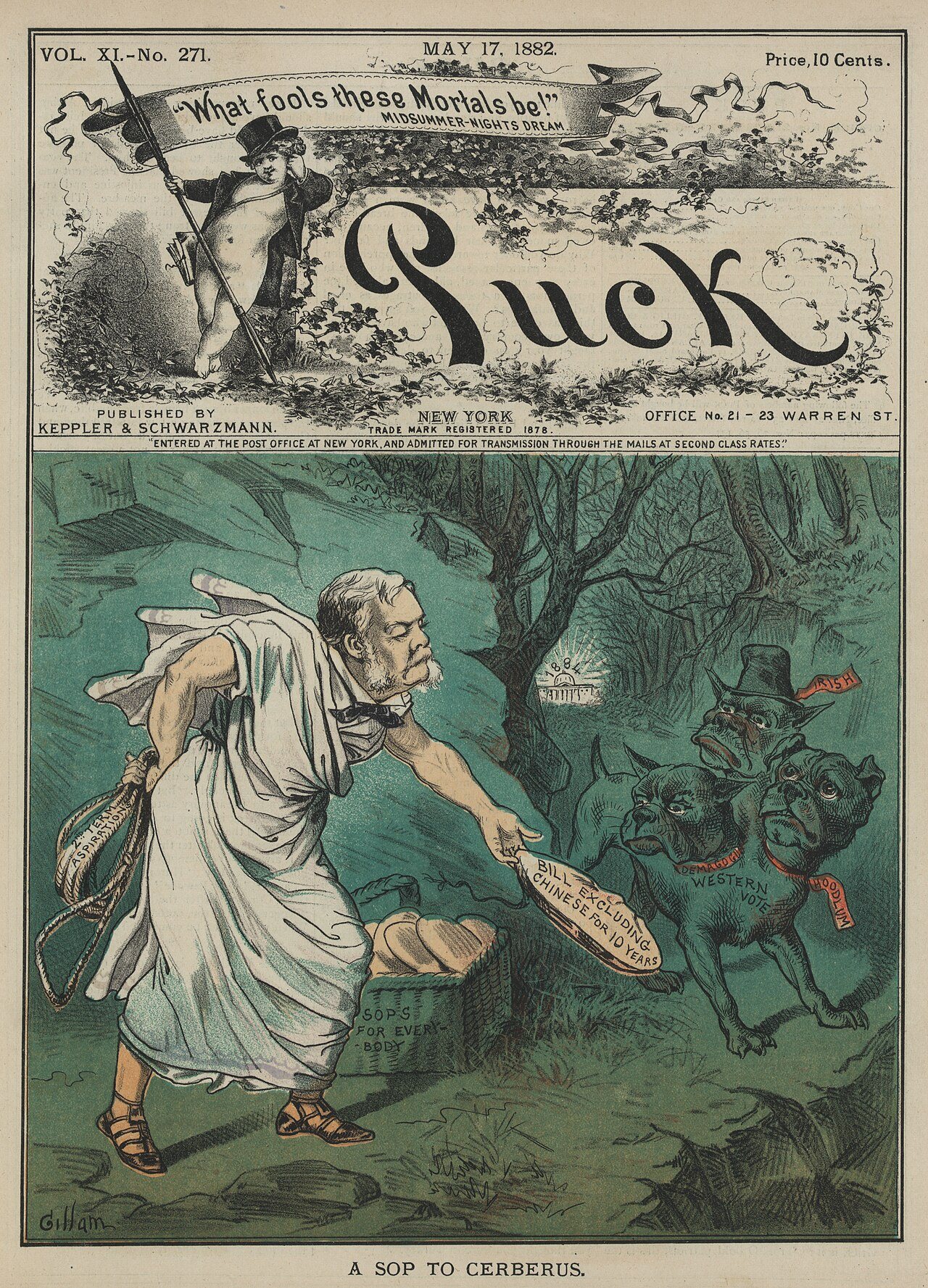
The pattern also runs the other way: the country has repeatedly built legal channels after decades of restriction. The 1952 immigration act ended outright Asian exclusion but kept the quotas, over President Truman’s veto. In the 1950s the government carried out mass removals of Mexican workers under a campaign it officially called Operation Wetback. In 1965 President Lyndon Johnson signed the Hart-Celler Act, abolishing the quota system he called “un-American in the highest sense.”
Conservatives have led on legalization as well as enforcement. President Ronald Reagan signed the Immigration Reform and Control Act in 1986, pairing employer sanctions with a legalization program he described as letting people “step into the sunlight.” In 2012 the Obama administration created the DACA program by executive action for people brought here as children; a court order has closed it to new applicants since 2021. In 2013 the Senate passed a comprehensive immigration bill 68 to 32. The House never took it up.
The Words: Illegal, Undocumented, Invasion
Each side has a vocabulary, and the words do work. Federal statutes speak of the “alien”, and restrictionists prefer “illegal alien” because it is the law’s own term and names the violation. Advocates prefer “undocumented,” which critics call a euphemism, since many such people have documents, just not valid ones. Pew Research Center uses “unauthorized,” which describes status without either charge.
The Associated Press stopped calling people “illegal”, keeping the word for actions, not persons. Republicans moved the other way, putting the word “invasion” into the 2024 Republican platform and then into official proclamations. That word has a long history, traced on the emilyadams.net page It Worked Last Time: Invasion, and in 2025 a federal judge ruled that its legal meaning requires an armed, organized force.
A precise vocabulary helps the argument. “Illegal” is accurate about an entry, which is a misdemeanor, and less accurate about a person, who may have overstayed a visa, have a pending asylum claim, or hold temporary protection. Saying which one is meant usually settles half the dispute.
The Stranger in Three Scriptures
Many Americans argue about immigration in religious terms, and both sides quote scripture. The Hebrew Bible repeatedly commands care for the stranger and grounds the command in memory: Israel had itself been a stranger in Egypt. The Gospel of Matthew makes welcoming the stranger one of the marks by which the nations are judged.
Christians who favor strict enforcement point to Romans 13, Paul’s instruction to submit to governing authorities, and to the state’s duty to keep order. The Quran asks believers to show kindness to the wayfarer and to grant protection even to an enemy who seeks it. None of these texts writes a visa policy. All three traditions treat how a society treats the outsider as a moral question, which is a separate matter from what the law requires. The emilyadams.net page on the Abrahamic faiths sets out the wider principles of all three.