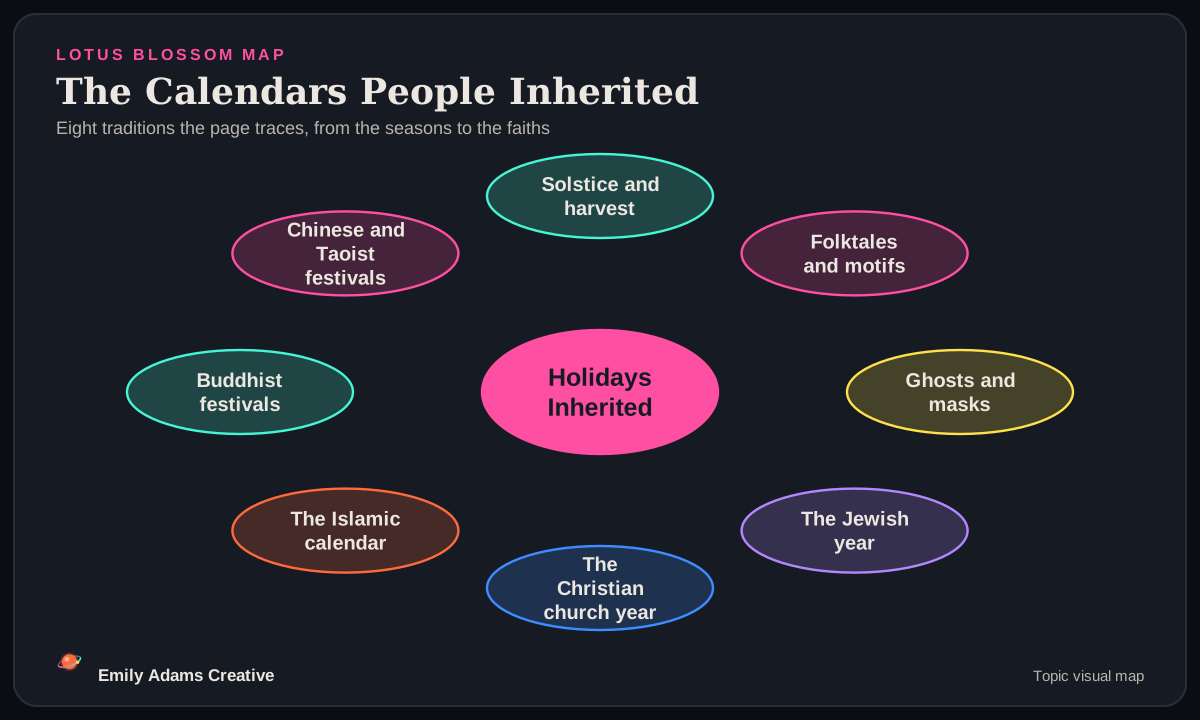
The Year Turns: Solstice, Harvest, and Sowing
Long before printed almanacs, people tracked the year by the sun. In Ireland, Newgrange was built so that the low winter sun shines through a roof box above the entrance and reaches the inner chamber at sunrise on the winter solstice, an alignment the National Museum of Ireland describes as recurring every year. In England, English Heritage notes that at Stonehenge the sun rises over the Heel Stone on the longest day of the year and sets over it on the shortest. Farming communities needed the same knowledge, because the right week for sowing and reaping shaped how a household ate through the year.
Harvest brought its own festivals. Hindu households keep Navaratri, the nine nights devoted to the Mother Goddess, and Diwali, the festival of lights tied to Lakshmi and to wealth and prosperity. Jewish tradition counts Shavuot among the harvest festivals, the Feast of Weeks, which also marks the giving of the Torah on Mount Sinai. Across these traditions the calendar began with the seasons and then gathered a religious story around each feast.
Midwinter Feasts and the Date of Christmas
The Romans held the Saturnalia in December, and the Encyclopaedia Romana calls it the most popular holiday of the Roman year. Slaves did not have to work, gambling was allowed in public, and gifts changed hands. The Norse marked the same dark season with Yule, when they lit bonfires, told stories, and drank sweet ale. Jewish households light the lamps of Hanukkah in the same weeks on the western calendar, eight nights that honor a victory of the Maccabees over the Syrian Greeks.
Christians fixed Christmas on 25 December, although the BBC notes that Orthodox Christians celebrate it on 7 January. A Roman calendar entry for the same day carries a note for the Unconquered Sun, and the Encyclopaedia Romana says the dedication of that entry is uncertain. The birth of Jesus was never the whole story of the feast, and midwinter custom had its own long history before the church gave it a name.
Spring: Renewal, Color, and a Disputed Goddess
UNESCO’s record for the multinational file on Nowruz describes it as a spring festival observed across Asia and the Middle East. The same season brings Holi, the festival in which people throw colored powder and water at one another. The BBC links Holi to Krishna and says it celebrates creation and renewal. Passover also belongs to spring: the BBC calls it the Festival of Spring, an agricultural feast that marked the start of the cycle of production and harvest, and it also tells the Exodus story.
Spring claims need checking. The goddess Eostre appears in a single passage by the English monk Bede, who names the month of April Eosturmonath. The Library of Congress folklife blog says Eostre is an early medieval English goddess not documented from pagan sources at all, and it treats the later hare and Ostara customs with the same caution. Much of the ancient spring folklore people repeat rests on a calendar of month names and on the stories told about them afterward.
The Folktale as a Living Form
Folklorists have built tools to follow stories across borders. The Harvard library’s folklore guide describes the Aarne-Thompson-Uther index of tale types, which sorts stories by plot, and it lists the Motif-Index of Folk Literature beside it, which catalogs the smaller elements inside those plots. Hans-Jörg Uther’s third revision of the tale-type index, issued in the Folklore Fellows series, carries the classification forward into the present.
The best-known fairy tale shows how a story moves. Charles Perrault’s version survives in English anthologies, such as the 1858 Four and Twenty Fairy Tales, which prints ‘Cinderella; or, the Little Glass Slipper’ among its stories. A Chinese cousin, Yeh-Shen, reached English readers through translations by Lin Yutang and Arthur Waley, and a 2023 article argues that the Chinese tale influenced the evolving image of Cinderella in the West. The folktale is a set of recognizable parts that finds a new body in each culture.
Ghosts, Masks, and Protective Customs
The dead were never far from the calendar. Samhain, the Gaelic festival at the end of October, marked the end of the harvest and what a University of Wisconsin-Milwaukee lecture calls a doorway into the new year. A BBC News report from the turn of the millennium described the Welsh New Year’s Eve custom of Mari Lwyd, a horse’s skull decorated and paraded through the streets. In Mexico, families build ofrendas on altars to draw the dead home for a visit, a festivity UNESCO inscribed on its list in 2008.
The church calendar absorbed some of this. All Saints and All Souls fall on 1 and 2 November, and Halloween sits on the evening before the first of them. Why do such rites persist? Anthropologists point to the surge of shared feeling in a gathering that Durkheim called collective effervescence, and psychologists have tested whether grief rituals help the bereaved. A 2024 study of a festival in Mikasa, Japan, examined a dance for the dead and found that belief in ancestors and active dancing were linked with social cohesion among 183 participants. A 2025 study of mourning among the Luhya people of Kenya reported that rituals helped people process grief, although it also found that some rituals were perceived negatively (mourning rituals in Kenya).
The Jewish Year: Dates That Move on the Western Calendar
The Jewish calendar fixes holidays by Hebrew date, so the western date moves from year to year. Rosh Hashanah is the Jewish New Year festival, falling on the first day of the seventh month, when the Torah calls for a sacred assembly and the sounding of trumpets. Yom Kippur, the Day of Atonement, is in the BBC’s words the most sacred and solemn day of the year.
The autumn cycle continues with Sukkot, which commemorates the years the Jews spent in the desert on their way to the Promised Land, and whose booths carry that memory into the present. Purim takes its name from the lots Haman cast to choose the date of the massacre in the Book of Esther. The BBC lists the main commandment as hearing the reading of the book, and the custom of sending gifts of money, food, and drink to others.
The Christian Church Year
The church year opens with Advent, which the Catholic Encyclopedia describes as the period that begins with the Sunday nearest the feast of St Andrew on 30 November and embraces four Sundays. Epiphany recalls the visit of the magi to the infant Jesus. Before Easter comes Lent, which the BBC describes as forty days traditionally given to fasting, and the Catholic Encyclopedia notes that the old English word for the season meant no more than spring.
The climax is Easter, which the BBC calls the most important Christian festival, commemorating the resurrection three days after the crucifixion, with Easter Sunday as the culmination of Holy Week. The calendar runs on to Pentecost, which the BBC describes as the festival that celebrates the gift of the Holy Spirit and is regarded as the birthday of the Christian church.
The Islamic Calendar: Moon, Fast, and Feast
The Islamic calendar is lunar. The Quran answers a question about the phases of the moon by calling them a means for people to determine time and to set the pilgrimage. The central observance is Ramadan, the month the Quran names as the time of its revelation, when believers fast, with the ill and the traveler excused and asked to make up the days later.
The month ends with Eid al-Fitr, which the BBC describes as the celebration of the end of fasting and a time of thanks. Eid ul Adha is the festival of sacrifice, and because it follows the lunar calendar its solar date shifts each year. Ashura falls on the tenth day of Muharram, a day of fasting that Shi’a Muslims especially mark with the commemoration of Hussein’s martyrdom in 680 CE. The birthday of the Prophet, Milad un Nabi, falls on 12 Rabi-ul-Awwal.
Buddhist Festivals: Full Moons and Monks
Buddhist observance keys to the moon. The BBC calls Wesak the most important Buddhist festival, held on the full moon of the lunar month of Vesakha, usually in May or early June, to mark the birth, enlightenment, and final passing into nirvana of the Buddha. Because the date follows the lunar month rather than the solar calendar, it moves from year to year against the western dates.
Monastic life has its own rhythm. Theravada Buddhism, whose name means the doctrine of the elders, is strongest in Sri Lanka, Cambodia, Thailand, Laos, and Burma, according to the BBC. Chinese Buddhist practice carried its own monastic festival, the Ullambana observance, which tells the story of a disciple who finds his mother among the hungry ghosts and makes offerings to the monastic community.
Chinese and Taoist Festivals: New Year, Boats, and Hungry Ghosts
China’s Spring Festival, the Lunar New Year, entered UNESCO’s Representative List of the Intangible Cultural Heritage of Humanity in December 2024. The Shanghai government calls it China’s biggest extravaganza and a day for family reunion, and it describes being with family at the turn of the year as a vital ritual. Like the Islamic and Buddhist holidays, the festival is set by a lunar calendar and moves against the solar year.
The Dragon Boat Festival has been on UNESCO’s list since 2009. On the 15th day of the seventh lunar month comes the Zhongyuan festival, also called the Hungry Ghost Festival. Sixth Tone describes a day when the gates of hell are thought to swing open, and it ties the Taoist observance to the officials who oversee heaven, earth, and water. The article also describes the Taoist and Buddhist observances as a seamless blend of influences.
Holidays Invented and Reinvented
Many modern holidays carry older names. Halloween in its present form is an evening of costumes and parties, and the BBC presents it as the product of a long history that runs back to the Celtic festival. The historian Nicholas Rogers titled his book on it Halloween: From Pagan Ritual to Party Night. Mothering Sunday is a second case: it falls on the fourth Sunday of Lent, and the British Library’s blog traces the medieval custom of a procession to one’s ‘mother church,’ usually the local cathedral.
The United States offers the clearest case. The First Thanksgiving is taught as a 1621 harvest feast, but the National Park Service opens its own account on 8 September 1565 with Pedro Menéndez de Avilés and 800 Spanish settlers, and National Geographic reported a thanksgiving held two years before the New England Pilgrims. The phrase invention of tradition comes from a Cambridge volume edited by Eric Hobsbawm and Terence Ranger, which argues that many customs presented as ancient were recent.
Folklore Used as a Weapon, and the Repair
Some folklore was turned into accusation. The blood libel claimed that Jews used the blood of Christian children for ritual purposes. In 1475 a two-year-old boy named Simon disappeared from Trent in Italy around Easter, and his father accused the local Jewish community. The United States Holocaust Memorial Museum says the charge figured prominently in the Kielce pogrom of July 1946, and the Nazi newspaper Der Stürmer made frequent use of ritual murder imagery in its propaganda.
Repair starts with naming the harm and recognizing the traditions that were pushed aside. The United Nations observes the International Day of the World’s Indigenous Peoples on 9 August. Listing customs as heritage is one modest form of recognition: UNESCO’s decision on Nowruz reports a positive effect on awareness among the States Parties, and in County Westmeath a Bealtaine fire was lit in May 2021 as a signal of unity and hope. Folklore does harm when it is told as fact about a people, and it renews a community when that community tells its own history with it.