Who Came, and How Many
England’s middle and southeast were shaped by arrivals, and the oldest argument about them is how many people actually came. When Roman rule ended in the early fifth century, language, burial customs, and farming patterns in eastern Britain changed within a few generations. For a long time historians split between a mass migration and a small elite that the locals copied.
Ancient DNA has largely settled the first round of that argument. A 2022 study led by Joscha Gretzinger and colleagues sequenced 460 medieval northwestern Europeans and found that people buried in eastern England in the early Middle Ages drew up to 76 percent of their ancestry from the continental North Sea zone, close to the people of present-day northern Germany and Denmark. An earlier study of living people, the People of the British Isles project, had put the Anglo-Saxon contribution to the modern southeast at under half. Both can be true: a large migration, followed by centuries more of mixing.
Mercia, the Kingdom of the Border
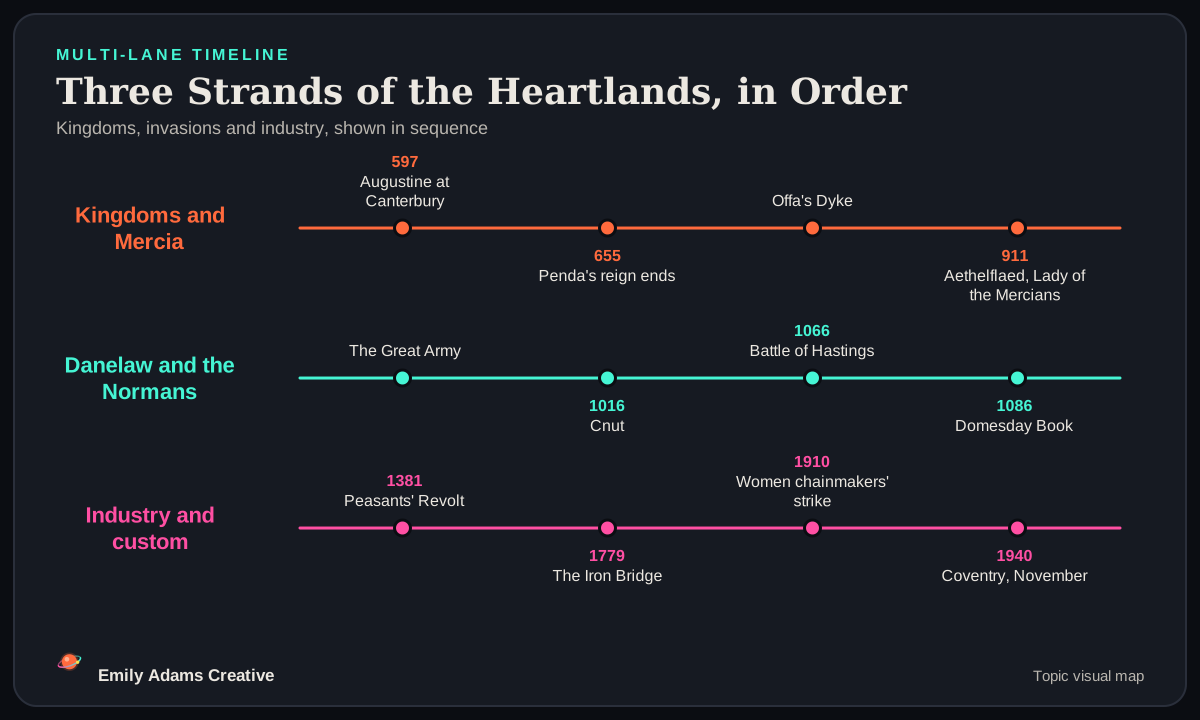
The West Midlands began as Mercia, whose name means the people of the border. From the mid-seventh century to the early ninth it was often the strongest kingdom in England. Penda, a pagan king who died in battle in 655, built its power by war. Offa, who ruled from 757 to 796, made it something close to a state from the Humber to the Channel, minted a new coinage, traded with Charlemagne, and left a great earthwork along the Welsh border, Offa’s Dyke.

After Offa, Mercia faded before Wessex and was split by the Danes in 877. Its last great ruler was a woman. Aethelflaed, the Lady of the Mercians, daughter of Alfred the Great, built a ring of fortified towns, took Derby in 917 and Leicester in 918, and died at Tamworth in June 918 with the reconquest nearly done.
Canterbury, the Great Army, and the Danelaw
The Southeast had its own settlers and its own turning point. Bede wrote that the Jutes settled Kent, the Isle of Wight, and parts of Hampshire. In the spring of 597 a mission of about 40 monks sent by Pope Gregory the Great landed on Thanet, and Augustine became the first archbishop of Canterbury. Canterbury has been the seat of England’s senior archbishop ever since.
Two and a half centuries later the threat came from the north. Danish armies overran much of eastern and northern England in the late ninth century, and the region they held became the Danelaw, named for the Old English Dena lagu, the law of the Danes. In the East Midlands their power rested on fortified towns later called the Five Boroughs: Derby, Leicester, Lincoln, Nottingham, and Stamford. The settlers left their mark in place names ending in -by and -thorpe, in words, and in a local legal culture that lawyers still recognized in the twelfth century.
How many Danes actually settled is a live question. The genetics are not yet in agreement, and the place names may record new landlords as much as new populations. What is certain is that England was briefly ruled from Scandinavia: Cnut, son of the Danish king Sweyn Forkbeard, became king of England in 1016 and later of Denmark and Norway.
1066 and the Paper Trail
The Southeast is where England was conquered, and where the conquest was written down. On October 14, 1066, William of Normandy defeated Harold Godwinson near Hastings. The Normans built castles on the coast and in the towns; at Dover, Henry II later raised the great fortress that still guards the shortest crossing to France. The Cinque Ports of Kent and Sussex supplied the king’s ships in return for privileges.

Twenty years after Hastings, William’s commissioners surveyed nearly every estate in the kingdom. The result, Domesday Book, recorded who held each manor in 1066 and who held it in 1086, how much land, how many people, mills, and animals. It is the starting point for the history of almost every village in the Midlands and the Southeast.
In June 1215, at Runnymede on the Thames, King John granted Magna Carta under threat of civil war. It was annulled within months and reissued in 1216, 1217, and 1225. One of the four surviving 1215 copies belongs to Lincoln Cathedral and is kept in Lincoln Castle, in the old heart of the Danelaw.
The West Midlands: Gold, Iron, and Workshops
Mercia’s wealth came out of the ground in 2009. A metal detectorist working a field near Lichfield found the Staffordshire Hoard, some 3,500 pieces of gold, silver, and garnet war gear from the seventh century, the largest Anglo-Saxon gold find ever made. It now belongs jointly to Birmingham and Stoke-on-Trent, and part of it is shown at Tamworth, the old royal center of Mercia.
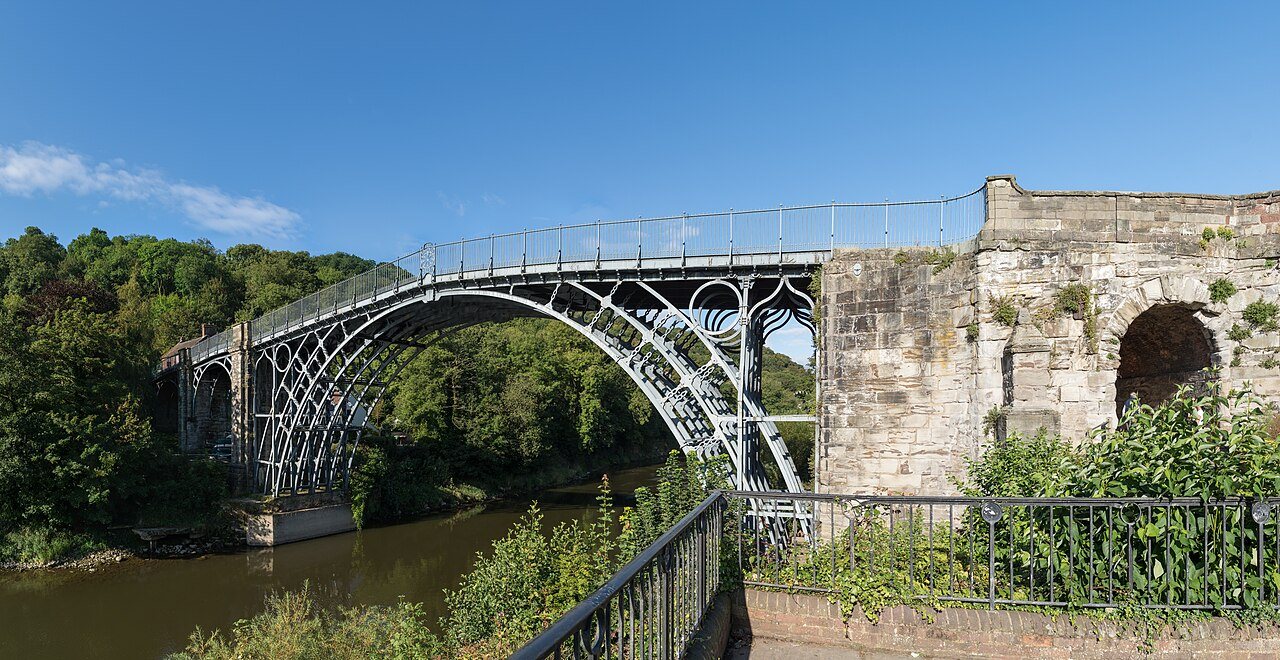
A thousand years later the same country became the workshop of the Industrial Revolution. In 1709 at Coalbrookdale in Shropshire, Abraham Darby smelted iron with coke, and in 1779 his grandson’s works raised the Iron Bridge over the Severn. In Birmingham, Matthew Boulton and James Watt built the steam-engine business, and Boulton’s house became the meeting place of the Lunar Society. West of the city, coal and iron turned the south Staffordshire coalfield into the Black Country, a landscape of small forges where, in 1910, the women chainmakers of Cradley Heath struck and won a minimum wage.
The region’s culture runs alongside the furnaces. William Shakespeare was born in Stratford-upon-Avon in Warwickshire in 1564. Coventry kept the legend of Lady Godiva, wife of an earl of Mercia, and in November 1940 lost its medieval cathedral to the Luftwaffe; its response, a ruin kept open and the words Father Forgive, made it a world center of reconciliation. And J.R.R. Tolkien, who grew up between rural Sarehole and industrial Birmingham and later taught Old English at Oxford, built Middle-earth partly out of the Mercian countryside and language he loved.
The East Midlands: Outlaws, Kings, and Separatists
The East Midlands is Danelaw country, and its best-known story is about defying the law. The ballads of Robin Hood go back at least to the fourteenth century and pit him against the Sheriff of Nottingham, though the earliest of them place most of the action in South Yorkshire rather than Sherwood.
The region also holds the end of a dynasty. Richard III, killed at Bosworth in Leicestershire in 1485, was buried in Leicester’s Grey Friars church, which vanished after the Reformation. In 2012 archaeologists found a skeleton under a city car park, and a DNA study published in 2014 matched it through the female line to living relatives of the king. The same study found that the male-line DNA did not match, a reminder that family trees and genomes can tell different stories.
Religious dissent left the deepest mark abroad. In the villages where Nottinghamshire, Lincolnshire, and Yorkshire meet, a Separatist congregation gathered at the manor house in Scrooby, where William Brewster was postmaster, and found shelter with sympathetic gentry such as the Hickmans of Gainsborough Old Hall. Persecuted, they left for the Netherlands in 1608 and, in 1620, for Plymouth on the Mayflower as the Pilgrims.
Frames, Lace, and the Midland Customs
From the seventeenth century the East Midlands clothed Europe’s legs. Framework knitters worked stocking frames in their cottages around Nottingham, Leicester, and Derby, and the lace machine grew out of the same frame. When wages collapsed in the Napoleonic Wars, the knitters of Nottinghamshire began smashing frames in 1811 under the name of a probably mythical Ned Ludd, and the Luddites gave the language a word for anyone who resists technology, though their quarrel was about pay and cheap goods, not machines as such. Up the Derwent, Richard Arkwright’s mills at Cromford had already invented the modern factory.
The region’s customs are as stubborn as its politics. On January 6 each year the village of Haxey, on the Lincolnshire edge of the old Danelaw, plays the Haxey Hood, a mass push of a leather tube toward one of four pubs. In the Peak District villages of Derbyshire, well dressing covers wells and springs with pictures pressed in flower petals on clay boards each spring and summer.
The Southeast: Pilgrims, Rebels, and Bonfires
Canterbury made the Southeast a destination. After Archbishop Thomas Becket was murdered in his cathedral in December 1170, his shrine drew pilgrims from across Europe, and two centuries later Geoffrey Chaucer framed The Canterbury Tales as a storytelling contest among pilgrims on the road there.

Kent and Essex also produced England’s first great popular rising. In 1381 a poll tax, on top of decades of wage controls after the Black Death, set off the Peasants’ Revolt. Rebels from Essex and Kent, led by Wat Tyler and inspired by the radical priest John Ball, marched on London and took the government of the 14-year-old Richard II by surprise.
The Southeast’s best-known modern custom is a loud one. In Lewes, the county town of East Sussex, seven bonfire societies parade through the streets every November 5 with burning crosses and blazing tar barrels, commemorating both the foiling of the Gunpowder Plot and seventeen Protestants burned in the town under Mary I. Across the region, morris sides still dance at May Day and summer fairs.
Bonfires, Crackers, and Invented Traditions
“Our traditions go back a thousand years, unchanged.”
Many English customs are younger than they look. The Christmas cracker was patented in 1847, the Lewes bonfire societies date from 1853, and much of today’s morris dancing was revived by Cecil Sharp after 1905. Historians call this the invention of tradition. The customs are still worth keeping; they just are not proof of an unbroken past.
Some customs from these regions became national. Bonfire Night marks the failure of the Gunpowder Plot of 1605; Parliament made November 5 a day of thanksgiving, and the first celebration was held in 1606. The common law and the jury, both grown in the king’s courts of medieval England, became the legal habits of the whole English-speaking world.
Many customs that feel ancient are younger than they look. The historian Eric Hobsbawm and his colleagues called this the invention of tradition: practices that claim continuity with an immemorial past but were in fact assembled within a short, datable period. A London confectioner patented the Christmas cracker in 1847. Pantomime took its familiar shape, with dames and Boxing Day openings, under the Victorians. The Lewes bonfire societies date from 1853, Derbyshire villages revived well dressing in the twentieth century, and much of today’s morris dancing was rescued and standardized by the collector Cecil Sharp after 1905.
None of that makes the customs fake. A tradition is something a community chooses to keep doing, and the Haxey Hood or a Peak District well dressing is real precisely because people turn out every year. The point is narrower: when someone claims a custom proves an unbroken ancient identity, the dates usually say otherwise.
Radical England
The picture of the English heartland as gentle and deferential leaves out how often its people rose. The Peasants’ Revolt of 1381 came out of Essex and Kent. During the Civil Wars of the 1640s the Levellers demanded manhood suffrage, equality before the law, and the reopening of enclosed land. The Luddites of 1811 were Nottinghamshire knitters fighting wage cuts.
In 1819, cavalry charged a peaceful crowd of about 60,000 at St. Peter’s Fields in Manchester, the Peterloo Massacre, and the reform movement it fed grew into Chartism, the first national working-class movement in Britain, with six demands that read today like a description of ordinary democracy. The Cradley Heath chainmakers of 1910 belong to the same line. The gentle heartland is also a country of petitions, strikes, and crowds.
Across the Atlantic
The emigrants from these regions carried their habits with them. The Pilgrims came out of the Trent valley; the much larger Puritan migration of the 1630s came mainly from the east of England. Magna Carta’s language passed into colonial charters and state constitutions, and American courts still run on the common law and the jury.
How much regional English culture shaped America is argued in a single famous book. In Albion’s Seed (1989), David Hackett Fischer traced four migrations from four British regions and argued that each planted a lasting American culture. Critics have answered that his regions are drawn too neatly and his transplanted cultures too fixed, and reviewers set the book beside newer work stressing that British America was multicultural from the start.
What a DNA Ethnicity Estimate Can and Cannot Say
“My DNA test says I’m 40 percent West Midlands, so that’s where my family is from.”
An ethnicity estimate compares your DNA with reference groups of living people, not with your family tree. AncestryDNA’s own 2025 white paper reports that when its model assigns the West Midlands region, the assignment is correct about two times in three. The percentage is a resemblance score with a range, and it changes when the reference panel does.
Consumer DNA tests now name regions as specific as the West Midlands or the East Midlands. That precision rests on a reference panel: a set of living customers whose families have deep roots in one place, chosen because they share long stretches of DNA with one another. A customer’s DNA is compared with the panels, segment by segment, and each segment is assigned to the closest match. The result says which present-day reference groups your DNA most resembles. It does not read a passport, a surname, or a family tree.
Several consequences follow. Neighboring regions overlap, so the company’s own accuracy tests show some English regions are assigned far more reliably than others. The estimates change when the panels change. And because each child inherits a random half of each parent’s DNA, siblings get different results even though they share the same ancestors. Splitting results by parent depends on phasing, an algorithm that guesses which stretches of DNA came from which parent.
Population genetics adds a deeper caution. Britain’s people were remade more than once: around 2500 BC the Beaker migration replaced roughly 90 percent of the island’s gene pool, and the early medieval migration and the Danish settlement came on top of that. The labels on a results page are slices of a continuous, long-mixed population. That is also why claims of Viking DNA say more about marketing than about ancestry.
The other half of the story is what happens to the data. In 2023 a hacker used reused passwords to break into about 14,000 23andMe accounts and, through the DNA Relatives feature, reach information on far more customers. The company went bankrupt in 2025 and its database was sold to a nonprofit led by its co-founder over the objections of several states. Police can also use genealogy databases through forensic genetic genealogy, and a 2018 study projected that about 60 percent of searches for Americans of European descent would turn up a third cousin or closer. Steps for locking down accounts like these are covered on the site’s security checklist.