What Liberalism Is
“Liberal means left-wing.”
In American usage it often does: Gallup found 59 percent of Democrats and 2 percent of Republicans call themselves liberal. But the Stanford Encyclopedia describes classical liberals, who tie liberty to private property, and new liberals, who accept a welfare state, as two long-running camps within liberalism. The meaning depends on the country and the century.
A political tradition that puts individual rights, consent of the governed and limited government first, and holds that political authority must be justified. The Stanford Encyclopedia of Philosophy quotes Maurice Cranston: “By definition, a liberal is a man who believes in liberty.” It adds that liberalism starts from the premise that political authority must be justified, so legal constraints need a reason. Liberty is the first value, and liberals argue about its meaning.
The word means different things in different places and eras. For classical liberals, liberty and private property are tied together. For the “new” liberals of the early 20th century, a welfare state completes liberty. In the United States, “liberal” now mostly names the political left: Gallup found 28 percent of Americans call themselves liberal, 35 percent conservative and 33 percent moderate, and the American usage drifts further from the older meaning.
The Stanford Encyclopedia organizes the tradition around four debates: the meaning of liberty; the old against the new liberalism; whether liberalism is a comprehensive view of life or only a political arrangement; and how far its reach extends. A reader who knows those four arguments can place most liberal writers.
Who Owns It: Private Property, Argued Two Ways
Liberalism has no single answer. For classical liberals, per the Stanford Encyclopedia, an economic system based on private property is uniquely consistent with individual liberty, and a free market protects liberty by dispersing power. Friedrich Hayek put it: “There can be no freedom of press if the instruments of printing are under government control.”
New liberals disagree on the economics, not the goal. By the early 20th century they doubted a market could sustain a “prosperous equilibrium,” in Beveridge’s phrase, and Keynes argued an economy could get stuck with high unemployment. They accepted a larger role for government (new liberalism). The two camps are the long-running property debate inside the tradition.
Who Rules: The Governed, Through Consent and Constitutions
The rule is consent. The Declaration of Independence (1776) says governments derive “their just powers from the consent of the governed” and that when a government becomes destructive of rights, “it is the Right of the People to alter or to abolish it.” The French Declaration of 1789 places sovereignty in the nation: “No body nor individual may exercise any authority which does not proceed directly from the nation.”
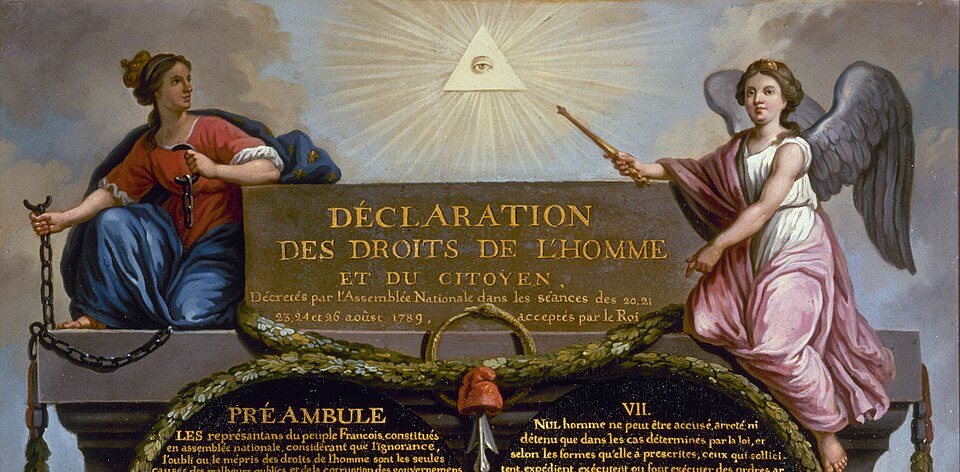
Power is limited by rights, courts and elections. Mill wrote that no society in which the basic liberties are not respected is free, “whatever may be its form of government.” The sentence makes the liberties, not the form of government, the test of a free society.
What Liberals Believe
The diagnosis is that power is dangerous and must justify itself. John Locke argued in 1689 that people are naturally in “a State of perfect Freedom,” and that being “all equal and independent, no one ought to harm another in his life, health, liberty, or possessions.” Mill argued the burden of proof rests on those who would restrict liberty.
The remedy is a limit on coercion. Mill’s harm principle (1859) says the only purpose for which power may be exercised over a member of a civilized community, against his will, is to prevent harm to others. His own good, physical or moral, “is not a sufficient warrant.” He added that a person “cannot rightfully be compelled to do or forbear because it will be better for him to do so.”
What Liberals Value
In rank order: liberty; equality before the law and in rights (“Men are born and remain free and equal in rights,” says Article 1 of the 1789 Declaration); consent; and freedom to think and live differently, in Mill’s terms. The Stanford Encyclopedia notes that contemporary liberals, from Joel Feinberg to John Rawls, agree on the presumption in favor of liberty.
What liberalism will trade away is the power of majorities and authorities to impose their ideas of the good life. It disagrees internally on how far to trade economic security for liberty: that is the dividing line between the classical and new camps. Rawls’s later work, political liberalism, asks how people with different beliefs can agree on public rules.
A Short History of Liberalism
Britannica says that after the French Revolution and the Napoleonic Wars, the policies of 19th-century political liberalism were increasingly put into practice. They included free trade, sound money on the gold standard, balanced budgets and minimum levels of poor relief (the classical program). Locke wrote in 1689, the American colonies declared independence in 1776, and the French assembly proclaimed the rights of man in 1789. Mill published On Liberty in 1859. Adam Smith’s Wealth of Nations (1776), with its passage on the invisible hand, supplied the economic half: Britannica says it recommended leaving economic decisions to the free play of self-regulating market forces.
By the early 20th century a “new liberalism” had formed, and the Great Depression ended laissez-faire in most countries, Britannica says. William Beveridge’s 1942 report and Franklin Roosevelt’s 1944 Second Bill of Rights carried the new liberalism into policy, and the report set the welfare state’s blueprint. After 1945 liberal democracies paired markets with welfare programs, and Rawls’s later work asked how citizens who disagree could share public rules.
The Branches of Liberalism
The Stanford Encyclopedia sorts liberalism by debates. Classical liberalism ties liberty to private property, and its spectrum runs from near-anarchist views to those that give the state a significant economic role. New or social-justice liberalism challenges that tie. Political liberalism, associated with Rawls, asks what public reasons can be shared.
Other lines include republican liberty, liberal ethics and liberal theories of value. At the libertarian end of the classical spectrum, the entry notes, a state is a legitimate monopoly that may charge for rights-protection services. The entry adds that classical liberals and libertarians have often asserted that property is in some way a prerequisite of liberty, and that some hold rights themselves to be forms of property. Libertarianism has its own page, and the argument over liberalism’s reach continues.
Where It Has Been Tried
The United States and France were founded on declarations of liberal principles. In Britannica’s account, the 19th-century liberal program was put into practice after the Napoleonic Wars. After 1945, the liberal democracies of Western Europe and North America combined markets with welfare programs, and Britannica says the economies of these countries performed well in the decades afterward (the postwar order).
Freedom House’s 2026 report rates 88 countries Free. Only about 21 percent of the world’s people live in them, down from 46 percent twenty years ago, and the report says 54 countries declined in 2025 while 35 improved. The United States fell 3 points to 81, the sharpest drop among Free countries.
The Case for It and the Case Against It
Defenders say liberalism protects dissent, minorities and the person from the majority and the state, and that its rights let people with different beliefs live together. Mill argued that a society is free only if its liberties are respected “whatever may be its form of government.” Freedom House says military coups and violence against peaceful protesters, among other causes, drove the recent decline in freedom.
Critics from the left say liberal freedom favors owners: Marx wrote the bourgeoisie left “no other nexus” than “naked self-interest,” and Lenin called bourgeois democracy “a paradise for the rich” (the left’s critique). Anarchists question consent itself: Lysander Spooner argued the Constitution is “unfit to exist” (the anarchist critique). Conservative critics are covered on the conservatism page.
Liberals answer that the tradition has changed when it was challenged. By the Stanford Encyclopedia’s account, new liberals came to doubt classical liberalism’s adequacy “initially on empirical grounds,” because markets proved unstable, and they revised the theory rather than abandoning liberty as its aim.
What Liberalism Is Not
It is not the same as the American left, though the American label has moved that way. It is not simply libertarianism: libertarians sit at one end of the classical liberal spectrum. And it is not the same as democracy, as Mill’s “form of government” line shows. Liberal democracy joins the two.
It is also not one economic system. Classical liberals defend the market, and new liberals defend the welfare state. Beveridge, a new liberal, warned that the state “should not stifle incentive, opportunity, responsibility.” The common thread is a presumption in favor of liberty, not a particular budget.
Liberalism Today
Gallup’s 2025 survey found 35 percent of Americans conservative, 33 percent moderate and 28 percent liberal, the smallest conservative lead since 1992, and a record 45 percent political independents (the trend). Liberal identification has risen from 17 percent in 1992, while the share calling themselves moderate has fallen from 43 percent. The previous high for independents was 43 percent, reached in 2014, 2023 and 2024.
The larger question is the system. Freedom House says global freedom declined for the 20th consecutive year, and only 21 percent of people live in Free countries.